
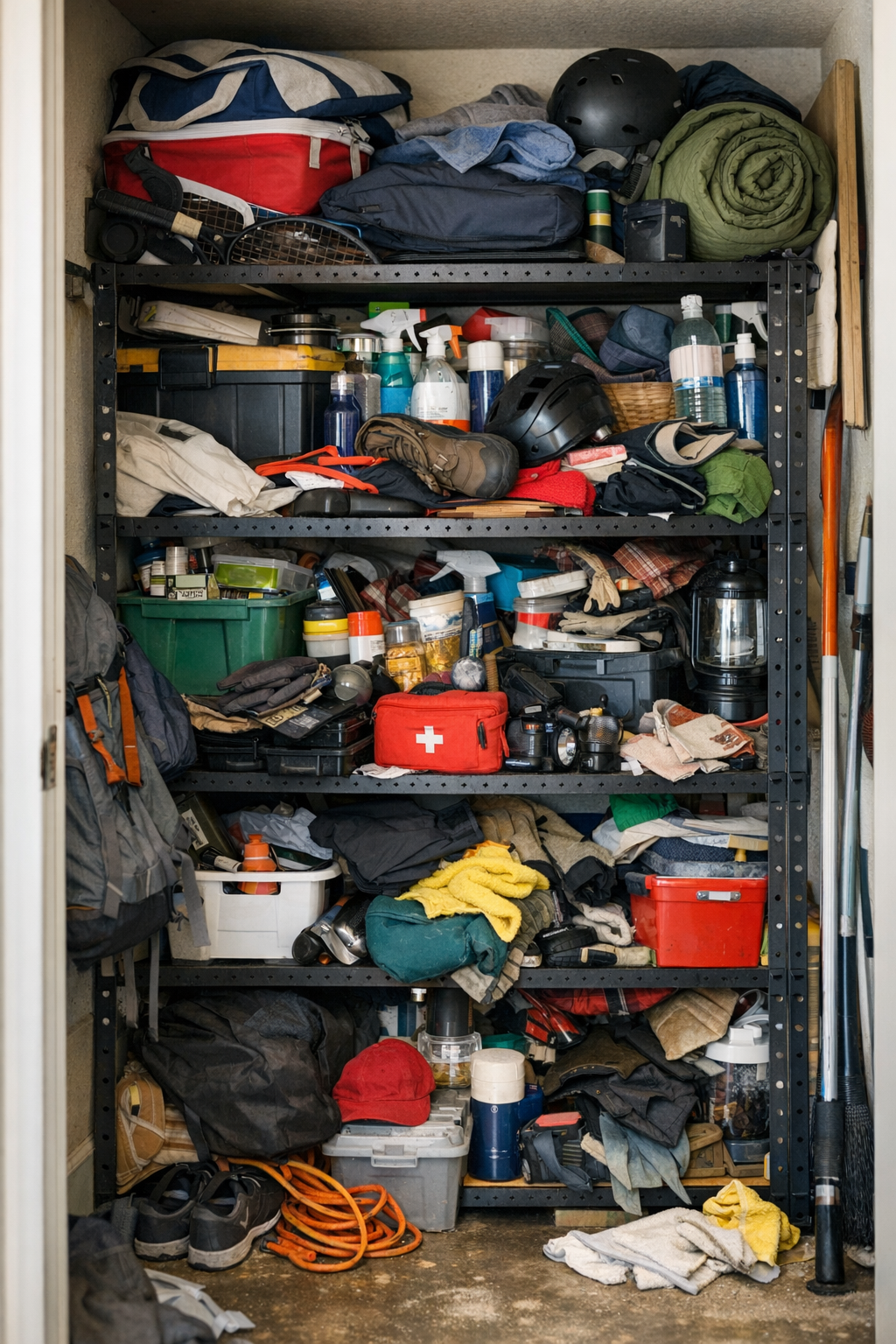
You open a closet to grab a jacket. One sleeve is caught on a bag handle. Gloves you stashed up front have slid behind laundry detergent. A shelf that looked organized on Sunday now seems booby-trapped by midweek. This is the invisible grind of everyday storage: the rows and piles that promise order, but slowly unravel with every reach, grab, or rushed return. That surface-level neatness rarely survives real-life routines—and by Thursday, the promise of ‘organized’ often collapses into a mess of categories lost, stacks slipped, and time wasted.
When “Everything Fits” Isn’t the Victory You Think
Your drawer closes. Every shelf looks tidy after a Saturday reset. For a moment, the system seems perfect—every item has a slot, nothing’s out of place. But come Wednesday morning, that rulebook is out the window. Jackets slide down underneath backpacks, folded shirts grow unstable and teeter, and shoes who once enjoyed their own cubby now pile heel-to-toe in a slow, silent landslide. You needed to grab one thing in 10 seconds; instead, you’re shifting two piles just to free it.
The frustration isn’t from bad intentions, but from overload. When shelves and bins are filled to the edge, there’s simply no slack in the system. ‘Grab-and-go’ turns into ‘shuffle, nudge, and hope the tower doesn’t fall’—and every small inconvenience multiplies over time, tangling categories and turning resets into a recurring chore.
The Quiet Creep of Hidden Chaos
At first, the chaos is invisible—a basket looks fine, but you notice yourself reaching awkwardly for mittens underneath hats, or searching behind bottles for the right spray. The space doesn’t explode overnight. Instead, each normal use leaves small signs: you return an item but have to wedge it into place because everything is jammed. Next time, it’s easier to just toss it on top. The spiral begins.
These subtle failures pop up everywhere:
- Utility closets where rags and extension cords slowly mix with screwdrivers and tape, until finding anything is a hidden-object game.
- Hallway shelves where “just for scarves” morphs into a jumble with wallets, mail, and whatever needs to be out of sight fast.
- Laundry rooms where folded towels are knocked flat by a bottle of stain remover perched too close to the edge, or lost completely behind a stack of empty hangers.
Early Red Flags: Spotting the Moment Organization Slips
You don’t need to wait for total chaos to see trouble. A few subtle cues tell you when your storage is fighting against you instead of working for you:
- You can’t grab one thing without disturbing something else. If picking out a pair of gloves triggers a cascade of shifting bottles, the shelf is overbooked.
- “Zones” get blurred. When bins meant for belts now house tangled socks too, or shelves meant for “sports gear” absorb art supplies, clear categories have dissolved.
- You double-check constantly. If every retrieval starts with a scan to see what’s shifted or what’s hidden, order is slipping—and so is your time.
Picture that utility shelf after a dozen rushed mornings: the box of lightbulbs you placed up front is now wedged between cords, and getting it out knocks over three things. You promise yourself a reset, but there’s never time. Every use makes the system a little less functional—and a little more tiresome to face.
Why “Filling It Up” Always Backfires
It’s tempting to squeeze in one more bag on a closet rail or squeeze another box onto a shelf—after all, “maximizing space” sounds like a win. But in practice, the tighter you pack it, the more every action becomes a hassle. Categories mix, access slows to a crawl, and returns become an exercise in patience. Soon, you’re storing stress alongside the stuff.
Real usable space isn’t just about physical volume; it’s about flow. Shelves with clear space between items invite quick, one-step use: grab, return, done. You see what you need in a sweep. Resetting is a matter of returning one thing to its home, not reshuffling an entire lineup.
The Practical Test: Remove a Third, Gain a Week of Order
Want to see how much your storage is working against you? Remove just one third of what’s packed onto a shelf or into a bin—then live with that setup for a week:
- The shelf feels easier on the eyes and hands—gaps appear, and you can retrieve what you want with zero drama.
- Everyday items don’t have to share, so nothing gets shoved into the wrong spot.
- Your quick tidies actually hold; one motion returns an item neatly, instead of layering or cramming.
This change isn’t about perfection or minimalism. It’s about building a system that doesn’t collapse as soon as routines get hectic or more than one person starts using the space.
Bins and Baskets: The Double-Edged Tools
Bins and baskets help divide categories and contain clutter—up to a point. But stuff them too full, and you’re trapped. One entryway basket meant for hats quietly becomes a burial ground for everything in your pocket by Friday. Mixing categories in desperation means next time, you’ll be sifting through a tangle hoping to find that one glove. And every time you dig, you scramble the rest.
Tip: Give your most-used items prime real estate: a portion of open shelf where they land and leave in a single move. Reserve bins for truly related items (not just “everything small”), and leave them roomy—half-full bins don’t just look calmer, they work faster and stay organized through the week.
Everyday Wins: Recognizing When Storage Is Actually Working
The best storage systems reveal themselves quietly when used—not after a reset, but while you’re living through back-to-back mornings and busy weeks. You’ll notice:
- The entry shelf never becomes a second junk drawer; keys and sunglasses stay in line.
- Shoes remain in a row you can actually see—stacking and hunting are gone.
- Folding and putting away laundry doesn’t mean leaning piles exploding onto the floor.
- You grab what you need in one move, and every category is still encounterable at a glance, without digging.
When your spaces support your routines—they never ask you to reshuffle or hunt, even during the busiest days—you stop dreading resets and actually trust your own system. That’s the difference between an organized home and one that’s just temporarily tidy. It’s not about display; it’s about surviving daily life, every week, with less frustration and more ease.
Find practical closet and utility storage that works for real daily routines at ClosetWorks.