
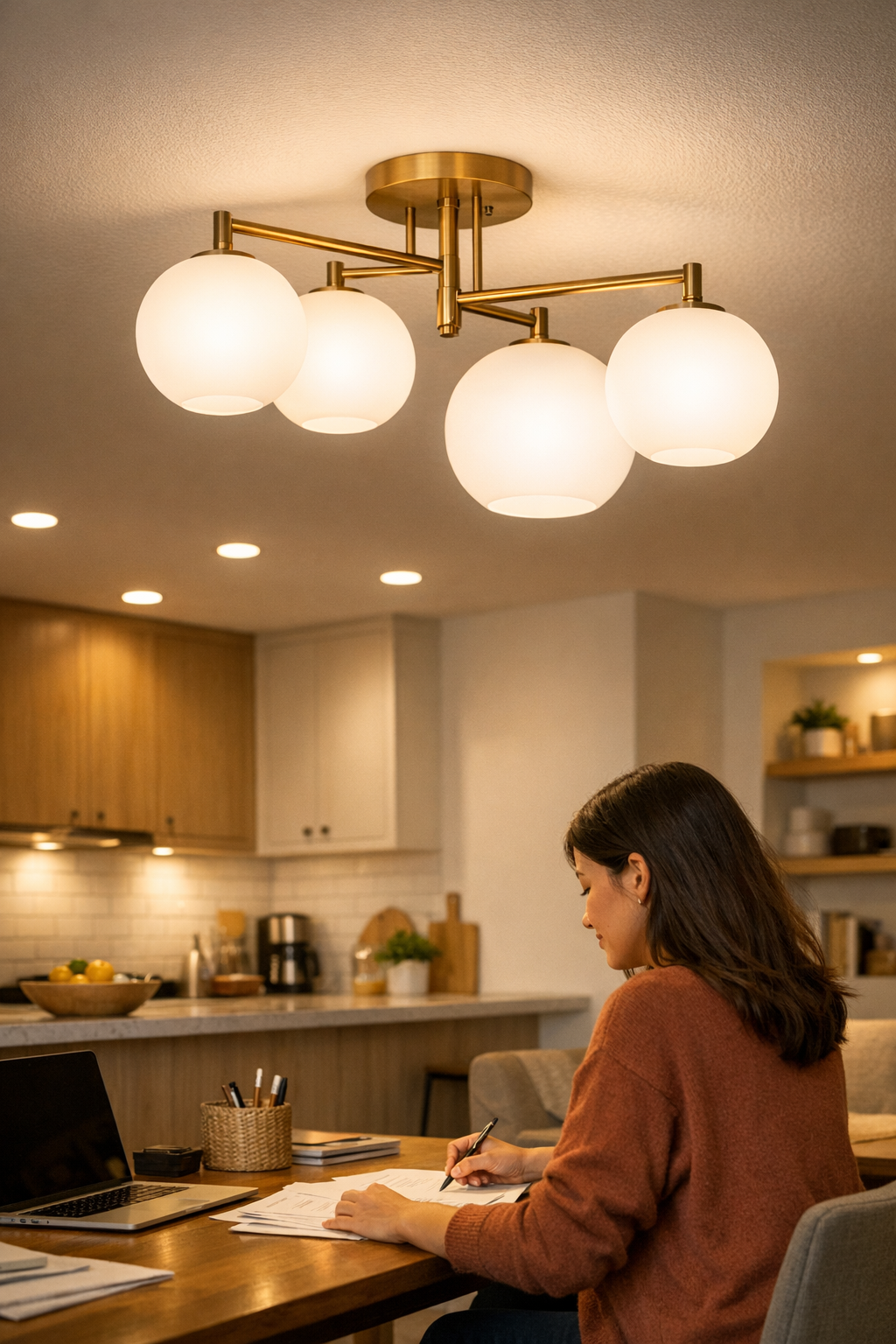
You see it fast: the awkward gray strip at your desk edge, the dimmed chair nobody stays in, or the ceiling fixture that looks right but leaves you dragging a lamp to the same tired spot night after night. Ceiling lighting that looks finished often creates a daily drag—glare where you work, tired eyes by afternoon, a surface that looks resolved but leaves half its space barely usable. What controls that discomfort often isn’t the power of the light, but the way the bracket, cable, or support routes light and shadow into your routines. How it’s mounted, where wires run, and which surfaces get hit first quietly decide whether your room feels easy to move through or stuck in a cycle of makeshift fixes.
Why “Looks Finished” Still Feels Wrong: The Confused Comfort of Clean Ceiling Light
A flush-mount panel with cables hidden and lines clean promises a resolved look at installation. But watch what happens after a week: you bounce from working at your desk, to answering messages from a corner, to a quick meal under the main fixture. Light falls just short along one bench, or you end up avoiding a part of the table because dusk turns it murky. Each time you switch spots, the “finished” setup stops feeling finished—surface light runs out at the edge, so you reach for a portable lamp or nudge a chair into a better patch, repeating the same shuffle every evening.
The core issue rarely lies in the bulb’s output—it’s about how the support hardware shapes the spread and placement. Poor bracket positioning shifts the whole beam off-center or leaves cables as a constant visual interruption. A fixture can say “minimal,” but if it creates practical dead zones, the daily setup quickly turns into a lineup of temporary workarounds.
When Routine Makes the Real Weakness Clear
The flaws don’t show up on a product sheet—they show up the third time you dodge monitor glare, or shuffle a pile to the only well-lit end of the desk. Kitchen prep repeats the same pattern: the overhead fixture says “bright,” but shadow lands right across the cutting board. Swapping bulbs or moving desk accessories works for a day, then the shadows, squinting, or cable mess reappear. A clean ceiling look solves the visible wiring but leaves your main surface just as split and reluctant in real use.
Isolated Trouble Spots: Reading Corners and Edges That Disappear
Edges call out the limits fast. That reading chair sparkles at 8 a.m., but slips into shadow after sunset because the ceiling mount throws all its reach toward the room center. A long workbench glows at one end and fades at the other—prompting an endless rotation of desk lights or a subtle reshuffling of how you use the space. You start to avoid certain tasks or shift awkwardly to follow a patchy beam, giving up on the spots that never quite feel lit or comfortable.
Supporting Light Where It’s Needed—Not Just Where It Looks Good
Function starts when brackets, arms, and cable paths are positioned for real usage—not just interior appearance. The most effective light comes from support hardware chosen for task spread, with mounting points that align the beam with your routines: brackets spaced to reach the room’s edge, cables brought across to meet the corner where you actually read or prep, not simply where construction left space. Sometimes a cable run that’s partly exposed, or an articulated arm that shifts, delivers reliable surface light where no flush-mount ever could.
“Better” often means visible support, not perfection at a glance. An arm out from the wall, a guided cable route across the ceiling—these can press the beam’s reach to both sides of a table or workstation. The point isn’t visual minimalism; it’s a room where every desk edge and seat stays fully useful, without a daily routine of repositioning, re-aiming, or apologizing for dim patches and glare points.
Real World Example: An Adjustment That Changed the Routine
Take a desk that doubled as a reading nook and workspace. The central ceiling fixture kept one side dim enough that a clip-on lamp became a crutch—moved back and forth depending on task or time of day. A small extension arm, anchored to a solid ceiling joist and paired with a clean cable path, let the main light finally cover both desk ends. Suddenly, every surface became easy to use, papers could be spread edge to edge, and the annoying lamp found permanent retirement. The visible support arm isn’t the highlight of the room—but the daily relief from glare and forgotten corners is something you stop noticing only because the setup just works, every time.
Visible Impact: Where Supports and Cables Outperform Appearance Alone
Setting up lighting support for true use can mean living with exposed hardware or planned cable paths. Yet, the results are real: no more plugging in emergency lamps, no more accepting glare lines as an unfixable part of the room, no more sidestepping cables that could have been routed differently.
- Whole worktops finally bright along every edge—not just down the middle
- Cable lines that hang where they help, never trailing to distract or interrupt movement
- Shared tables that stay open for any seat, all seats equal—no side quietly sidestepped anymore
- Fixtures and support that carry through as daily habits and routines shift, instead of breaking down with every new need
Simple Tweaks, Noticeable Results
If you keep shifting items to the spot with the least glare, or use the same backup lamp every day, the cause isn’t always an underpowered light. The more frequent fix is better support—rerouted cables, a bracket repositioned to sharpen spread, or swapping a fixed mount for something that pivots. Sometimes it comes down to sliding a bracket over by a few inches, or adding a guide that steers the cable along your movement path instead of straight for the shortest run.
Practical tip: Map your routines across the surfaces and see where light runs short or glare interrupts most. Before defaulting to another upgrade, try changing bracket placements or adding cable guides to match the lines you actually follow, not the ones that seem neat on a plan.
The Difference Between “Cleaner” and “Easier to Live With”
It’s easy to call a setup finished when wires are hidden and fixtures sit flush—but in daily routines, “done” on installation rarely matches comfort in use. The overlooked bracket, cable path, and point of light’s spread either enable your real work and habits, or quietly stall them with persistent friction that never shows up in before-and-after photos.
Finishing a lighting setup for daily function doesn’t demand designer minimalism or an extra-bright bulb. Real comfort starts with hardware and support that hit the right spot for what you do and where you move—even when that means a bracket or arm in plain sight. A surface that stays genuinely usable at every edge and a room that feels finished not just in photos, but in repeated, easy routines—that’s when lighting finally shows its full worth.
For practical lighting support, mounting, and accessories designed for real daily improvement, visit LightSupport.