
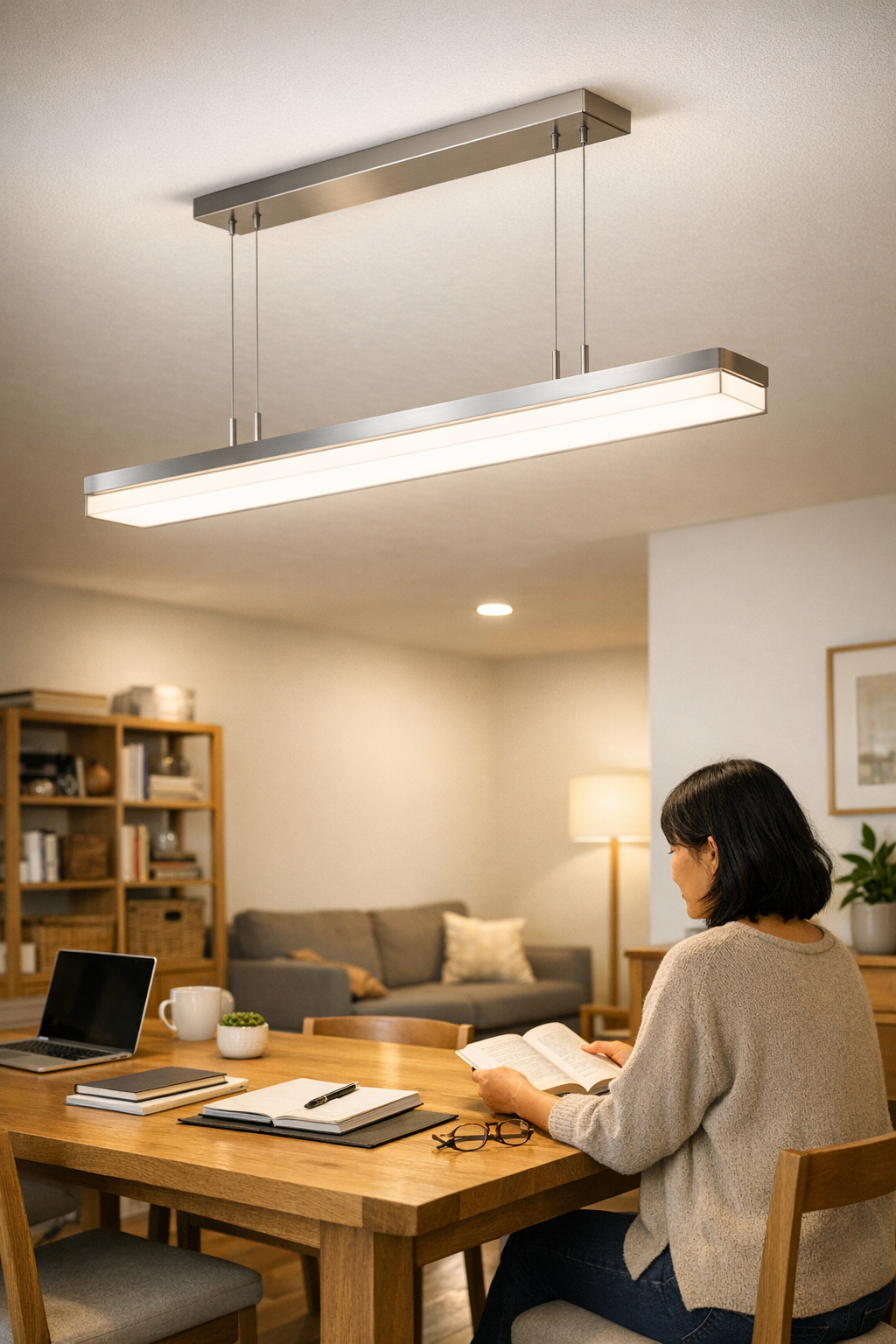
Clearing away floor lamps and covering up cords can make a room look “solved”—but watch how fast small lighting failures return when routines heat up. Ceiling lighting that looked perfect on move-in day often starts falling apart as soon as real-life habits kick in. Suddenly you’re shifting chairs, dragging out clip-on lamps, or squinting at your laptop in a shadowy patch at the table’s edge. A room can appear finished—wires hidden, surfaces clean—while corners go unused and “clutter-free” setups quietly trigger daily workaround fatigue. The real verdict isn’t how the lighting looks at rest, but what happens after a week of actual use.
When a Clean Look Masks Lingering Problems
Flush ceiling lights promise order. No lamps tripping up the walkway. No cords in sight. But in practice, this calm is paper-thin. The second someone stretches out homework or starts a group puzzle across the table, dim patches emerge at the edges and effort shifts from work to lighting triage. The desk that looked polished at first gets steadily eaten up by improvised solutions: loose bracket arms clamped to shelves, power strips trailed over corners, a flashlight angled precariously across the page. You tidy one problem, and a new tangle forms every time the room sees actual activity.
In a compact home office, it shows up quick. A flush-mount fixture sits perfectly centered, but by afternoon, the far edge of the desk is murky enough that someone drags a clamp lamp back into service. Cables snake into the “clean” setup. Glare hops from the ceiling onto glossy workbooks, forcing everyone to play musical chairs just to keep a clear view. The cycle is familiar: temporarily solved in the morning, unraveled by nightfall.
Coverage Gaps: How Ceiling Lights Fall Short in Real Use
The average ceiling light floods the center and leaves the rest in polite shadow. It’s installed for symmetry—not for task clarity or busy surfaces. The result: a wide “bright zone,” but edges where printing, writing, or reading routines routinely collapse. The fix is rarely more wattage—what fails are the angles. Move to the fringe and the fixture’s light falls off fast, especially when surface needs shift daily.
Common Signs of an Underperforming Setup
- Edges of desks and tables never feel fully lit—no matter how clean the room looks.
- Shadow bands creep in as you use ends, corners, or side nooks.
- Someone always borrows a clip-on, a portable lamp, or even holds up a phone just to reclaim basic surface clarity.
- New extension cords and brackets spring up anywhere actual work happens, undoing the original “cordless” plan.
- Glare blooms at the center, overpowering nearby zones, leaving the periphery dull or actively uncomfortable.
These aren’t one-time annoyances. They’re signals that coverage never matched how the room is actually used, and every workaround erodes the appearance the ceiling fixture once promised.
Surface Clarity vs. Surface Usability
It’s easy to mistake a neat tabletop for a usable one. A clean ceiling fixture keeps up until routine changes—extra homework, late-night spreadsheets, multiple projects forcing laptops and books to opposite sides. The “clear” look shatters fast: unused desk lamps are pulled from storage, cables wind over surfaces, and adapters clog outlets. Your work surface that once felt expansive now shrinks in invisible ways—blocked by shadows or made awkward by stumbling over cords and supplementary lights.
The new friction is smaller than a major outage, but more draining. Reaching for a light, angling a notebook, or awkwardly shifting a chair becomes a repeating choreography just to keep up daily flow. That’s where ceiling-only plans break down: they’re visually satisfying, but operationally fragile, exposing weak points the minute every area gets used for real.
Real Improvement Is in the Details (and the Placement)
The fix isn’t “more light”—it’s targeted coverage. In one home, swapping in a low-glare panel fixture just 15 centimeters toward the work wall covered the long-missed desk edge. For the first time, no one reached for a clamp lamp all week. The result wasn’t just visual: cables stayed stowed away, surface shuffling vanished, and everyone stopped improvising just to see clearly. Week after week, the friction just stopped showing up. The gain isn’t a photo-op—it’s noticing silence where frustration used to be.
Small Shifts, Lasting Results
If you catch yourself nudging a lamp, shifting to escape glare, or crowding around the only “good spot,” your ceiling light is missing where it matters. Sometimes a 15cm move, a shallower bracket, or a swap to a broader panel is enough to sidestep an entire cycle of daily fixes—and the setup finally stops fighting your routine.
Panels, Linear Fixtures, and Better Shared Zones
The shape of ceiling lighting changes everything for busy, multi-use surfaces. Panels and linear fixtures are built to throw light all the way to the edge—over tables, wide desks, under shelves. This isn’t just about brightness. It’s about reducing the “gray border” where clutter and ad-hoc lights return.
- Surface edges stay bright, not just the center, so you don’t default to extra lamps by week two.
- Desk zones stay open and cable-free during actual use, not just after a cleaning sweep.
With wide fixtures, rearrangement isn’t a daily disruption. Someone can shift to the far side, start a project at the other end, or work across from a partner without patching in a stop-gap lamp each time. The setup flexes with routines rather than working against them.
Spotting the Real Coverage Gaps
The telltale signs show up in use, not after a fresh setup. Questions that matter:
- Are certain corners, seats, or table ends quietly avoided—especially for reading or detail work?
- Are “solved” surfaces beginning to sprout new lamps or extension cords a month after install?
- Does a pristine setup break down the minute group work or an unplanned project lands?
“Yes” to any means a placement or fixture shift may do more than any bulb swap. Coverage and spread—not just intensity—are the levers that change everyday comfort.
A Setup That Feels Solved, Not Just Appears Tidy
Lighting support only works when each part of the surface gets the light it needs—without recurring side solutions. Tightening fixture placement, swapping to broader or lower-glare panels, or rerouting cable runs can erase entire categories of daily fixes. The difference is quiet: surfaces stay easy, cables stay out of sight, and routines flow, not stall. In the end, it isn’t about a space looking finished—it’s about it actually running smoother, no matter how often the routine shifts.