
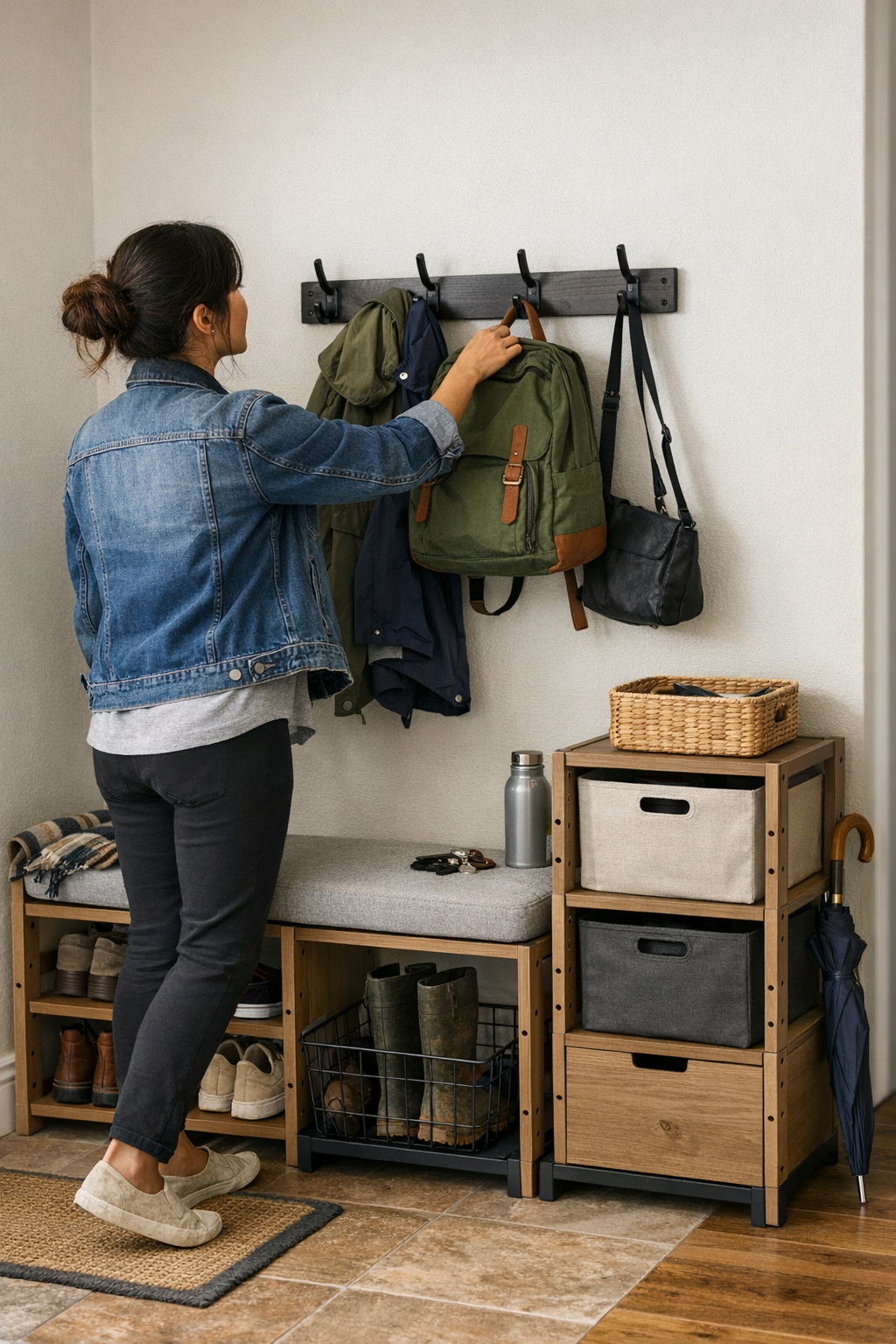
Most entryway setups don’t collapse all at once—they skew, sag, or lose you a few precious steps before anyone notices. The signs arrive fast: suddenly, your best wall hook hangs a little lower, a scuff deepens beneath the shelf edge, or yesterday’s bags lean so precariously you stop trusting even the sturdy spots. This is not about aesthetics. It’s the moment your daily drop zone crosses from “barely holding” to “quietly failing”—and the only real warning is the way small resets start taking longer and the morning flow starts stalling. If you want an entryway that survives repeated school runs, wet gear dumps, random overflow, and back-and-forth bag switching, the strength and placement of your wall mounting decides whether your threshold keeps running, or keeps recalibrating.
How Fast Can Order Unravel in a Busy Entryway?
For the first days after putting up wall hooks or shelves, the system holds together. Hooks stand level, shoes briefly behave, and returning things to their place passes for “done.” But as one routine blurs into the next—rushed Monday mornings, drippy outdoor gear, tired schoolbags—weak anchoring reveals itself. Drywall-mounted hooks start shifting as soon as too many bags cluster, or wet coats arrive in waves. Once a hook tilts, you’ll see bags migrate to benches, shoes pile near doors, and anything that’s “just set down for now” quietly becomes a tripping hazard. Resetting after one messy afternoon gets harder; by week’s end, the original order doesn’t survive the traffic it’s supposed to tame.
The Reality of Repeat Loads: Why Stud Mounting Changes the Game
What separates an entryway setup you can trust from one you keep fixing? It usually comes down to where—and how—each component hits the wall. Just because two wall hooks look identical doesn’t mean they’ll last through the same pounding: schoolbags, raincoats, muddy boots, gym gear. Here’s where things break down after actual use:
- Drywall-mounted: Looks fine until actual weight or sideways tugs start nudging it loose. One overfilled hook can become a tilted anchor or even rip out and leave a dent or gash below. Each micro-movement under stress widens the gap for the next small failure.
- Stud-mounted: Screws catch solid wood, taking repeated, uneven weight day after day. Hooks remain level, storage stays predictable, and daily resets shrink to seconds—even after a double-bagged school morning or a sudden stack of soggy gear.
This isn’t about cosmetic longevity; it’s about whether “organized” means order holds up in daily chaos, or if every return-home turns into a slow-motion shuffle around unstable storage.
Shared Spaces, Shared Strain: Everyday Scenarios in Transition Zones
The Drifting Shoes and Expanding Rows
Monday: four shoes in a disciplined line, hooks lined above. By Friday, shoes creep towards the door, compress into odd corners, and extra bags dangle where hooks feel least wobbly. If mounting points slip—even a little—the line breaks. And every detour around the pile means more time lost and more friction at the busiest five feet of your house.
Benches That Become Overflow Zones
A bench below the hooks starts out as a clean pause for tying shoes. But once one hook sags, emptied backpacks and bulky coats take over its surface. The “temporary spot” quickly becomes the default. Instead of solving mess, you inherit a loop: items move from wall to bench to floor and back, never genuinely clearing the threshold. Stud-mounted hooks above stop this creep—when they hold, overflow rarely lands for long.
Blocked Pathways and Slow-Reset Weekdays
Mounting hooks or racks where convenient—rather than where studs run—invites long-term gridlock. Shoes lose their slot, the entry path squeezes tight, and the scramble to clear passage becomes a multi-step reset, not a quick fix. Every slow turn or re-hang tells you the setup looks “finished” but works like it’s hanging by a thread.
Beneath the Surface: How to Test and Improve Your Entryway Mounting
Test your setup now: Grab a stud finder and check what’s behind each anchor point. Hooks and shelves with at least one screw in a stud rarely shift. If mounting in studs isn’t possible, select high-strength wall anchors—but recognize that traffic-heavy zones punish every shortcut. Watch how often you need to re-tighten, re-center, or simply work around an anchor you don’t trust. The more cycles your entryway endures, the less margin non-stud hardware offers before visible breakdown.
One practical adjustment: If your ideal layout doesn’t line up with stud locations, don’t stretch weak anchors across the wall just for symmetry. Three stud-anchored hooks you trust get used more reliably—and last far longer—than five that constantly risk twisting loose or leaving holes to patch every season.
When a Setup Holds (or Fails): What the Difference Looks Like Long-Term
A stud-anchored entryway delivers the real payoff when routines break down: Mondays with extra bags, days when weather triples the hang-up load, weeks when nobody has time to reset. Bags land, gear cycles through, and the system stands up to it. Meanwhile, the wall looks no worse for wear—no fresh scars, no hairline cracks, no tilting hardware. By contrast, setups built on wishful thinking and wall anchors alone nearly always reveal their failure by the third round of rushing out the door. What was “good enough” quickly hits its wall—literally. The fix is rarely just cosmetic.
Questions That Come Up During Real Use
How do I know if my hooks or shelves are mounted correctly?
Gently pull down or forward—if the hook feels rock solid and immovable, you’ve likely hit a stud. Squishy give, a hollow tap, or visible wiggle means it’s relying on drywall. Stud finders confirm fast. Catching it now prevents wall wounds and rework later.
If studs aren’t where I want my hooks, what’s my best option?
Go with the best wall anchors rated for repeat load. But check these regularly, and don’t be surprised if trouble zones (main bag drop, rainy gear area) need repair sooner. Whenever possible, shift your plan to hit studs—even just one per device.
What are the early warning signs of mounting failure?
Look for hooks that start sloping after any extra load, spreading screw holes, chipped paint rings, or hardware that shifts when bumped. Frequent small shifts mean you’re already on borrowed time—act before re-hanging and repairs eat into your week.
Entryway Storage That Actually Matches the Mess
Most entryways can be made to look organized—for one photo, or one afternoon. The real test is whether a setup still works after it meets rain, traffic, and the relentless return flow of active lives. Solutions built on stud anchors don’t just look sharper longer—they let order survive, even as gear volume and user habits keep testing whatever you install. Every time you drop a bag and the wall still feels secure, you know the system is set for real-world rhythms, not just show. In a transition zone, that difference is the one that actually stays visible—and useable—every day.
See storage options built for transition zones at Betweenry.