
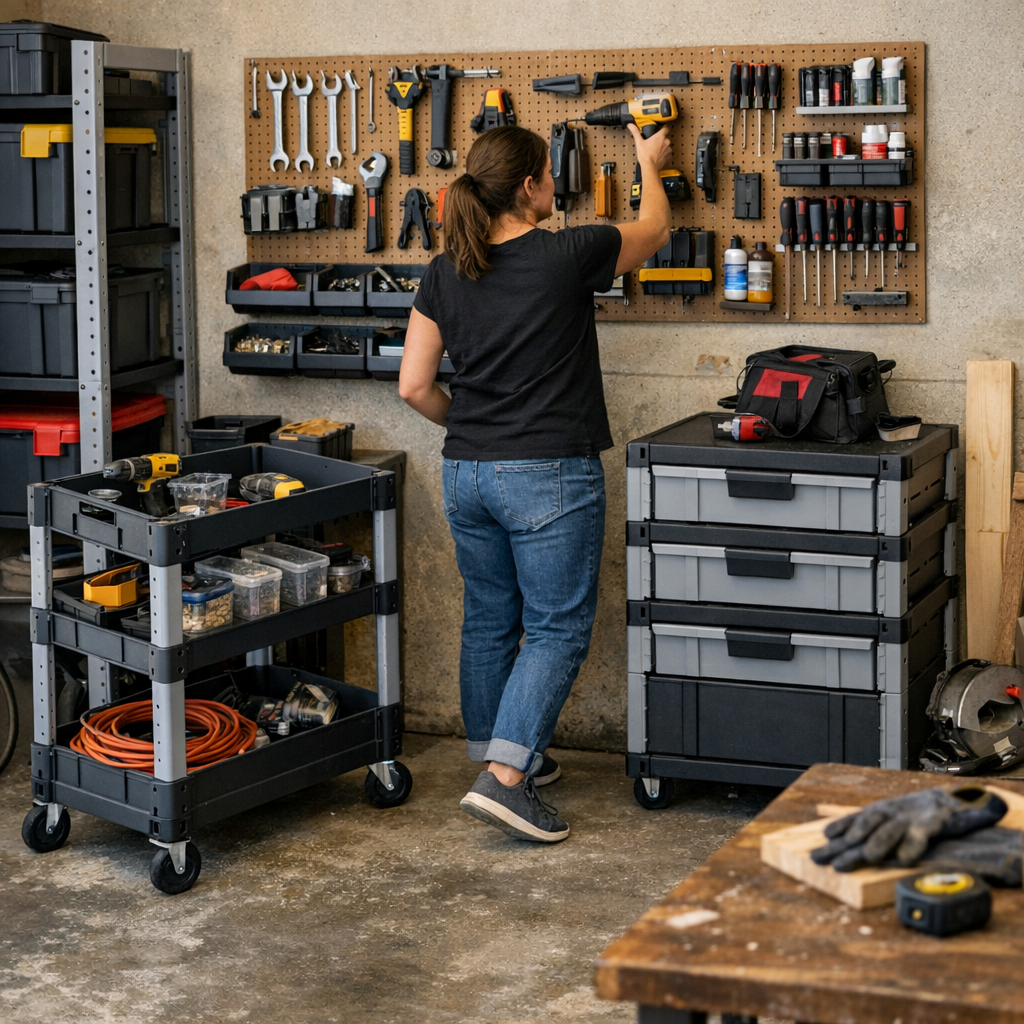
The workshop felt dialed in—on day one. Racks lined the walls, every tool had its slot, and a mobile cart sat thoughtfully nearby, promising easy overflow. In those first smooth hours, it felt tight and responsive: walk in, grab what you need, put it back. But as the projects stacked up and hands reached for the same driver or mallet for the third time, the initial order started to slip. A single nudge to the cart’s wheels made just enough space for a lumber cut—then left it blocking the main rack. The screwdriver was returned, but not all the way. By midweek, the supposed efficiency was outmatched by small, nagging detours, the workflow quietly devolving into a series of workarounds.
When “Organized” Quietly Gets in the Way
Most setups look sharp just after a reset: pegboard lines clean, labeled bins stacked up, a mobile cart ready for “extras.” The layout promises easy flow, but once real work starts, invisible friction sets in. That cart—so convenient for overflow—becomes an obstacle every time it blocks the main rack or crowds the edge of the bench. Returning a tool turns into a mini maze: slide, pivot, reach awkwardly around the cart’s handle. Every sidestep to get around a cabinet or cramped shelf chips away at the feeling of smooth movement.
Meanwhile, corners turn dead as shelf ends or drawers extend a little too far—just enough to shave usable floor. Overflow clutters quickly: clamps “resting” on the cart handle, measuring tapes left on cabinet tops, screws queued up for return. In the rush, you skip the extra step to proper storage because even tiny obstructions add up. Beneath the surface, efficiency leaks away—one slow return at a time.
The Routine: How Organization Fades
Order on paper rarely survives actual workflow. Take the drill everyone uses: it starts with a clear home up front, but by afternoon it’s resting on a half-open shelf, blocked by a shifted cart. To put it back, you now have to shuffle the cart aside (again), or balance it “just for now” somewhere nearby. Multiply that by a dozen daily returns, and within days, a tidy rack has a backlog of half-stashed tools—less from laziness, more from subtle barriers that wear down routine.
The issue isn’t lack of storage—it’s the constant drag of blocked access and awkward movement. Slow tool returns. Bumping past overfilled carts. Detours and doubled-back steps all because the setup works on a diagram, but chokes up in the real-life surge.
Where Overflow Hides and Clutter Builds
Watch any high-traffic zone by a cart or modular chest: “temporary” stacks appear out of nowhere. A mallet hangs from the cart lip. Pliers get jammed into a not-quite-empty bin. Full zones spill over not from capacity but from blocked lines of access. Pileups don’t register on day one, but they’re unmistakable by Friday. The very spots meant for order end up collecting the pieces that don’t fit the flow.
The Surprising Power of a Small Shift
The difference between feeling boxed in and moving freely can come down to shifting the cart just 16 inches outside the main return lane. Suddenly, there’s a clear path—no more shuffling or bumping to return essentials. Instead of a traffic jam, the work loop feels natural again. It’s not a massive overhaul, just a tweak that respects how the space is actually used. Immediately, tool returns get quicker, “temporary” stacks fade, and the temptation to abandon items nearby drops off.
Paired with moving the most-used tools to chest-level rack slots and keeping overflow on the cart—not in the main work zone—routine resets become almost second nature. These tweaks don’t just preserve the intended layout; they defend it from the quiet slip of daily use. By re-mapping the setup to real behavior, order actually lasts.
Letting Your Layout Reflect Real Life
No system is one-size-fits-all, and that’s the point. Wall racks maximize airspace but can’t absorb bulky bits once a project swells. Mobile carts enable growth, but park them in the main artery for too long and they become semi-permanent roadblocks. Modular chests and deep shelving create storage—until they sprawl into walkways and corral movement at the edges. Lasting setups are those where wall, cart, and shelving placements track the actual pulse of your routines—where things truly land, not just where they look best for a photo.
How to Spot a Layout That’s Dragging You Down
Signs it’s time to rethink the arrangement:
- You’re always shifting carts or zig-zagging past cabinets just to reach a tool
- Tools and parts keep piling up “just for now” on whatever’s closest
- Overflow zones turn into the unofficial dumping ground and stay that way
- Rerouting your path—taking extra steps—to skirt around dead corners or overcrowded carts
- The wall looks organized, but is practically a hassle to use at full speed
If any of this sounds familiar, your setup is creating silent friction—however “organized” it might look after a reset.
Lasting Ease vs. The Day-One Glow
The real test of a workspace isn’t a picture-perfect reset. It’s whether, over weeks and months, you can move without thinking, reset without roadblocks, and keep access to every tool as easy as the first week. True clarity comes from layouts that absorb real-life use, not just survive it.
It’s clearing main return lanes instead of filling every inch. Keeping high-frequency slots comfortably at arm’s reach, not in the name of “grid symmetry.” Resetting carts to the ready position at the end of each session. These are small shifts, but the payoff—faster returns, less reshuffling, more usable space—is cumulative. Little improvements beat dramatic overhauls every time.
The ultimate measure isn’t an organized look—it’s a setup that works as hard as you do, all the way through the messy details and silent resets of everyday use.
See what modular storage, wall systems, and smart cart placement can do for real daily use at StackNest.