
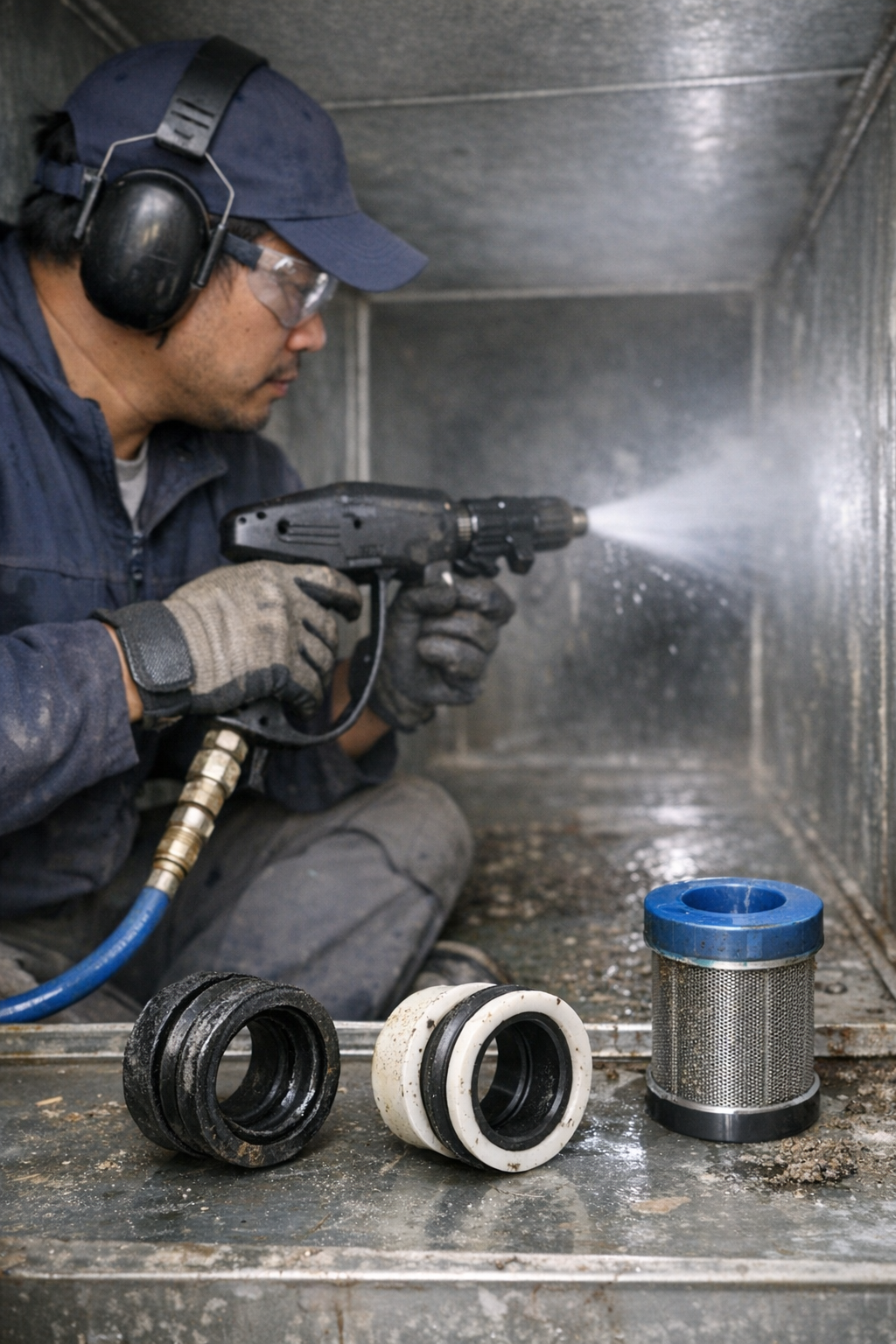
You don’t notice the pump seal when your air cleaner is fresh and the first duct run is still easy. But on a filthy second shift—knee-deep in sawdust, squeezing the trigger while juggling hoses—the wrong seal can drag your whole workflow down. In real shops, the difference between a job done smooth and a job done twice is rarely dramatic; it’s squinting at patchy spots, wet streaks, or a half-stuck trigger, wondering why control keeps slipping away.
Where Tool Friction Shows Up: Not at Startup, But in the Middle of Real Work
Imagine it: an unboxed cleaner, still factory-tight, ready to take on a row of ducts choked with gypsum dust, old resin, or metal shavings. For the first set of passes, pressure feels stable, the trigger snaps back, your lines stay crisp. Whether it’s a standard or reinforced seal, everything works as advertised. It’s only once the first hour rolls by—and your arms are starting to ache from overhead work—that the difference creeps in. You feel a sticky lag in the trigger, or a subtle sag in power output. It’s minor, until suddenly you’re doubling back to polish out light haze you couldn’t see at the start.
Missing the Warning Signs Costs You Time
Think you’re just tired? Maybe—the job is monotonous and fatigue undercuts your focus. But it’s rarely just muscle: small seal breakdowns trigger mist leaks you can’t ignore. Where there should be a clean line, there’s a faint wet edge. Pressure wobbles unpredictably. As soon as the tool loses precision, so do you—and the job gets slower, messier, and grinds you down twice as fast.
This is when a weak component quietly becomes your bottleneck: turning solid effort into rework and eroding your standards before you even realize it.
Standard Seals vs. Reinforced: Invisible Until It Isn’t
Lay a new standard and a reinforced pump seal side by side—no obvious differences. But clamp in a standard seal, run back-to-back clearing cycles through grit and debris, and hairline leaks sneak up quick. Fine metal flakes or dense sawdust grind straight into the standard edge, and it shows: you’ll notice tiny vacuum drop-offs, dulling your control with every trigger pull. Suddenly, those “normal quirks” are robbing you of speed and precision, especially when you’re already pushing to keep up.
With a PTFE-backed or reinforced seal, those small breakdowns don’t stack up as fast. The pressure actually stays even. Your arm notices the lighter, more predictable action: no extra fight at the trigger, no guesswork on whether the vacuum will hold at the far end of the run. It’s not a miracle, but it’s a clear subtraction of headaches. Patterns stay tight, less redo, more flow.
Real Shop Scenario: Weak Link, Wasted Hours
Recall the end of a long shift—everything dusty, trigger hand cramping. What tanks the finish isn’t your effort, it’s micro leaks at the seal. Dull response, streaks where crisp lines should be, and the frustration of lurching to a halt just to shine a light at the nozzle. If that sounds familiar, you know how fast confidence drains away when the tool starts fighting back.
How to Stay Ahead: Simple Upgrades That Compound
If you want to keep your workflow sharp, don’t wait for major breakdowns. Upgrade your seal and clean out your intake before the next grind-heavy project lands. A reinforced or PTFE-edged seal is small insurance against “do-over” days. Pair it with a quality 30-micron intake filter to stop abrasive fines before they reach the pump. This isn’t theory—these are the tiny shifts that keep your tools working with you, not against you.
Real Payoff: Two Jobs, Two Results
One shop swapped in PTFE seals and added new intake mesh before tackling their monthly machine-room cleanout. They weren’t hoping for miracles—just fewer breakdowns and clean passes. By hour three, the win was crystal clear: no drop in trigger response, no puddle streaks, no rework. The veteran on the team summed it up: “It just held pressure like day one—even when the air was thick with ceramic shard dust. No pause, no fixing leaks, just work.” For them, it wasn’t hype. It was the first job in months finished on schedule—with energy left for clean-up, not just collapse.
Sometimes, the mundane wins are the most valuable: consistent passes, less fatigue, no surprise setbacks. That’s what keeping your gear upgraded really delivers.
Tighter Habits, Better Results
Replace before failure. If the trigger softens or light haze appears, swap your seal without delay—a half-hour spent now will save a half-day of rework. And always eyeball your intake filter before tackling dirty jobs, especially in older workshops where sediment and dust float everywhere.
Small changes stack up. Each cycle you skip double-passing, each spot you don’t have to touch up, hands you time—and control—back. Quality work comes from those saved hours, not luck or extra sweat.
Find more tools tested under real shop conditions at Gumboll.