
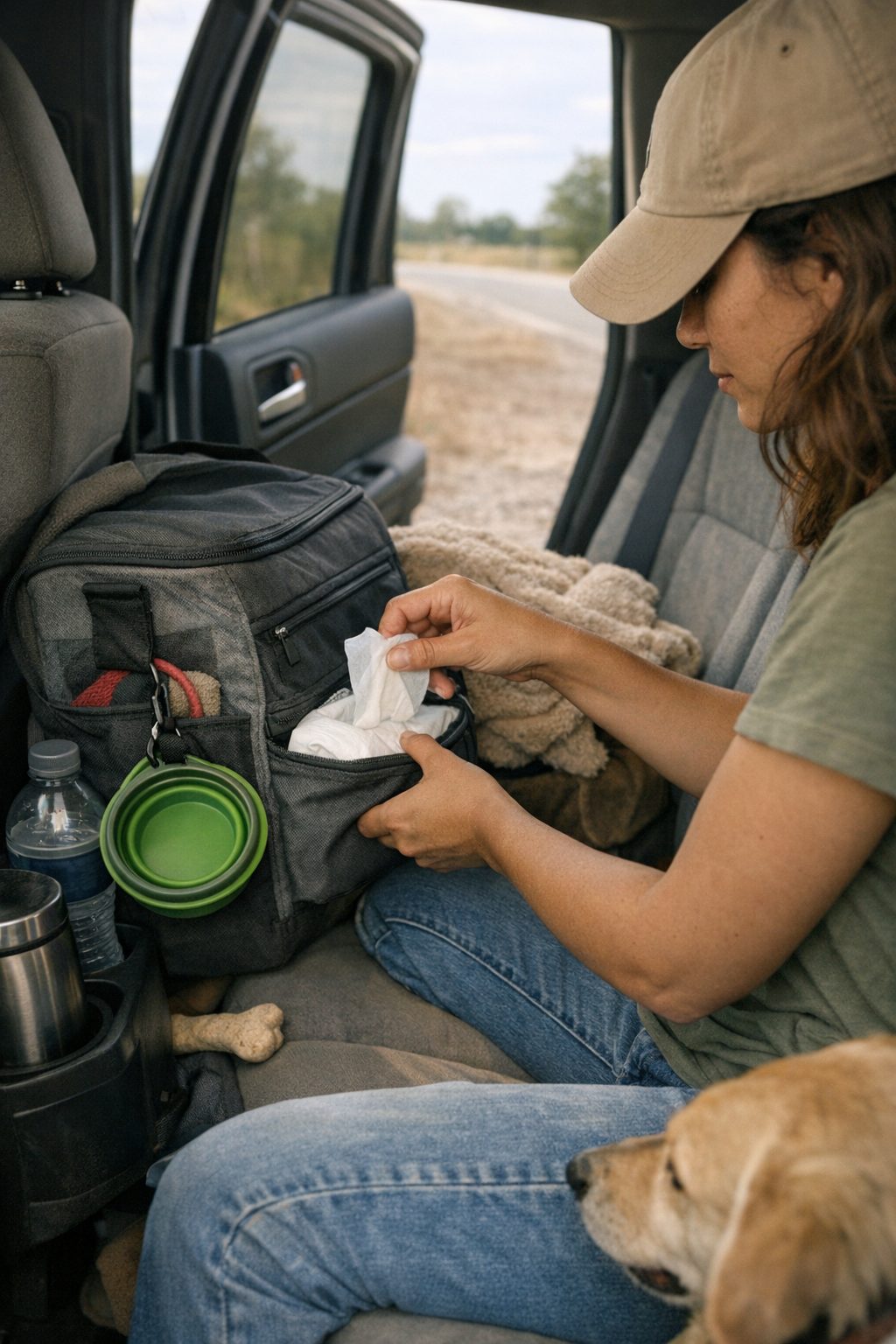
The problem isn’t packing—it’s what happens after the first stop. At home, your pet travel bag looks ready: wipes, leash, treats, all zipped up. But once you’re parked and your dog needs a quick clean or a comfort item, organization turns into obstacle. You dig through a tangle, open the wrong pocket twice, disturb three other items just to reach one. Every everyday stop—coffee, gas, a stretch at the next park—adds another round of awkward shuffling. What passed for “ready” in your living room stalls out when real travel demands fast access, calm handling, and cleanup at the speed of actual use. This is the gap PawGoTravel setups are built to close: not perfect order, but stress that doesn’t pile up with every restart.
The Hidden Friction in “Organized” Pet-Travel Setups
A bag can look fine on the seat but leave you struggling once you’re in motion. The biggest cracks show up at routine, short stops—not while packing. Every moment you reach for wipes and find them under two bowls, or trigger a mini landslide grabbing a comfort item, you feel the difference between “stored” and “actually reachable.” Each pause to reshuffle what should have been ready is a small repeat penalty that piles up through the day.
- Wipes stuck under layered bowls or blankets when mess hits fast
- Comfort item grabs turn into clumsy treat-leash avalanches
- Every restart means re-stacking gear just to regain order that shouldn’t have fallen apart
Order on a checklist isn’t the same as order in action. Stops get slower, frustrations stack, and all that neat packing means little when you’re blocked on the basics.
Why Reach—and Not Just Storage—Defines Real Travel Use
The more you stop and move, the more your “system” reveals weak links. If a wipe pouch is “safe” behind two layers, cleanup is never quick. If water bowls are buried for security, hydration becomes an ordeal. Accessories placed for photo neatness rarely survive the third stop without friction. A bag with one outside, always-ready wipe or treat spot immediately outperforms one with a dozen clever compartments if it saves you fumbling when your pet needs speed.
Pet travel works on repeat. The process is never just pack and go—it’s settle, supply, soothe, clean, reload, and restart, again and again. Every extra move you make, every layer, multiplies the difficulty and turns organization into a drag on your flow.
The Real Test: Repeated Use, Not First Impressions
Picture the morning: a few short errands, your dog joining you stop-to-stop. After step one or two, setup seems fine. But by the third stop, your order starts breaking down. Wipes are deeper in, now under the leash and snack bag. The blanket your dog needs is stuck—again—beneath bowls and treats. Each return to the car becomes more about untangling than traveling. That convenience you organized at home turns into a slow cycle of setup and reset, where every essential is technically present, but never quite at hand.
The irritation is cumulative. A few lost seconds for a wipe, another scramble for a treat, another shuffle for comfort—they all start to slow you down, break your routine, and make the “organized” setup feel clunky fast.
Recognizing Recurring Weak Points
The same logic traps repeat every trip:
- Moving the same leash to snag wipes at every stop
- Storing calming items so deep they take five moves to actually use
- Cleanup gear “present” but buried, turning a quick grab into a minor search
There’s a difference between location and accessibility. Real-world cycles reveal where your bag’s structure works against you, not just whether everything has a “spot.”
Seat-Side Access: A Game Changer for Speed and Sanity
Setup location, not just sorting, changes your daily friction. The wipes you can pull seat-side, the travel bowl with a grab-and-go outside slot, the leash stored unclipped but upright—these shifts reduce each restart from a mini-reset into a single, thoughtless motion. Forms that look simple—like a broad, flexible side pouch—can eliminate layers of fuss without adding bulk or complication.
In practice, moving from deep nesting pockets to open, seat-access sections kills two pain points immediately: the need to dig, and the urge to re-pack after. What the bag gives up in looks, it gains in momentum. Reach, clean, go—no pile, no reset, no lost pace.
Repeat Exposure: When Good Structure Outperforms Extra Organization
Packing for photo order fades after your fifth stop. You notice which items truly need to be at hand and which can wait. The systems that last aren’t “maximally packed”—they’re built for the cycle: grab, use, move on. If reaching for a must-have means shifting two other things, every restop is a test your bag keeps failing. Responsiveness, not layers, keeps your travel pace smooth.
Each stop is an audit. If you’re not gliding through seat-side wipes, open treats, and quick comfort resets, order becomes drag—and all the extra pockets aren’t helping.
Troubleshooting the Most Common Pet-Travel Slowdowns
Are You Moving Items Just to Reach the Essentials?
If grabbing one item means uprooting or untangling others every time, your structure is working against you. Placement must match frequency; every extra layer burns time.
Comfort Items: Helpful or Hindrance?
If your pet’s soothing blanket is always trapped under bowls and treats, it’s doing as much to slow you as it does to calm your dog. Frequent comfort needs deserve top visibility, not deep nesting.
Quick-Access for Frequent Use
Test your setup by literally tracing your stops: how often do you reach, pause, or reshuffle for just one small thing? Each repeated snag signals structure, not just storage, is the culprit. Mark those pressure points—then adjust before your next outing.
Practical move: Assign your top three travel essentials to always-open or seat-side slots. Even removing just one layer of friction can cut the worst delays—and you’ll know it by the third stop.
The Outcome: Smoother Restarts, Less Friction, Real Relief
Effective pet travel isn’t judged by how tight the kit looks at departure, but by how quickly you can handle, clean, and settle at stop eight. The gear that feels best is almost invisible in use—items fall to hand, cleanup is automatic, comfort is available without a scramble. Keep watching for those repeat points of drag or overlap—places where you lose pace for no good reason. Those are the structure fixes that matter. Pet travel reliability is won or lost in the pattern, not the first impression.
Find travel setups designed for real use at PawGoTravel.