
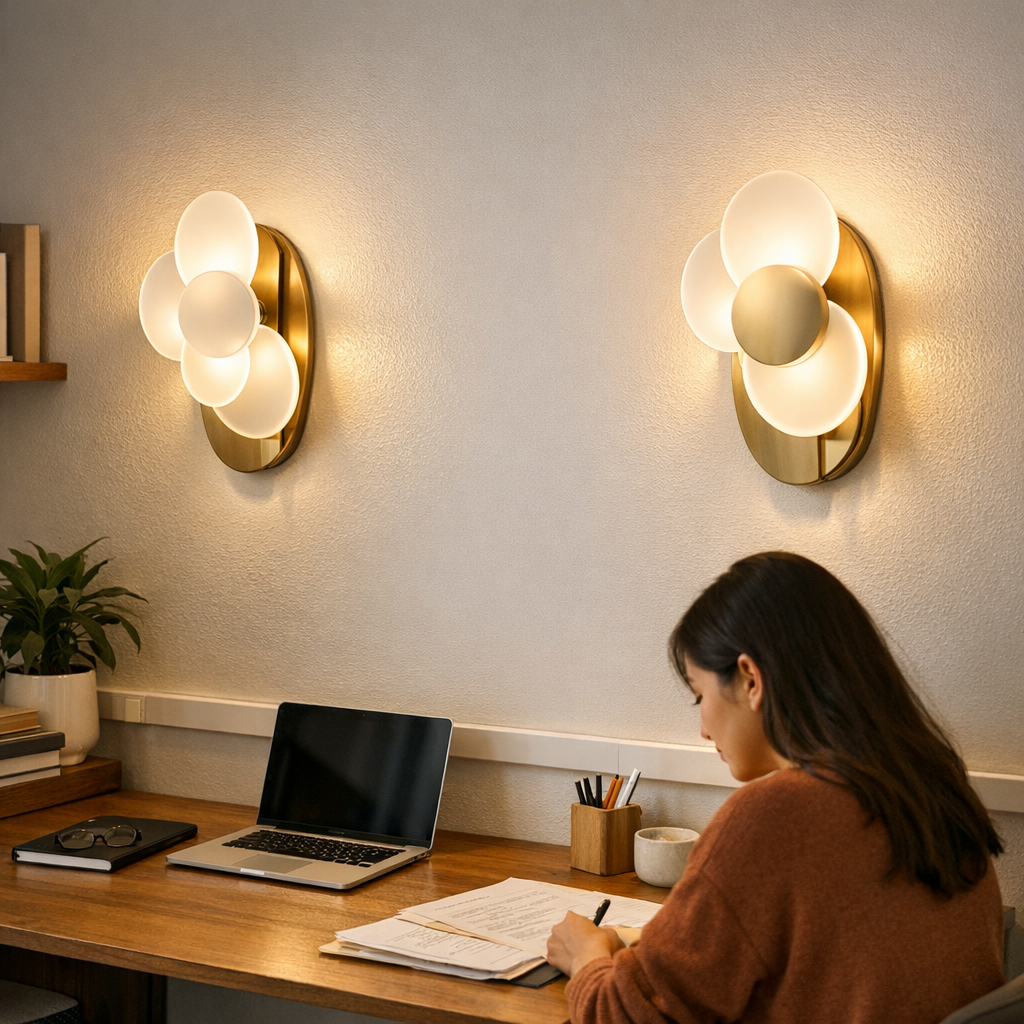
The problem in most desk setups isn’t simply too little light—it’s light that lands in the wrong place, at the wrong angle, turning a “bright” room into a field of small, daily frustrations. Sit at any desk under a single ceiling fixture: the top of your keyboard glares; your arms cast sharp shadows right where you need to see details; the back edge of the desk sinks into dimness. You straighten posture. You shift your chair. The lighting looks finished but never quite fixes the friction—until you realize you’re spending more energy managing glare and hunting for usable space than actually working.
When Overhead Lighting Looks Bright, but Still Fails to Deliver
In most home offices, shared study corners, or tight bedrooms, you’ll spot tidy ceiling domes, LEDs, or recessed downlights—symmetrical, promising complete light. Yet with every session, something nags: you angle your monitor to dodge a steady flash of reflection; paperwork migrates across the surface, always seeking the one glare-free zone; you lose time groping at shadowed desk corners for a missing pen.
Overhead setups breed a stack of familiar friction points:
- Bright ceiling light throws your forearms or hands into hard, distracting shadows—right over keytasks.
- Desk and shelf edges vanish into shadow, forcing constant shifting, and making organization feel like guesswork.
- Glossy desk surfaces or laptop screens catch relentless reflections, leaving you squinting, not seeing.
- Cable runs, however “organized,” start grabbing your eye—with clutter growing more obvious the longer you use the workspace.
Why Wall Sconces Change the Tone of the Room—and the Routine
Wall sconces aren’t just decoration—they’re targeted tools for shifting the whole lighting dynamic. Positioned around eye level, sconces push usable, diffuse light sideways across the desk and immediately erase the most persistent issues from ceiling-only setups:
- Instead of a single hot spot, you get clear, even coverage that reaches the awkward desk edge and shelf recesses where work actually piles up.
- Lateral light cuts across shadows—not just softening the margins, but breaking up the hard lines that overhead beams always draw.
- In compact corners or beside stacked shelves, the right sconce sidesteps the need for another clunky lamp base; you keep precious surface open without sacrificing usability.
- Support pieces—when managed properly—move cables out of sight and out of reach, keeping both movement and vision clear, not just on day one but after a dozen uses.
The routine shifts fast: small print stays readable no matter where it lands; you don’t have to squint for keyboard symbols in the evening; paper passed across the desk stops vanishing into shadow under your own arm.
Scenes Where Setup Friction Remains: Not All Solutions Are Equal
Ceiling lights that look “done” at a distance can unravel the minute you settle in. Real use exposes every weak spot—especially if you’ve made quick fixes or underestimated support placement:
- Central lights swamp the immediate area but leave the back edge of the desk murky. You end up physically tracking light, shifting seats, or craning over the middle to see both text and screen.
- DIY clamp lamps clear away some clutter on paper, but during real work, the brackets intrude. Cables nibble at your workspace, snare your sleeve, or wedge between shelf items as you reach.
- Wall sconces installed as an afterthought look clean when new, but let their cords crawl down the wall or across reach zones and watch the “upgrade” become another maintenance chore.
- Supposedly sturdy brackets start shifting after a week. The light creeps off target—sometimes millimeters at a time—and every nudge to realign is more distraction than improvement.
The real test isn’t how a setup cleans up for a photo—it’s how many times in an average day you have to adapt, compensate, or silently curse a fix that created its own leftover hassle.
How Effective Wall Sconce Placement Rewrites the Workspace
Here’s a typical reality: your desk runs against the wall, no windows nearby. The overhead LED makes a well-lit pool in the center but burns glare across your keys and leaves the right edge—where your notes sit—deep in shadow. Every note you jot means nudging your chair or hunching to escape your own shadow. As the hours drag, your comfort drops, and you catch yourself rearranging, not working.
Add two wall sconces, just above eye level and spaced out on either side. Instead of one glaring spot, the entire desk—both edges, all corners—gets bathed in balanced light. The difference: no more shadow-chasing or posture adjustment every time you switch tasks. Tucked cable covers seal off visual mess so the focus shifts back to actual work, not the distractions collecting under your line of sight. Even during wordless evenings or spreadsheet marathons, the lighting quietly disappears into the background—until you notice you’re no longer fighting with it.
This isn’t “brighter” lighting—it’s a shift from hostile to helpful, from working around a setup to letting it work for you.
Tip: Small Adjustments for Big Comfort
Never mount sconces by guesswork. Use painter’s tape to mark planned spots and actually move through your workspace. Is the light in your direct line of sight? Do cords cut through your key paths? Is any bracket right where your reference book or keyboard needs to go? Five minutes of testing this way almost always reveals friction before it becomes a built-in aggravation.
Trade-Offs: It’s Not About “More” Light—It’s About the Right Light
Adding side lighting isn’t about cranking up the wattage. When sconces are angled toward real work—and installed with support that keeps cords unobtrusive—brightness doesn’t need to increase. Instead, the light stays steady across surfaces, so shadows and distraction drop. You move your eyes from screen to page and back without a pause. The urge to “fix the light” evaporates.
But trade-offs creep in when sconces are pushed too close to mirrors or left with cords exposed. Bad support—brackets that wiggle, cable runs that cross every reach—just brings old annoyances back in new forms. Solutions that only solve noise or aesthetic leave the functional hassle in place.
The Real Win: Small Daily Habits, Actually Improved
What actually changes with a well-supported sconce setup isn’t showroom drama—it’s subtle relief across countless daily habits:
- Your chair stays put, no more shuffling just to see the corners of your own desk.
- Papers stay legible from any angle, without a black stripe of shadow wherever your hand lands.
- The urge to move a lamp or fix a cord mid-session disappears.
- After a long workday, what stands out isn’t the light—it’s the lack of friction, clutter, or the usual pile of minor annoyances.
Making Lighting and Support Work Together for Real Life
Sconces aren’t perfect, and neither is any one-time installation—but they solve a daily-use problem that ceiling lights and makeshift desk lamps rarely touch. If your setup keeps fighting you—glare, shadow, cables always just in view—then targeted support, smarter mounting points, and solved cable runs will do more to smooth your routines than any wattage boost. The mark of a solved setup isn’t how it looks the first day, but how it quietly disappears as a source of friction week after week.
For lighting and support options that actually hold up under repeated use, Visit LightSupport for practical lighting and support solutions.