
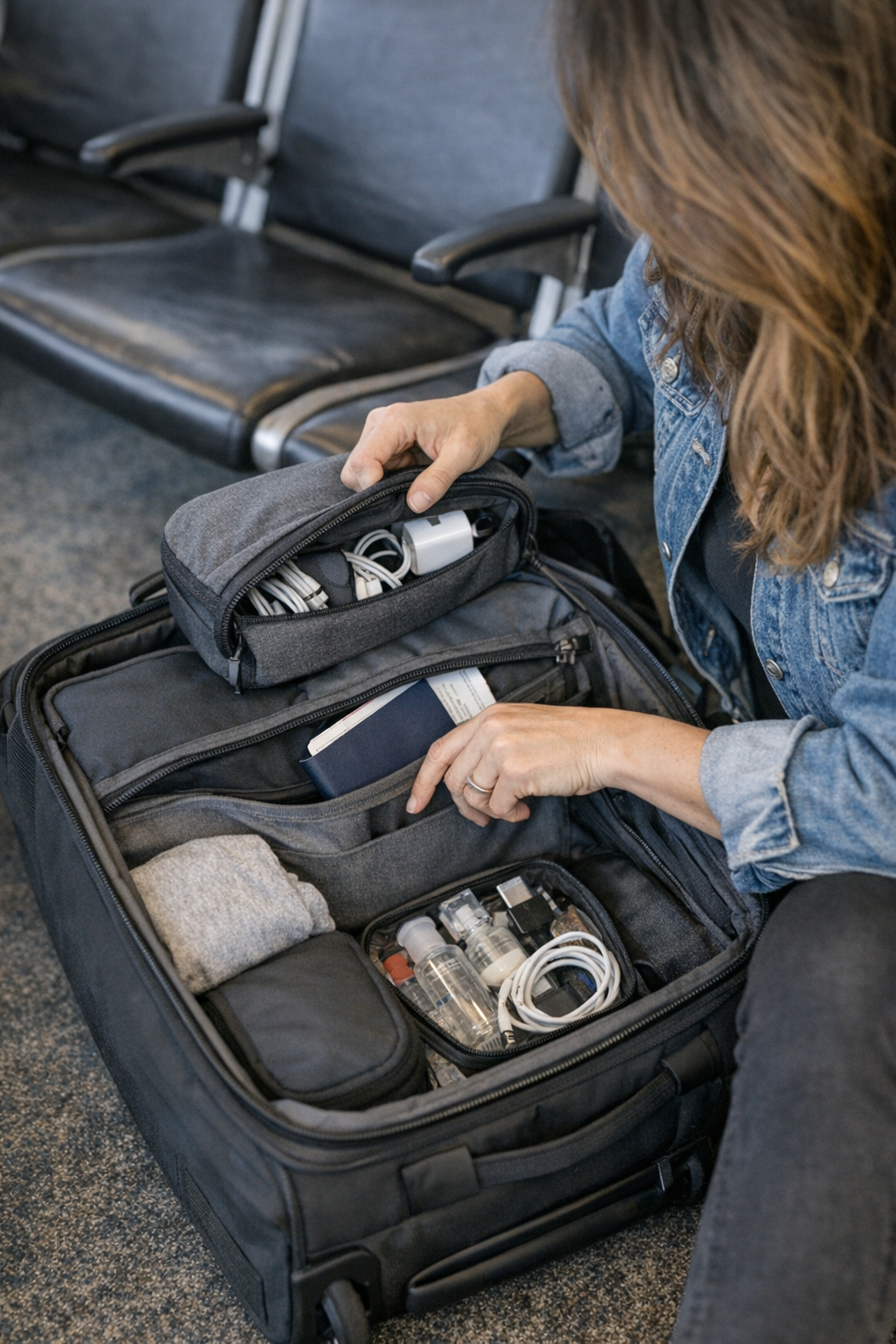
If you travel more than a couple times a year, you already know the pattern: A carry-on that looks orderly on your hotel floor turns into a slow-motion struggle by your second airport transfer. A passport you stowed proudly in its “spot” is suddenly wedged beneath a scatter of charging cables. That tech pouch you zipped smoothly into place now demands a total shuffle—just to reach the one charger you really need, while the security line breathes down your neck. Visual neatness means nothing if every small retrieval feels like untangling someone else’s logic under travel pressure.
Why Visual Tidy-ness Isn’t the Same as Real Efficiency
A bag that photographs well does not guarantee a faster trip. Packing cubes stacked perfectly and mesh panels zipped tight lull you into believing your setup will stay sharp through every stage. In reality, these “clean” layouts often disguise the very flaws that slow you down. The order you see before takeoff dissolves the moment you reach for anything twice—what worked on the hotel bed rarely survives real, repeated retrieval and return cycles. It’s not just about looking good for the pre-flight shot; it’s about whether your system can withstand the wear of actual movement and interruption.
Cross-packed compartments are a classic trap. Toiletries ride beside travel docs “just for now.” Cables get layered under a sweater to keep things snug. None of it feels wrong—until the first document check or charger search stops you cold. You pull out one item and trigger a half-undo of your whole arrangement. What started as calm order now becomes a scramble, every small retrieval turning into its own frayed puzzle.
The Real Scenarios That Break Order—And Why They Matter
Checkpoint Chaos: When Packing Order Falls Apart in Line
The moment of truth usually isn’t packing—it’s that pressurized pause just before the security tray. You go for your ID, but it’s blocked by layered pouches and a cable sack that’s slipped off its mark. Forced to unzip fully, you fumble through overlapping gear, hoping nothing spills out as the line inches forward. Once you finally clear security, repacking is anything but tidy: now you’re restacking half-blind, pushing items wherever there’s room. That “system” that made sense an hour ago? It’s breaking down, piece by piece, at exactly the worst time.
Reaching, Retrieving, Repacking: The Unseen Drain on Movement
Boarding is fast until you hit the aisle squeeze. The moment you need something—headphones, travel docs, sanitizer—your brain already knows the dig is coming. Instead of a quick grab, you have to push past three soft pouches and a sagging cable roll while the queue stacks up behind you. What should have been a seamless move now marks you as the person clogging the flow. For every retrieval, you add small delays and extra attention, trading calm for awkwardness again and again.
Overhead-bin Surprises: Why Compactness Isn’t Always Convenient
The “ultra-compact” carry-on seems efficient—until you’re standing mid-aisle, hunting for an item you thought you’d only need at your seat. Instead, your charger hides beneath a compression cube, and getting it means unlocking the entire main compartment. Now you’re balancing the bag half-open in a too-narrow aisle, risking a messy spill or clumsy re-pack that unravels on arrival. The clean look turns into real hassle the moment you need anything out of sequence.
The Subtle Difference: Looking Packed vs. Moving Smoothly
A carry-on that only looks tidy almost always falls apart after real use. The collapse isn’t dramatic—just silent, repetitive breakdowns. You start the trip with chargers on top, documents where you expect, and pouches stowed for quick access. By the third retrieval, cables snake their way under shirts, boarding passes drift, and you find yourself improvising temporary “fixes” that slow you down again at the next checkpoint. Every small interruption signals that your setup isn’t truly built for rapid, repeated access. Order that can’t survive movement isn’t order at all.
Habits That Actually Make a Difference
Dedicated Pockets, Zero Overlap
Speed and sanity come from strict separation. Assign one top or exterior pocket for documents—never for snacks, coins, or spare tech. That way, you train both hand and memory: the item you need is always in the same place, every time. Tech—chargers, cables, headphones—belongs in a single, upfront pouch: no digging, no tracing random wires, no stress when the tray line moves. Use it, return it, same spot—no exceptions. When your essentials have fixed homes, retrieval and return become second nature, not fresh problems.
Modular over Monolithic: Why Separated Items Win
The “everything-in-one” organizer feels efficient until you need just one item—again. Modular pouches for clear categories (one for tech, one for overnight, one for liquids) prevent the domino effect, letting you grab and replace each type without disrupting the rest of your setup. At a checkpoint or during forced repack after searching for a passport, you return each piece to its predictable place. There’s no cascade; disruption is minimal. Over a long day’s travel, the accumulated savings in time and energy are impossible to ignore, especially when systems that once seemed neat start to fail after only a few retrievals.
Recognizing Trouble Early—And Resetting Before It’s Too Late
One clear signal your system is failing: you find yourself digging for the same item several times an hour—a passport behind toiletries, a charger lost under layers, a boarding pass buried under headphones. If, halfway through the trip, you invent a “temporary” holding spot because returning something is too much hassle, it means workflow breakdown has already set in. That’s when it’s time to stop, strip down, and assign each essential its own clear place. A quick reset, strict pouch discipline, and ruthless avoidance of overlap restore flow—and keep you from stacking repack mistakes for the rest of your journey.
What Actually Speeds You Up: Practical Takeaways from Lived Travel
The best carry-on setups aren’t the ones that look untouched on arrival; they’re the ones that recover fast, retrieval after retrieval. The advantage isn’t in the initial neatness but in the repeatable, predictable access patterns when tired, rushed, or interrupted. Assign zones—tech, documents, comfort basics. No mixing. No creative repurposing mid-trip. Each return and retrieval follows the same path. After dozens of flights, the difference is measurable: minutes saved, stress dropped, and fewer mid-aisle repacks under pressure. Your bag won’t stay photo-perfect, but your movement through every gate and aisle finally feels as streamlined as it looked back at the hotel.
For travelers who are done with systems that look good only before the first boarding, it’s the setups that withstand real use—and recover after every interruption—that actually change the trip. Move toward modular, separated, purpose-built arrangements. See what order feels like when it works at every phase, not just the start.