
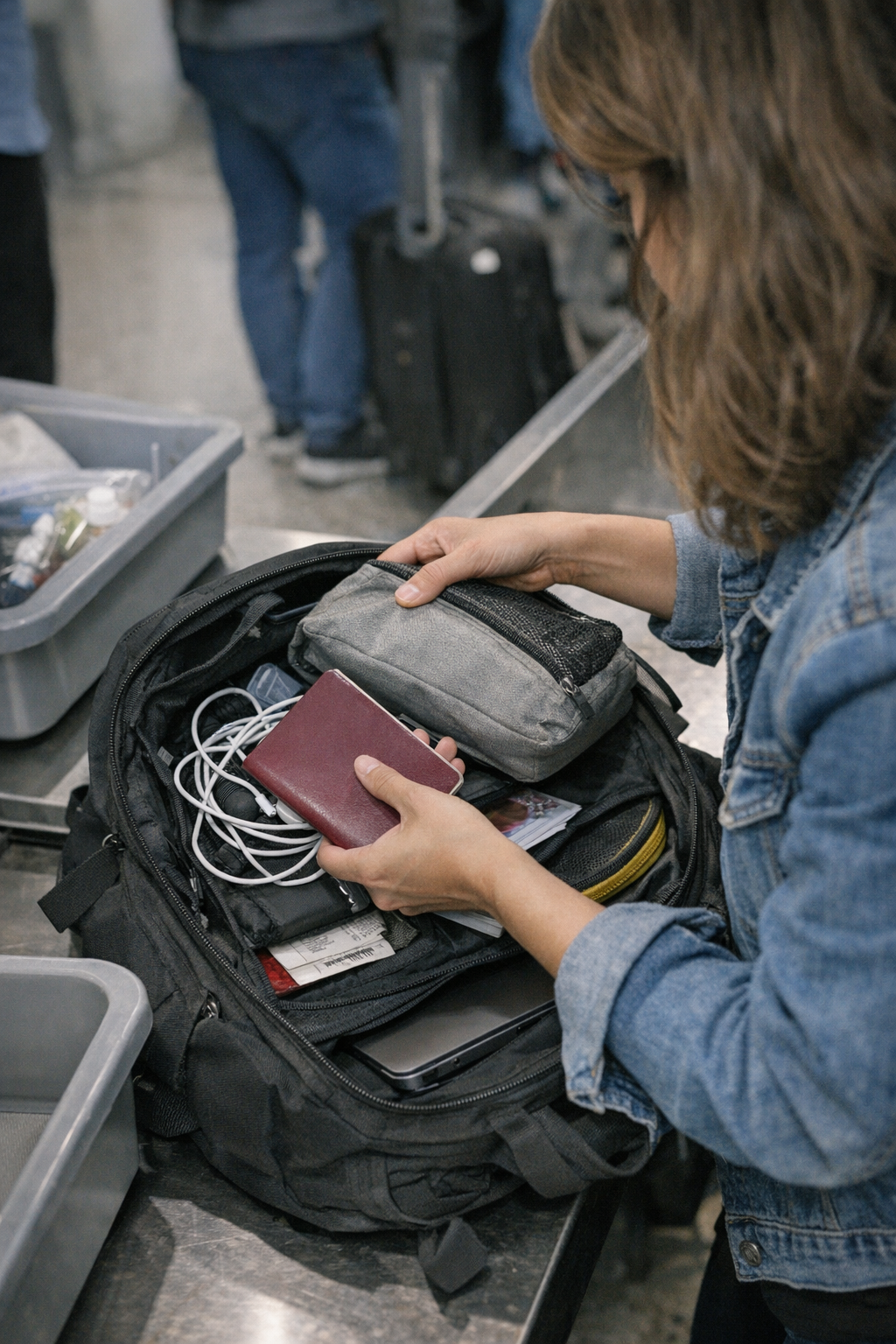
The most organized carry-on at home can turn into a slow-motion obstacle course the second you start moving through an airport. You zip bags closed, stack every pouch just right, only for every routine—security check, document scan, seat entry—to expose a flaw in your layout. A cable blocks your passport. A toiletries pouch jams the main zipper. The bag that looked efficient on your floor now feeds a series of micro-delays: reaching, pausing, unzipping three pockets, and putting your energy toward finding the right item instead of moving forward.
Why Neat Packing at Home Isn’t Enough
Packing is not performance. Bag order on the kitchen table means little when airport movement takes over. The first test comes before security, where headphones tangle around a pen or your passport wedges behind a bottle. Each pause—digging past stray chargers, sliding out a document stuck under yesterday’s receipts—costs seconds and exposes what the home setup missed. A well-intentioned pocket becomes a delay point, and after a single checkpoint, what once seemed neat already needs a partial repack.
Momentary holds add up. By the time you’ve done a security tray transfer, shuffled in a boarding line, and had to reach for that one repeat-use item again, the superficial order you brought with you splinters into a new kind of clutter. The real test of packing isn’t how it looks when zipped; it’s what slows you down once you’re in motion.
The Hidden Cost of Carry-On Friction
No traveler expects their own bag to work against them—but even carefully planned compartments fail under repeated pressure. Packed tight almost always translates to packed difficult under airport stress. Here’s where the small breakdowns show up:
- Headphones out of reach, buried behind a novel you swore you’d start onboard
- Passport hiding under knotted cables just as you hit a document check
- Toiletries pouch wedged where your laptop sleeve folds—tripling your time to produce it for security
- Tech and snacks jammed into outer pockets, forcing you to dig for charging cables every single time
Each snag is minor by itself. But as these access hurdles repeat, they chip away at your focus, chip by chip, until airport routines start dictating your pace—not the other way around.
Real-World Scenarios Where Efficient Access Matters
Security Checks: A Repeated Test
At the tray transfer, speed isn’t showy—it’s survival. You’re juggling shoes, belt, and a laptop, and suddenly notice a tight zipper fighting you or find yourself reaching through two layers for a liquid pouch. Every pocket you open past the first multiplies stress—especially with a dozen impatient travelers waiting behind you. Repacking after each scan isn’t just busywork; it interrupts momentum and invites disorder that wasn’t there when you zipped the bag at home.
Boarding and Seat Entry
Now the real bottleneck: the aisle shuffle. If your passport or headphones aren’t right up front, you end up pulling out pouches and shuffling layers just to get in your row. What felt streamlined now has you repacking on a seat edge, holding up a line of travelers with nowhere to go. Neat packing helps nothing if quick-access items are buried or blocked by your own system.
Overhead Bin Access and In-Transit Retrieval
Another round of frustration: you stand up halfway through the flight or dash to your connection, ready to grab a charger—only to find outer pockets jammed, pouches blocking your main compartment, and urgent items shuffled away mid-transit. The repacking spiral repeats: open, dig, shove, try to restore false order before another rush. “Set and forget” becomes “set and redo.”
What Actually Improves Flow: Structure Over Appearance
Efficiency isn’t about squeezing more in; it’s about separating vital from secondary. Fast-access essentials—passport, headphones, boarding pass—need space where nothing overlaps or stacks above them. Looks can deceive: overlapping pouches seem tidy but guarantee you’ll be digging or dislodging every time you need something quickly. The best setups make it physically impossible for a cable to block a document, or a sanitizer pouch to trap your charger.
Change the rule to placement, not exclusion. Give each high-frequency item its own shallow, obvious zone—a sleeve that doesn’t share space with tech or snacks, a pouch that never gets buried. Keep cables and power banks in a secondary layer if you only need them mid-flight. Move toiletries where they can be extracted in one clean motion at security. The bag doesn’t need fewer things; it needs structure that matches movement, not just a surface impression of order.
Recognizing the Red Flags in Your Current Setup
Stop and notice if you’re hunting for the same item at more than one checkpoint, repacking after every retrieval, or unzipping extra pockets just to get one thing. The friction isn’t failure—it’s the natural outcome of categories that compete for the same space and force you into manual reshuffling just to keep pace with airport routines.
You’ll see it most starkly at the gate or entering your row: headphones or a boarding pass tangled under a toiletries kit, or a passport you can’t reach without unloading a tech organizer. Smooth travel depends on flow, not just tidiness—in practice, that means never letting a high-frequency item get blocked more than once in a journey.
Small Changes, Big Impact on Travel Days
- Move every repeat-grab item into its own dedicated sleeve or pouch—never overlapping, never buried.
- Pick the shallowest, most visible compartments for the big three: passport, boarding pass, headphones.
- Aim for a structure where tech, toiletries, and “sometimes” gear don’t interfere with your main flow access points.
The goal isn’t just looking organized—it’s moving with trust in your bag on every transition. In crowded lines, tight seating, or while racing to a connection, you need a system that holds up, not a setup you keep having to fix.
The Real Outcome: Progress Without All the Pause
Build around friction-free movement, not just visual neatness, and travel changes. It’s not about finishing faster—it’s about eliminating the hundreds of pauses: those half-a-minute delays, aisle moments, or tray transfers that sap energy trip after trip. The payoff is quiet but lasting: getting home without remembering a single aisle apology or repack panic. Structure beats surface, each time.
Find carry-on solutions designed for efficient movement at CarryOnSupply.