
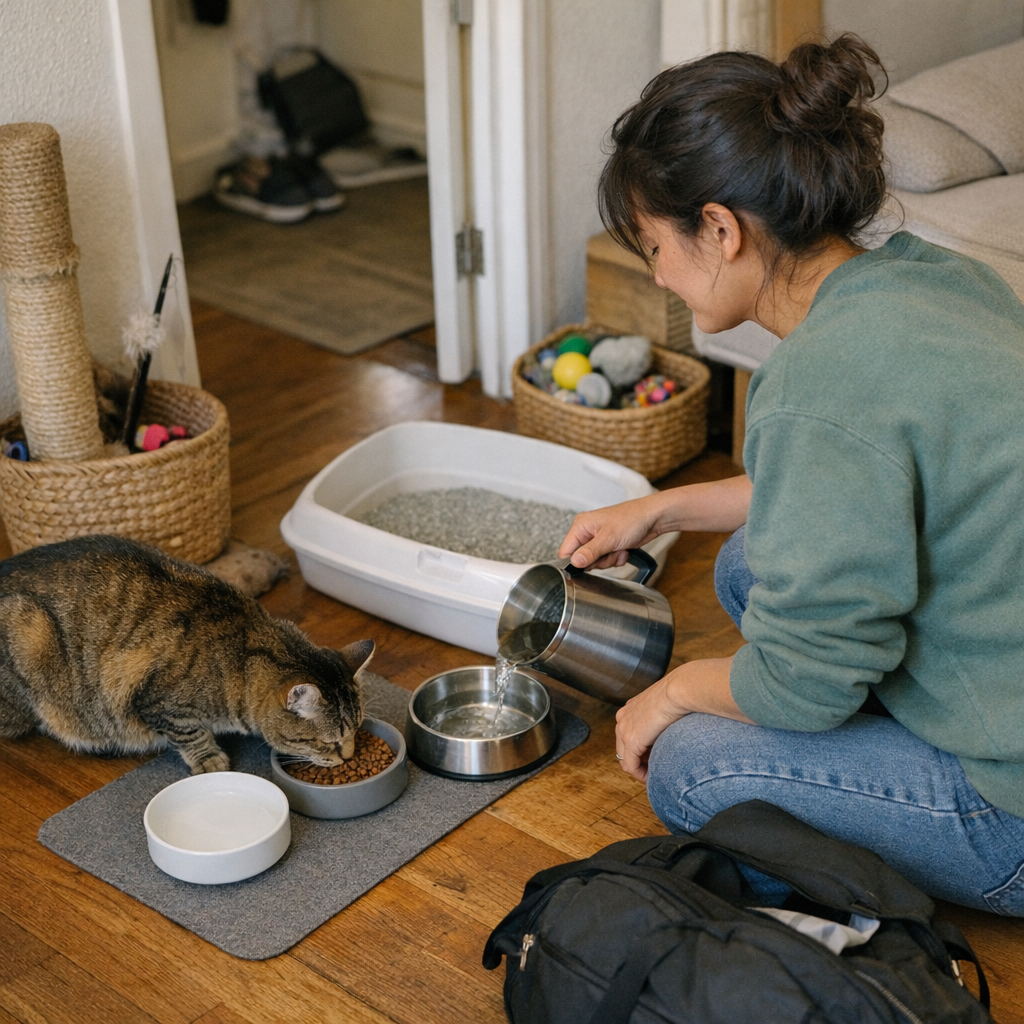
Leaving your home—even for a quick errand—exposes every flaw in your indoor-cat setup. What seemed “fine” during a calm evening falls apart when you’re in a rush: a food bowl wedged out of sight suddenly adds an extra step, the litter scoop is missing again, and a water bowl tucked under a side table turns one refill into a cramped juggling act. These aren’t minor annoyances—they’re the repeat interruptions that make departure feel like a gauntlet, not a goodbye. StillWhisker’s world is built around cutting this daily shuffle down to size.
Where Setup Friction Hides in Daily Life
It’s easy to design a cat corner that looks neat—bowls behind décor, litter hidden behind a laundry door, everything clustered out of your walking path. But these “tidy” decisions bury the real work. The litter scoop’s always blocked by a box. The toy basket sits prettily in the far corner yet requires moving a chair. The food mat seems contained yet collects crumbs where you can’t swipe them until they trail across the floor.
The pressure hits when you’re late—groping for liners under a cabinet, kneeling in the shadow of a plant just to wipe up that missed spill, resetting the same clumped spot again and again before you can leave.
Departure Pressure: The Ultimate Indoor Cat Setup Test
Leaving home is the stress test for every setup choice. Fast exits expose every hidden inefficiency: if you have to shift a watering can just to grab the bowl, you’ll keep doing it. If refilling the food means trail-walking to a closet, next time you’ll cut the task entirely—or risk an empty bowl while you’re gone. Skipped toys, forgotten wipes, reset mats locked behind furniture—these become regular snags, not rare slip-ups.
Friction points show up as:
- A water streak you only notice as you pass the threshold—because the bowl edges out of your periphery on normal walks
- Food left unfilled when the feeder “out of sight” means it stays out of mind, especially when you’re multitasking
- Spray bottles stored two rooms away, so litter cleanup becomes a future-you problem—and the mess lingers
- Toys stashed in “nice” baskets but always missing when your hand reaches, causing a detour or a skipped play session
- Crumbs fan to the edge of the food mat, blocking smooth movement and turning a one-minute reset into a repeat wipe-down after you return
Repeated-Use Realities: Where Routine Breaks Down
Arrangements that look composed crumble under repetition. Take the food bowl “tucked” neatly against a wall—the line pleases the eye until bits travel off-mat, demanding extra sweeps on your way out. You end up fishing kibble behind chair legs with your bag already on your shoulder. Or water bowls: what feels discreet in a room-corner becomes a source of dings and cold wrist-spills when you’re reaching on autopilot before work. Over time, the setup that looked invisible becomes a source of daily missteps.
When Cleanup Tools Aren’t Where You Need Them
Even with the best supplies, access ruins rhythm. You spot litter dust or fur tufts but realize the wipes are wedged behind a pile-up—or in a basket you “organized” out of reach. You plan to handle it later, but the delay guarantees the mess spreads. Each skipped cleanup loads another reset onto tomorrow, turning last-minute departures into a cycle of half-done chores.
The Trouble with “Looks Ordered, Works Slow”
Placements that hide cat life—the feeder behind decor, the litter box behind a door, toys invisible until cleanup—promise an ordered space. But in practice, the “order” transfers effort into the exact moments you need fastest movement. During departure, the setup reveals its true cost: the time lost flipping baskets, repositioning bowls, rescue-missions under the sofa, and always returning for something you meant to reset earlier. All for a room that looks better, but works slower, every single day.
A Real-World Moment: The Last-Minute Reset
Imagine the real cost: you’re jacketed, coffee in hand, ready to lock up—then spot the water bowl wedged behind a planter, only now realizing it’s empty. Shift the plant, knock over a leaf, spill the water, then cross the room for a towel. Suddenly, “just refill” expands into four tasks, and your whole timeline slides. This isn’t a one-off. It’s a daily rerun for anyone whose setup hides the real use path behind layers of “tidy” logic.
What Actually Streamlines Departure: Visibility and Access
The setups that actually save time put every reset tool and task in plain reach and obvious flow—not just out of sight. When your feeding, water, litter, and toy areas are placed for in-motion handling—with no doubling back—you clear the invisible obstacles. You scoop without pausing, spot a mess in passing, and grab a toy in stride. Everything stays “in circuit” with your real daily movement, not an idealized diagram.
Small Placement Tweaks, Big Daily Payoff
Shove the water bowl just to the edge of your walking line—each refill takes one hand, one second, and nearly eliminates the “leave it for later” temptation. Move the cat food closer to both prep and feeding stations: no more crossing the kitchen, no more kibble dust on the wrong counter. These tweaks, repeated in real morning rushes, make the difference between a seamless send-off and a weekly resentment.
The Hidden Cost of Deep-Tucked Cat Items
Deep storage or far-away corners mean micro-messes grow in your absence. Litter, scoops, wipes—anything not instantly reachable breeds compound cleanup. You notice it most on high-pressure days, but the friction exists on every ordinary morning too: a rag migrated out of room, a toy always under the same low table, each one breaking routine flow. Over time, this becomes an obstacle course built by yesterday’s “out of sight” choices.
Recognizing Persistent Friction Points
If you find yourself repeating the same clumsy kneel, or resetting a corner with your keys already in hand, those are signal flares, not quirks. A litter tray that needs a gymnastic reach, a food mat always on the verge of crumbs, or a wipe-down that never feels “done” until you’re moments from the door—these are signs your setup isn’t matching the real flow of indoor-cat life.
When “Looks Nice” Shouldn’t Trump “Works Fast”
Coordinated bins and hidden nooks impress when company visits—but if you’re cleaning, searching, or reshuffling just to keep up with daily basics, it’s not efficiency. Test it: shift bowls, supplies, and key toys into direct paths for one week. Track whether double-backs drop and if your reset routine speeds up. The best structures blend into daily pressure, not just into room photos.
Making Your Indoor Cat Setup Work Under Pressure
The real upgrade isn’t a picture-perfect corner, but a setup that absorbs routine stress without dumping it back into your busiest hours. When food, water, litter, and play zones stay in the sightlines you actually use—without sacrificing reach for looks—departure becomes predictable. No scramble to double-check, no invisible mess trailing into the evening. Instead of last-minute pivots, you get an exit routine that stays as smooth after thirty departures as it did on the first reset.
If a weakness returns every time—slow refill, mislaid scoop, always-reset blanket—treat it as proof the setup isn’t working for you yet. The best indoor-cat routines erase these snags, letting you leave on your terms rather than on your setup’s schedule.
For practical solutions that support smoother routines and lower friction in real indoor-cat-life moments, visit StillWhisker.