
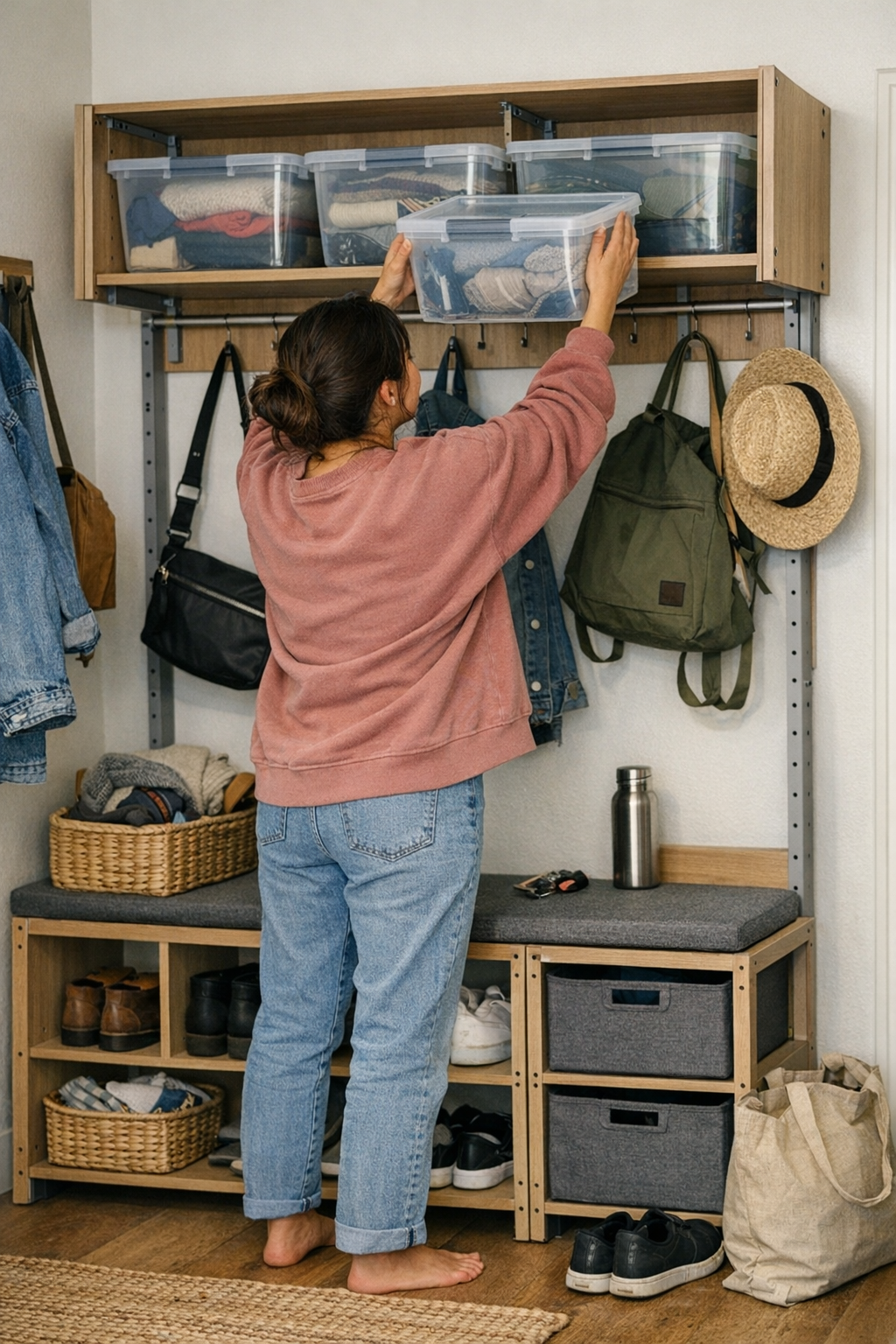
When you start stacking shoes or bags on the high shelf or upper cabinet “just for tonight,” you’re not organizing—you’re setting a trap for your own routine. Those upper entryway zones are supposed to keep occasional gear out of the way, but the first time you toss something you’ll need tomorrow up high, your reset flow starts to buckle. The problem is immediate: every ‘temporary’ drop adds invisible friction, and your well-intentioned storage turns into a slow-motion pileup above eye level, right where you don’t want it.
When Backup Storage Turns Into a Catchall
High entryway shelves and cabinets—built for backup coats, guest gear, or once-a-month tools—only work if they stay truly backup. But busy weeks break that rule fast. The intent is always, “I’ll move it in the morning.” Instead, umbrellas land on the top shelf after a wet school run, the gym bag rests out of sight “for now,” and before you notice, long-term spots are full of daily overflow.
By the week’s end, the upper zone becomes a silent dumping ground. Now gloves mix with outdated mail and yesterday’s tote. Shoes you meant to keep lined by the bench inch their way upward when the floor gets crowded. The difference between backup and everyday blurs, and your entry starts fighting against you every time you look for something you actually need.
Quick Resets, Slow Retrievals: The Cost of Compromised Upper Storage
The slowdown shows up right when you need speed: someone’s late, opens a cabinet, and finds a tangle of wrongly grouped stuff—jackets jammed with paper bags and mismatched shoes. That easy “drop and grab” flow is gone. Simple movements stall while you dig through bins that now hide as much as they store. Each extra step is a penalty for yesterday’s shortcut, and the habit grows with every “just this once.”
The routine gets corrupted by small decisions: a fast bag toss you plan to fix later, a pair of shoes exiled higher because the lower shelf got crowded, a bench seat that never clears because it’s where overflow lands between trips. You don’t see the drift until you’re standing on tiptoe, rummaging, annoyed, while everyone waits by the door.
How Upper Storage Drift Actually Feels
You try to hold the line: shoes in a row near the door, bench open for putting on boots. But the boundaries start to bend. The row of shoes spreads until it blocks the path. A bag left on the bench nudges someone else to drop their stuff on top. The closed cabinet keeps the mess out of sight, but inside, bags, hats, last week’s receipts, and off-season gloves are crammed as if tomorrow might never need them. The “backup” shelf becomes a silent overflow trap—especially right when the entry is busiest.
The Tipping Point: Overflow Eats Up Movement
Transition spaces fail slowly, then all at once. Add one more basket perched up high and soon you’re dodging loose gear just to reach the door. Once the backup zone turns into a catchall, movement tightens—benches become bag piles, walkways shrink, and every reset takes longer. It isn’t chaos, but it’s enough to add micro-delays that stack up every week.
Drawing a Hard Line: Why Labels Matter
What actually fixes this? Distinct boundaries, not just neatness. Move all daily gear to within easy reach—benches, floor, or low cubbies only. Label every high bin with what belongs (“Rain Gear Backup,” “Guest Accessories”). When a bin is labeled, anything that doesn’t match stands out. The system draws the line for you: stray shoes or regular bags have nowhere to hide above eye level, and the messy upward drift stops cold.
Clear, labeled bins force choices you can see. No more rooting through random containers: you know you’re only checking once a month, not every morning. The urge to stash daily clutter goes away—if it doesn’t fit the label, it doesn’t go up high. The high zone becomes controlled again, not just hidden mess.
Reset Speed: The Real Test of a Good System
You’ll feel the reset speed improve almost immediately. When you can open a cabinet and spot exactly what’s inside—no double-checks, no shuffling, no mystery—you cut the time and hassle out of packing up or returning. Shoes stay below, backup stuff stays up top, and your flow from in to out and back again keeps moving instead of sticking.
Real-World Routine: Signs Your Setup Is Slipping
Most entry setups don’t fail suddenly. It starts with a pinched sidewalk or a doorway blocked by a stray bin. Next, you take an awkward pause to remember where you hid your main bag, or you keep climbing to the high shelf for things you should have on hand. The signals are clear: daily items drifting upward, every reset taking longer, more thinking required to leave or enter—and the return path feels always one drop away from gridlock.
If you’re re-sorting the upper shelves every week, your boundaries are gone. That’s the sign not just to tidy, but to redraw the lines: relabel, relocate, and reserve the top for what really stays out of rotation.
Practical Tips to Keep High Zones Working For (Not Against) You
- Label every bin clearly. One glance tells you backup vs. overflow.
- Use see-through storage for upper zones. Visibility discourages accidental stockpiling and stops hidden mess.
- Set a quick monthly review. Take five minutes to keep categories honest and boundaries sharp before drift sets in.
- Keep the essentials where you reach them without climbing. Shoes, go-bags, and wet-weather gear belong at hand or foot level—never up high.
Looking Controlled vs. Working Every Day
The biggest trap in transition storage: setups that look organized but fail on a normal morning. True function is measured by reset speed and flow—how rarely you have to re-sort after daily use, not by how tidy things appear at rest. As soon as high storage shifts from true backup to overflow trap, the consequence is a daily grind—hidden, but felt by everyone who passes through.
With the right rules and clear signals, high zones become backup again—not friction points. The entryway keeps its flow: shoes line up beneath, bags are dropped where they belong, and every trip in or out is predictable instead of unpredictable. You lose the need to reshuffle, the entry stays functional, and reset is quick no matter how many trips it sees in a week.