
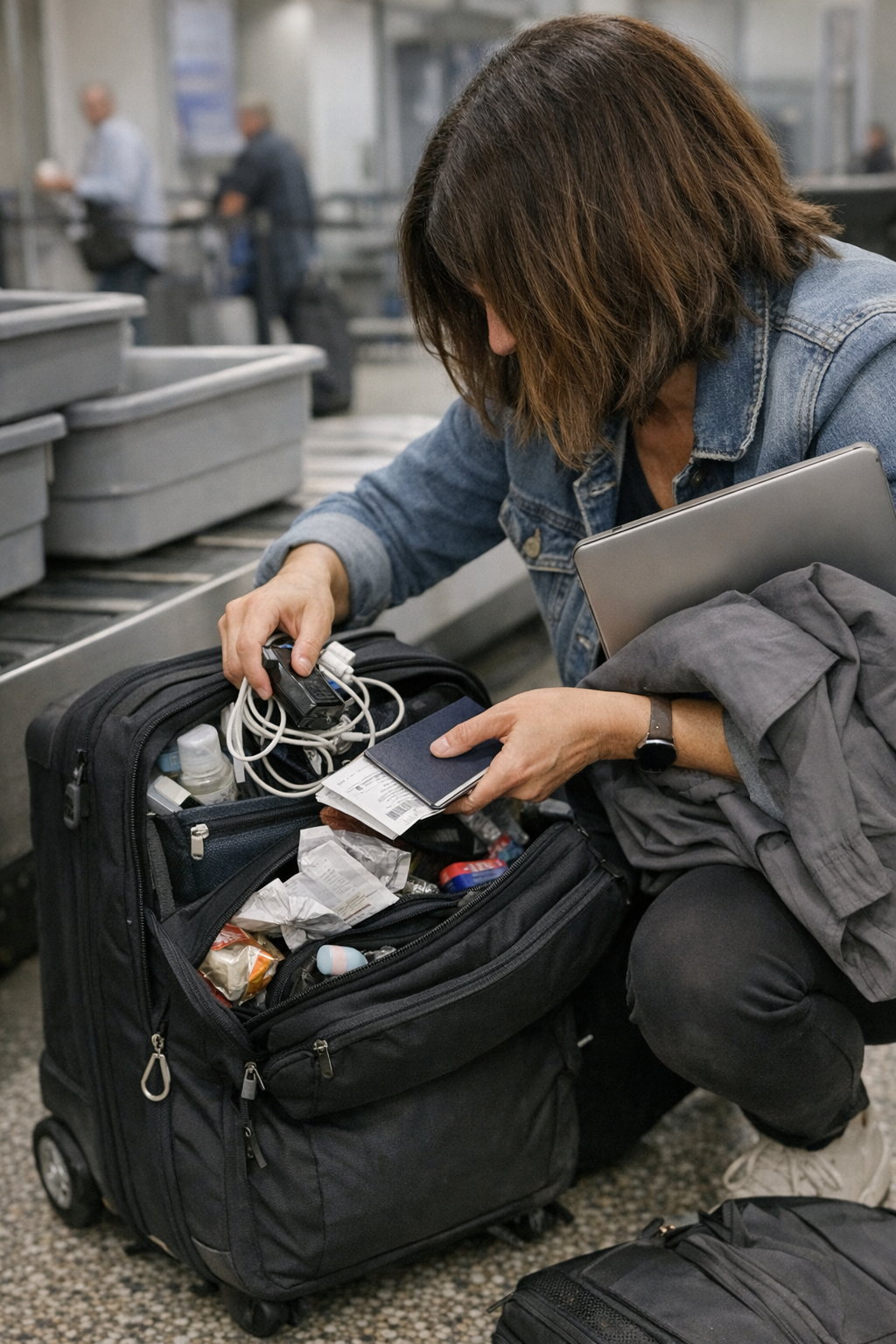
Your carry-on might look perfectly packed on your bed. Walk it through one airport, and the cracks start to show. Zippers catch on pouches that barely fit. Outer pockets bulge with snacks, a power bank, and the “quickly accessible” passport now trapped beneath loose receipts. By the time you reach security, the setup that seemed precise at home demands awkward digging and repacking—right when you need to move fast. Each boarding line, tray scan, and seat entry adds another layer of interruption, so what felt organized turns into a series of repeated slowdowns. If you’ve ever fumbled for a charger at the gate while boarding groups close in, you know: organization on paper often fails in motion.
How Order Breaks Down When Your Bag Starts Moving
No one rehearses airport routines in their living room. At home, every pouch has its place. But the first real test comes at security: is your tech organizer easy to repeatedly open? Does your outer sleeve become a black hole by the second document check, forcing you to sift through things you swore you’d sorted? The calm of home doesn’t survive contact with conveyor belts, moving lines, and unexpected document demands. Each pass exposes flaws your trial packing never caught. Neat doesn’t mean ready.
Worse, these aren’t rare moments. Each stop—security trays, boarding lines, tight seats—reshuffles your setup. Main zippers start to resist. Pouches intended for “just cables” pick up gum wrappers and pens. Five minutes after your first checkpoint, the clean geometry you trusted seems to have doubled its chaos with every quick grab and slow return.
Tiny Friction that Multiplies
You may think: just one overstuffed pocket, just one receipt left loose. But the next time you reach for your boarding pass, a tangle of odds and ends forces a mini repack with impatient travelers behind you. A gateway jam with charger cords isn’t a one-off—it’s the first round of a repeated hassle that eats up every unplanned second.
Why Most Carry-On Setups Don’t Survive Real Airport Life
Checkpoints are brutal truth-tellers.
- The outer pocket spill: You grab for your passport, but chargers, tissues, and pens pour out first. Pressure builds as the line keeps moving. Now you’re hurrying to re-stuff everything, knowing you’ll need that passport again just past the next rope barrier.
- Pouch pile-up: Initial neat stacks slide during the walk to your gate. Suddenly, the zipper path is blocked; you’re forced to dig out a toiletries pouch that wedged itself sideways right as you need to slide a laptop for the tray. Every extra second drags under fluorescent lights.
- Essentials swallowed whole: A compact setup hides a critical item—your headphones, a travel pen, the one cord you need. You’re stuck, hunched over, elbow-to-elbow with strangers, digging into a pouch that seemed organized—until now.
Individually, these look minor. In real use, friction stacks up. After a few cycles, your “smart” packing method starts to block the same essentials you designed it to deliver. Each carry-on shuffle leaves you one step behind the flow of airport life.
Repeat Adjustments—the Real Difference Between Packing and Traveling
The promise that a tidy setup at home will stay efficient is the most expensive illusion in travel. It’s not the initial arrangement that counts; it’s whether your layout supports rapid, one-handed grabs and quick returns, over and over. Travel exposes shortcuts: pouches that make sense on your kitchen table create hidden delays in overhead bins, in-seat cubbies, and at every checkpoint. When you catch yourself hesitating before unzipping for the fourth time, you see the difference between a bag that’s packed neatly and one that’s actually built to be used under pressure.
Small Realignments Prevent Messes from Spreading
The only setups that keep working are the ones you repeatedly reset. Slip the passport straight back after every check. Keep a single cord in a marked pouch, not wherever it fits in the moment. Take thirty seconds before boarding to clear out used tissues or slipped receipts. Otherwise, the first moment you rush, your “system” becomes another catch-all—and your search times double when you least have time.
The Breaking Point Always Comes Mid-Trip
Problems aren’t obvious until something finally snags. Maybe you watch another traveler breeze through security while you’re stuck wrangling a tangled badge or blocked zipper. Maybe you already lost a minute on each return to your seat. By the halfway mark, what “looked” organized at first now interrupts you at every access point, showing the difference between real structure and home trial.
Proving Out What Keeps a Carry-On Useful—Scene by Scene
Switching from a loose pouch system to a segmented, enforced-structure organizer instantly shifted how airport movement felt. Security checks became faster: each item could be pulled in a single move, with nothing sliding or hiding underneath, and the outer pocket, finally able to keep essentials separate, avoided the bulging free-for-all of earlier trips. The most noticeable gain? The time from reclaiming items at the tray to zipping up and moving on dropped by half—not because of more gear, but because the packing setup forced routine, small resets instead of letting friction accumulate.
Track the Signs—Your Setup Is Slipping If…
When you feel your zipper path getting tougher, or document retrieval slows after just a few repeats, take note. The drag always starts with small lapses—items not returned to their spot, chargers mixing with random snacks, a boarding pass “just for a moment” shuffled deep. Quick intervention—putting things back, unmixing pouches—restores the order you relied on, and keeps the flow moving instead of inching along.
The punchline: Real carry-on efficiency is alive to repeated use. Ignore creeping clutter and even the best setup collapses under minor but multiplying slowdowns. Notice the patterns—each new snag, each access point that stalls—and your bag becomes less drag, more built-for-motion. A carry-on that works doesn’t just survive the first checkpoint—it handles every repeated interruption the airport throws at it.
Find carry-on travel structure that lasts at CarryOnSupply.