
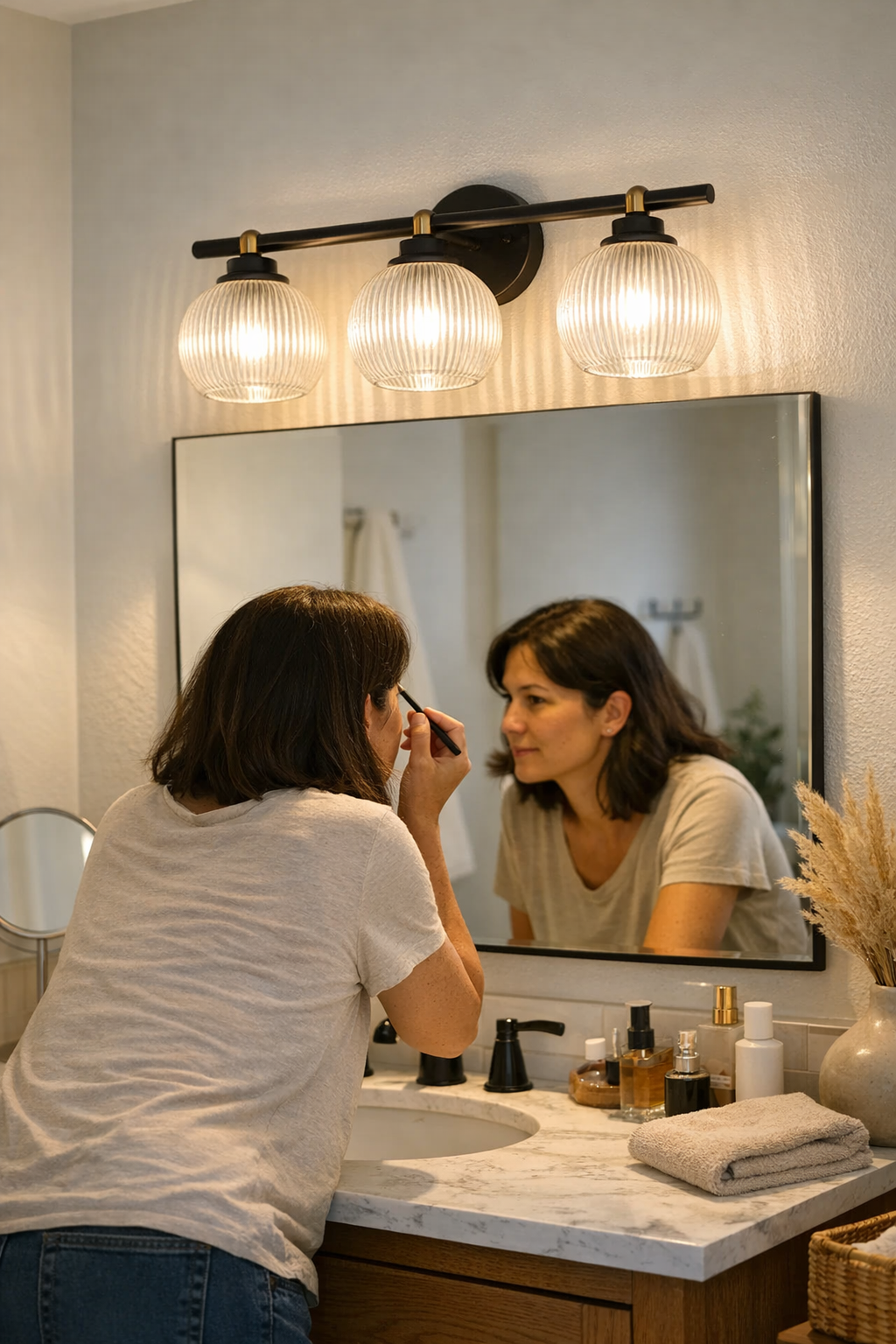
Why does a room that shines at first glance fall apart in real use? You step into a kitchen or bathroom lit by fresh overhead fixtures—everything “looks” bright. But the moment you slice at the counter or check your face in the mirror, the catch becomes obvious: the lighting doesn’t land where you actually need it. A kitchen looks crisp until your hands disappear in your own shadow mid-chop. A bathroom mirror glows, but step in close and one side of your face blurs into darkness, the other caught in glare. General ceiling lights fill the volume but miss the working zone, forcing your routine to bend around the lighting instead of the other way around. These aren’t rare hiccups—they are everyday friction, making ordinary routines feel more annoying, uneven, or slow, no matter how “bright” the room appears.
The Friction Behind “Well-Lit” but Poorly-Working Rooms
Most lighting problems aren’t about wattage—they’re about direction, placement, and what happens after a week of real use. In kitchens, every time you lean over a prep surface, the line between overhead light and your reach creates a shifting shadow. You adjust your stance, tilt the board, or pause to check what’s been missed. In the bathroom, even an upgraded ceiling fixture still leaves one cheek in gloom once you step closer, making detailed routines—shaving, skin care, makeup—awkward and slow.
The pattern repeats in laundry rooms and work corners. Spaces seem bright until you spot the patchy shadows creeping along the back wall or across the folding surface. Suddenly you’re squinting for stains or tracing a stubborn crease that only shows in the right angle. The consequence is always the same: extra moves, uncertain details, small moments lost to chasing clarity. It’s not just distraction; it’s time and effort eaten up by a setup that calls itself finished but keeps falling short where routines actually happen.
How Fixed Task Lighting Delivers Real Clarity
Task lighting changes the entire dynamic by putting light exactly where it counts. Under-cabinet strips, wall sconces, or vertical mirrors-side fixtures don’t just add brightness; they cure the shadow lines and glare points that slow you down. With focused task light aimed at the true work zone, you stop strategizing around the gloom and start using your space as intended.
What Actually Shifts Day to Day?
- Cooking and prepping: Every inch of your counter is evenly lit. No more awkward reach, no more food hiding in dim patches or hands swallowed by your own silhouette. Tasks move faster because visibility stops being a variable.
- Mirror routines: Side or wraparound vanity lights balance your reflection, so every detail is there without squinting for contrast or fighting a line of glare. You lean in and see what’s actually there first try—no spins or double-checks required.
- Laundry, workbenches, utility spaces: Directed lighting over folding, sorting, or cleaning spots eliminates the dull fade that slows you down. Stains and creases are visible the first pass, not only after a second hunt under a brighter bulb.
When Overhead “Brightness” Backfires
Too often, the instinct is to upgrade to “brighter” or larger ceiling fixtures, thinking the problem is total illumination. But high-wattage flush and semi-flush mounts flood the room while leaving the real work zones largely unchanged—or worse, produce more glare and sharper shadow boundaries. Mirrors stay uneven, corners remain dim, and work surfaces depend on your angle not to fall into a blind spot. The more you chase brightness from the ceiling alone, the more you notice yourself side-stepping, tilting, or hunting for the actionable patch of light every time you need to focus.
Spotting the Red Flags
- You habitually lean or twist to catch extra light at counters, sinks, or mirrors.
- Shadows jump across your hands and tools with nearly every movement.
- Cabinet edges, corners, or one side of a hallway never reach full clarity, even after swapping bulbs.
- Half your face drops into murk at the mirror, despite the room looking “well-lit” overall.
These patterns aren’t quirks—they’re direct signals your current setup is outmatched by your real routines.
What Steady, Directed Task Lights Actually Change
Replacing a single stretch of overhead lighting with a focused under-cabinet or vanity fixture can change daily workflow overnight. By sending clear, shadow-free coverage right onto the work surface or mirror edge, routines become faster and noticeably less strained. The task stops being dictated by glare, and the room finally works at your pace. Over sink or stair, a properly placed sconce or flush-mount keeps every step in sight, each fold and cut straightforward—no more pause, tilt, or squint required.
Even hallway or stair turns change: well-placed ceiling or wall lights can eliminate the fading edge, preventing one side from falling away as you pass in low light. It’s not about visual drama or decorative appeal—it’s about the space actually holding up after dozens of real repetitions, not just the first impression.
Pinpointing Friction: A Practical Test
In any task zone, mark where the shadow or glare always breaks your flow—the line where overhead light consistently fails. That’s your target for fixed, directional lighting: an under-cabinet run, an angled wall sconce, or a vanity bar precisely placed to catch your reflection without diffusing into the ceiling. Skip the urge to blanket the whole room in overhead glow; solve for the spots where friction repeats. That’s where task lighting matters most and pays off every day.
The Real Price of Shadow and Glare
Every ignored patch of shadow or slice of glare quietly increases your daily load. The fight for visibility wears you down, even if you don’t notice at first—lost minutes adding up as you check for missed spots, redo tasks, or simply move slower to avoid mistakes. General ceiling light may flatter the room, but when the gear is wrong, routines stay clumsy and repetitive. Task lighting isn’t a luxury or a visual upgrade for showrooms—it’s the fix that recovers control, pace, and reliability after months of repeated use.
Leaving a room “bright” but structurally mismatched means you trade the space’s full comfort for a string of minor slowdowns, double-work, and perpetual second-guessing. Get the layers and the direction right, and suddenly your routines don’t just run—they snap back into focus, again and again, without you even noticing.
Explore practical indoor lighting solutions at LightHelper.