
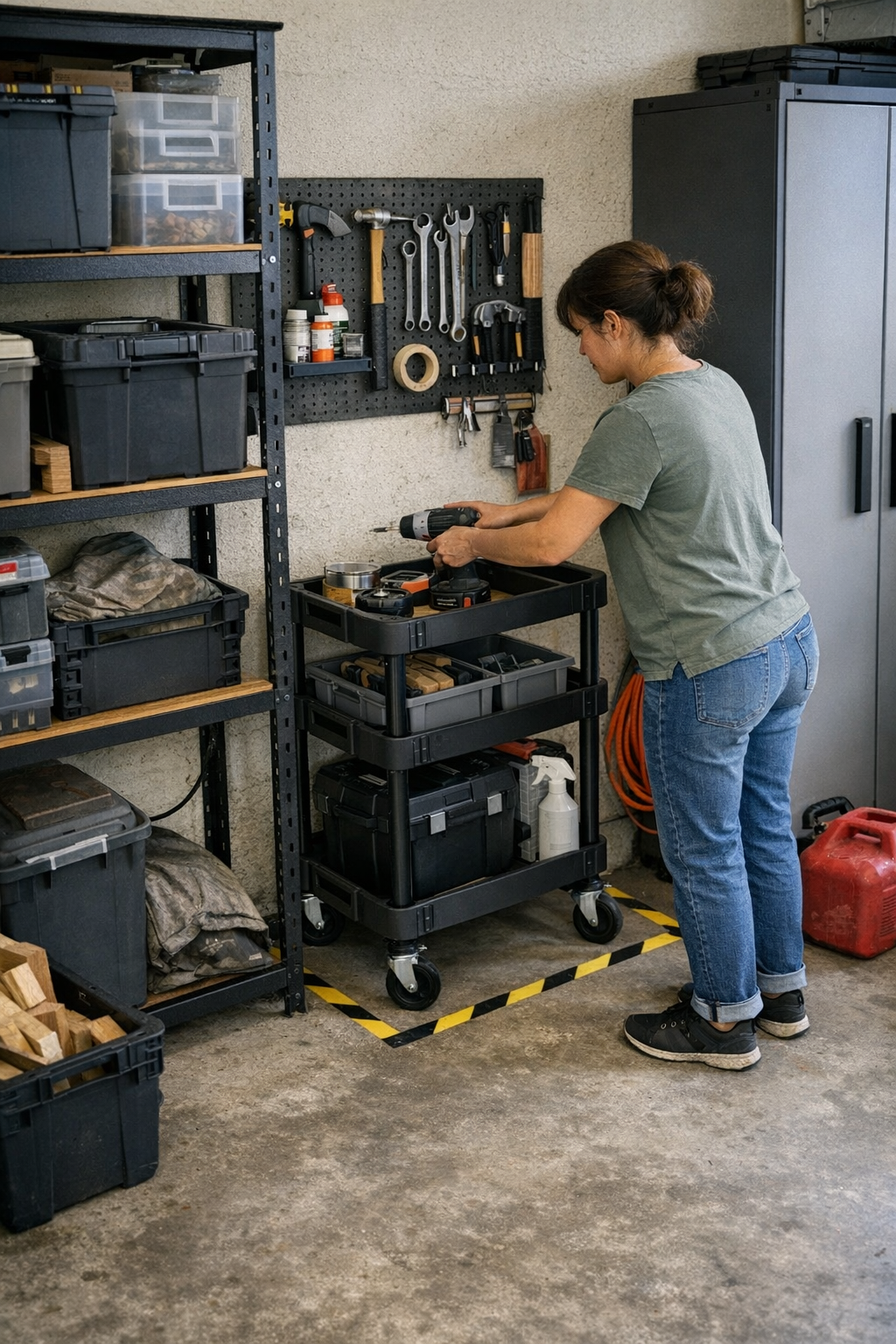
On the day you first roll in a mobile cart, the promise is vivid: flexible storage, instant access, a tool that moves in step with real projects—not just catalog photo shoots. But within a week, reality creeps in. In the garage after a Thursday cleanup, or the workshop in the middle of a project, that “flexible” cart is right there in your way—blocking your one open pathway to the shelf, wedged where you need to walk, or drifting up against the wall so nothing else fits. The upgrade becomes a hassle: a shape-shifting obstruction that follows you around, quietly collecting clutter instead of clearing it.
Mobility: The Everyday Hassle Hiding in Plain Sight
Every setup starts with good intentions. You find the perfect spot for the cart—lined up by the workbench, everything within easy reach. For a day or two, it even looks sharp. But then the small hassles pile up. You roll the cart “just for a second” to grab the extension cord, then again to get the cabinet open, then again because it’s blocking the outlet you rely on for chargers. Every move is a detour—one more tug, one more pivot. Suddenly, instead of smooth flow, you’re squeezing past a handle or navigating a tight bend that didn’t exist before the cart arrived.
What looked modular and open turns into a puzzle with changing pieces. One day the cart blocks the bin where you keep seasonal supplies; the next day, it’s cluttering the only open space you use for large projects. The result? Floor gets crowded, wall space goes to waste, and every “quick reset” becomes a round of reshuffling—moving the cart from trouble spot to trouble spot, with no clear resting place.
The Slow Creep of Cart Drift
It’s rarely an obvious disaster. Instead, the problem builds through the week: The cart never quite returns to the “right” place after you use it. A few inches off one day, a bit further the next—before long, it’s stuck in a dead corner collecting drop cloths, cables, and loose hardware. The area behind the wheels turns into a drop zone for whatever you don’t want to deal with now. Wall hooks for your most-used tools? Suddenly harder to reach. Shelves meant to stay open are partially blocked. You reach awkwardly around the cart more and more, while the “flexible” storage quietly becomes the messiest part of your setup.
Instead of solving clutter, the cart invites stuff to accumulate: a stack of project odds on the lower shelf, bags of parts you forget to put away, gloves draped over the handle. Movement through the area gets choppy. The more you try to “flex” the cart into new spots, the more the rest of your workspace suffers. What you gain in theoretical mobility, you lose in clear routes and functional access.
Why Assigning a Cart “Home” Changes Everything
More shelves or fancy organizers aren’t the answer. The real fix is simple: give the cart an unmistakable home base. In a busy garage, all it took was two strips of high-vis tape in a quiet corner near the main bench. From then on, the cart parked in the same spot every time—no wandering, no crowding, no “where does this go now?” One glance told anyone using the space exactly where to return the cart after grabbing tools, and the habit stuck after a few uses.
With a visible, fixed dock, resets speed up. Roll the cart back to its taped rectangle, the walking path and cabinet doors stay clear. Power outlets aren’t blocked, and that critical zone behind the cart doesn’t turn into a new landing pad for overflow. You don’t have to think about where the cart belongs—the space tells you, and so the daily routine runs smoother. Even a subtle boundary holds back the chaos, anchoring movement and keeping wall and floor space as open as the layout actually needs.
Inside a Real Reset: The Before and After
Picture a weekend cleanup. You finish trimming hedges, stow supplies, wipe down tools. Without a set cart location, the final step is a vague round of musical chairs—push the cart here, then there, just trying not to block the door or scrape the car. By the time you’re done, it’s crammed into an awkward “good enough” niche, blocking one or two things you’ll need by Monday. Tools linger in the cart for days simply because returning them means maneuvering around a lopsided, out-of-place cart.
Introduce a fixed parking zone, and the reset becomes almost automatic. The cart slides into its marked space—never blocking traffic, always giving you full use of walls and floor. Within a week, the routine is easier: park, unload, move on. No wasted minutes hunting for an open patch. No accidental buildup in corners. The space stays clear for spontaneous projects and the inevitable “I need this out, right now” moments.
Small Adjustments That Actually Stick
The beauty of a cart home is in how the benefit builds. It doesn’t require a perfect cart or a brand-new layout. What you’re preserving is not just order, but usable space: overflow drops off, cabinet handles are accessible, and the sense that your setup “almost works” gives way to routines that actually run cleanly. You spend more time working, less time shuffling, and fewer moments annoyed at what “should” be easy. And the fix is visible—a humble strip of tape is all it takes to reset the habit and keep your workspace working for you, not against you.
The Payoff: Flow Returns, Cart Hassle Disappears
After a month, trying to work with a wandering cart feels unimaginable. The open floor stays open. Tools come off the wall without an obstacle in the way. The cart is no longer a magnet for overflow or a giant trip hazard. Instead, it’s synced to your pattern: always where you expect, never in the way, always supporting—not sabotaging—your daily jobs. The routine gets easier not because you bought another storage solution, but because you anchored the one you have where it belongs.
This isn’t a showroom transformation. It’s a real, repeatable improvement—the kind that makes everything else in your setup finally fit together.