
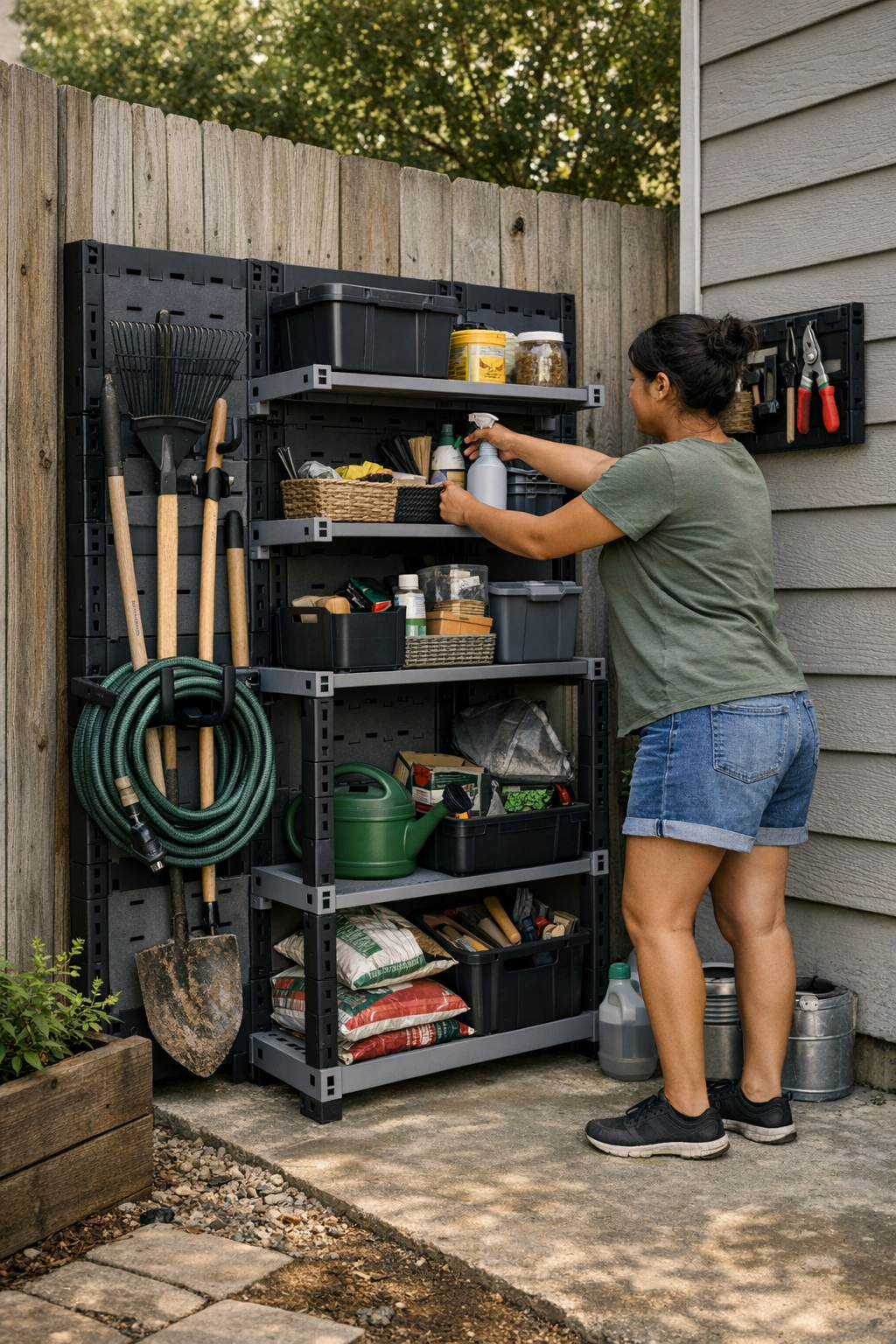
Outdoor storage is rarely judged by how it looks after a weekend clean-out; it’s exposed by what happens three hurried days later. Those neat lines and empty pathways vanish the first time you rush in midweek—elbowing past a stack of gear, shoving a half-damp hose aside, or upending a box searching for pruners you just used. When setups turn every fast yard job into a sidestep-and-dodge routine, it’s clear: good storage isn’t about day-one order. It’s about surviving constant, careless, repeated use without turning into an obstacle course.
When “Organized” Collapses Under Real Routines
The honeymoon lasts about 48 hours. Sheds and racks look great right after installation: each tool slotted, nothing crowding the edges. But normal life doesn’t run on resets. Maybe you come home late, toss the sprayer “just for tonight,” or nudge a cooler out of the way because your hands are full. One shortcut leads to the next—a coil of rope dumped by the door, a forgotten bucket left by the mower. Suddenly, that intentional lineup becomes an awkward jumble, and resetting it means moving half the pile just to put back one thing.
The difference shows in every rushed grab-and-go. If you can’t pull a trowel or stash shears without shifting bags or stepping over clutter, your setup is working against you. Overflow creeps outward—a bag sagging into a walkway, a tool propped against the fence, bins wedged into corners. Instead of a working zone, you’re tiptoeing through clusters of nearly-right storage, losing time and patience every lap.
The Gap Between “Same Size” Setups
It’s easy to think any side-yard shed or wall rack will handle the churn. But actual use tells the difference—especially when you need something buried at the bottom or need to return gear in a hurry:
- The deep floor box: Looks generous on day one. But a week later, long-handled tools sink under coolers, sprayers wedge at odd angles, and every buried thing means a quick avalanche onto the patio. What began as organized storage gradually turns into a heap right at your feet.
- The zone-labeled wall panel: Each handle has a marked slot, bins hold stray gloves, and every missing rake is obvious. Nothing’s hiding. Returning or grabbing something is a one-step move, not a rummage. You spot when overflow tries to take root—catching a fallen trowel or a stray bag before the pile rebuilds. It doesn’t magically hold more. It just works harder—allowing repeated, careless returns without losing the thread of order.
This isn’t abstract. The test shows up by week’s end: in one corner, the box margin creeps outward, tools touch your ankles, and the path narrows. In the other, things slip back into place almost by accident because there are fewer puzzles and fewer opportunities to stall out the system.
How Narrow Zones Turn into Endless Obstacles
Side yards and patio edges promise walkable space—right up until a stray trimmer slides from its hook or a tangled extension cord sags into your feet. That “clear path” becomes choked by one folding chair, then two, then bags and loose buckets stuck wherever an open patch appeared. At first, you move things “just for the moment.” Days pass, new gear lands, and before you know it, opening the shed involves shuffling a ladder, weaving around a propped rake, or dragging a bin out by the handle because nothing slides anymore.
In these tight passages, storage that only maximizes capacity quickly backfires. Every new item blocks the last, and even basic movement—grabbing a mower, hauling out the hose—requires a two-step shuffle. If your gear keeps blocking your own way, the setup is “full” only in the sense that it now controls your route, not your tools.
Incremental Fixes That Actually Stick
Resets don’t require a full rebuild. After tripping for weeks over a box that regularly spilled tools into my only side path, I hung a segmented anchor panel three inches higher on the fence. Suddenly, rain shovels finally had vertical clearance; overflow buckets could hang above the traffic line instead of blocking it. Assigning “home stretches” for each tool—so they naturally slotted into place—reduced the quiet urge to just drop things in the closest empty corner.
The biggest shift? I stopped dreading half-resets. Returning just one lopper mid-task took a quick hook, not a balancing act. Clutter was visible before it grew—so I could catch a problem on Tuesday instead of spending every weekend on a full reset. What changed wasn’t the storage “volume”—it was the layout’s ability to handle the churn without decaying into a mess.
When More Space Stops Helping
More square footage won’t save a setup that can’t manage movement. If every trip through your storage means squeezing around junk or stacking gear on the floor, a bigger shed just means a bigger mess to move each time. Floor space and wall space only work when both allow fast, direct access—no detours, no silent pile-ups. Modular panels and adjust-as-you-need hooks let you nudge zones around as seasons change, instead of locking dead corners into every layout.
The best setups expect “routine messes”—muddy boots, rained-on gloves, supply runs that leave an extra bag behind. Real improvement comes from layouts that let you spot and clear trouble early—so your walkways stay open and your gear flows through the week without demanding a restart.
Lessons From Messy, Real-World Use
- Make every spot obvious—even if it means leaving wall space open. The clearest setups mark lanes or color-code hooks, so missing tools are glaring and returns need zero guesswork.
- Defend movement space. If gear slides into your steps, lift it higher or shift it to the sides—racks should protect traffic lines, not become new obstacles.
- Don’t let “efficient stacking” trap you. Wall storage that turns into a high-rise of handles or a jigsaw of bins just speeds up the next bottleneck. Leave air between anchors for honest single-move access.
- Resets are inevitable. But make them a one-minute fix, not a Saturday project. The strongest layouts don’t prevent all mess—they just shrink the fallout and make the reset loop nearly automatic.
Where Real Storage Proves Itself
No shed or rack fails on day one—they all shine with a fresh sweep. But actual routines erode the difference between a temporary lineup and a working layout. Systems that keep walking room clear and tool returns frictionless resist collapse week after week. The setups you don’t have to think about—the ones you can use half-tired, one-handed, mid-rush—are the ones worth keeping.
Outdoor storage that matches how you actually move, drop, and retrieve gear lets you get through any chore without the space biting back. That’s the difference between storage that looks right and storage you barely notice—because it just works.
Discover practical outdoor storage and zone systems at TidyYard