
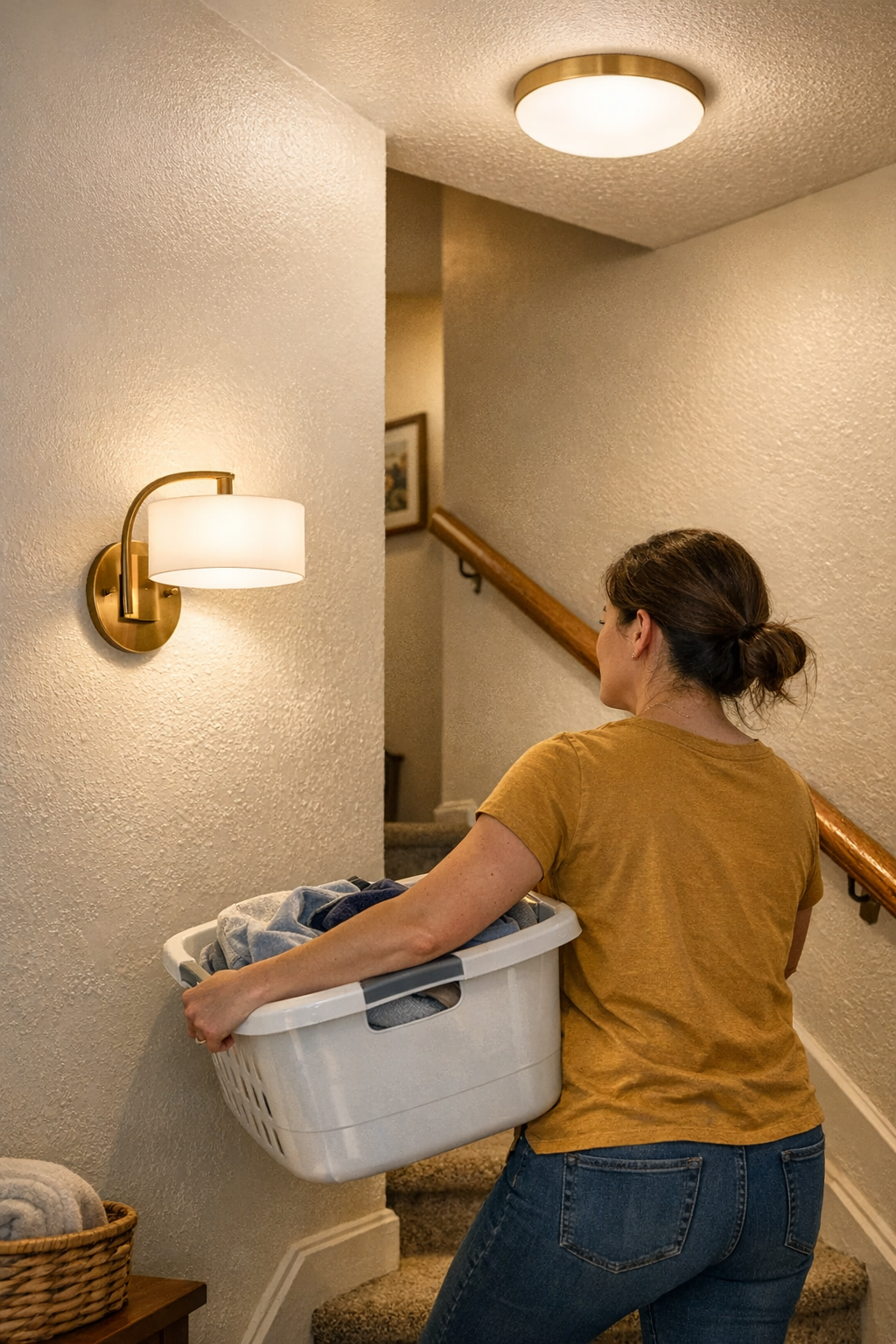
Most homes “look bright” on paper—until daily routines reveal the truth: You’re halfway through the hallway or rounding the stair turn, and a stretch of flooring simply disappears into shadow. You fumble for the rail, slow down at the bend, or tilt the laundry basket for a better angle. The ceiling light boasts plenty of lumens, but one reach or step off-center, and surfaces turn unpredictable. The problem isn’t just mood—it’s practical: poorly placed or single-point lighting quietly stalls everything from moving laundry to finding the edge of a counter. The right fixture isn’t just what fills the room with glow; it’s what makes each repeated step, grab, or glance obvious and effortless. Most routines break down not from lack of light but from light falling in the wrong place at the wrong moment.
Why “Looks Bright” Doesn’t Mean “Works Right”
Traditional flush mount and semi-flush ceiling fixtures promise evenness. In reality, they often cast dramatic shadows right where daily movement demands clarity—a stair tread, hallway crossing, laundry corner, or face in the mirror. The “impressive glow” overhead can leave whole zones unreliable the minute you cross into them. You’ll see it in scenes like:
- Climbing the stairs, the first few steps are visible, then a pocket of shadow breaks your pace at the curve.
- Hallways look lit, yet the threshold near the door or wall edge fades out, forcing anyone carrying groceries or a hamper to hesitate or steady themselves.
- In the laundry room, you lean forward, and your own shadow darkens the washer’s edge, obscuring spills or stray buttons.
- At the bathroom mirror, top-down light carves deep face shadows, so you have to crane for an even reflection or miss small details during your routine.
These aren’t minor quirks—they’re repeated friction points that slow you down, chip away at your confidence in the space, and raise the risk of missing spills, tripping at turns, or missing the small hazard you meant to catch early.
Shadow, Glare, and Broken Routines: How Lighting Friction Builds Up
Relying on a single “bright” fixture means improvising around its failings: pausing at a dark stair mid-turn, blinking through glare above the bathroom mirror, or making multiple passes across the laundry counter because the far edge remains in partial darkness. Movement that should be automatic turns tentative. Glare forces your eyes to recalibrate; shadows hide the very surfaces you need. The result isn’t dramatic—but it adds friction to every trip, every reach, and each repeated task. Over time, the invisible costs stack up as slowdowns and small slips you never needed.
The “Three Points of Contact” Indoor Lighting Method
Borrowing from the principle of keeping three points of physical contact on stairs, three points of lighting contact means using a combination of ceilings, walls, and task fixtures. The aim: every key surface, stair, mirror, work area, and turn point stays both visible and free from harsh contrast—no dark wedges, no glare, no missing edge when you move.
Ceiling Lights: The Wide Sweep
Flush and panel-style ceiling lights deliver the field of general brightness, but as soon as the room bends, narrows, or the cabinets create overhangs, the single-source setup starts missing patches. In long corridors or L-shaped spaces, you might notice one wall clear while another side loses detail, especially away from the dead center. Ceiling fixtures set the baseline but rarely finish the job on their own.
Wall Lighting: Closing the Gaps
Wall sconces and hardwired wall lights let you position light exactly where overhead coverage fails. For example, putting a sconce just before a stairway curve eliminates the unseen edge that causes hesitation. Eye-level wall lights in hallways or corners polish off shadow lines and let your vision “track” forward naturally, reducing the urge to slow down or scan with a phone flashlight. You see where you intend to step—without second-guessing.
Task Fixtures: Precision Where You Need It
Task-focused and under-cabinet lighting exists to make sure you’re not working against your own shadow. Mounting a strip beneath kitchen cabinets, above the washer, or beside the vanity mirror switches the surface from a guessing game to fully visible. This means finding lost buttons, checking for stains, or shaving in even light actually becomes possible, instead of improvising with poor angles and missed spots. The difference: it fixes what matters most, right where your hands, face, or work zone are actually in use.
How Real-World Improvements Play Out Over Time
After a week, the effects are plain: the stair sconce kills the urge to hesitate at the turn; the under-cabinet light in the laundry means missed change and detergent smears become obvious before you close the lid. Bathroom mirrors stop producing harsh “face halves”—making routines faster and less awkward. The gain isn’t just brightness or aesthetics, but reliable, interruption-free paths through daily spaces. The lighting now serves your routine, not the other way around.
Two Small Fixes With Outsize Impact
- Keep pausing in the same spot? A well-placed wall sconce there may outperform any “brighter” bulb overhead—placement beats power every time.
- Edge of your workspace always dim? Drop a task or under-cabinet light exactly where you lose visibility. One addition can free you from years of tiny, repeated workarounds.
Most adjustments are simple add-ons or swaps—no redesign needed if you target where you actually move and work, not just where the old plan said the ceiling bulb belonged.
The Shift from Visual Brightness to Practical Clarity
Piling up brightness in a single fixture only goes so far—true comfort means layering light where it fits the task, angle, and real texture of your routines. Until wall lights or task lamps fill in the weak spots, your home may look “done” yet still frustrate you in motion. The three-contact method turns spaces from visually impressive to genuinely usable. When critical steps, edges, and surfaces get their share of real, directed light, your path through the day actually becomes easier—even when your hands are full or focus is elsewhere.
Find lighting solutions for ceilings, walls, and task surfaces at LightHelper.