
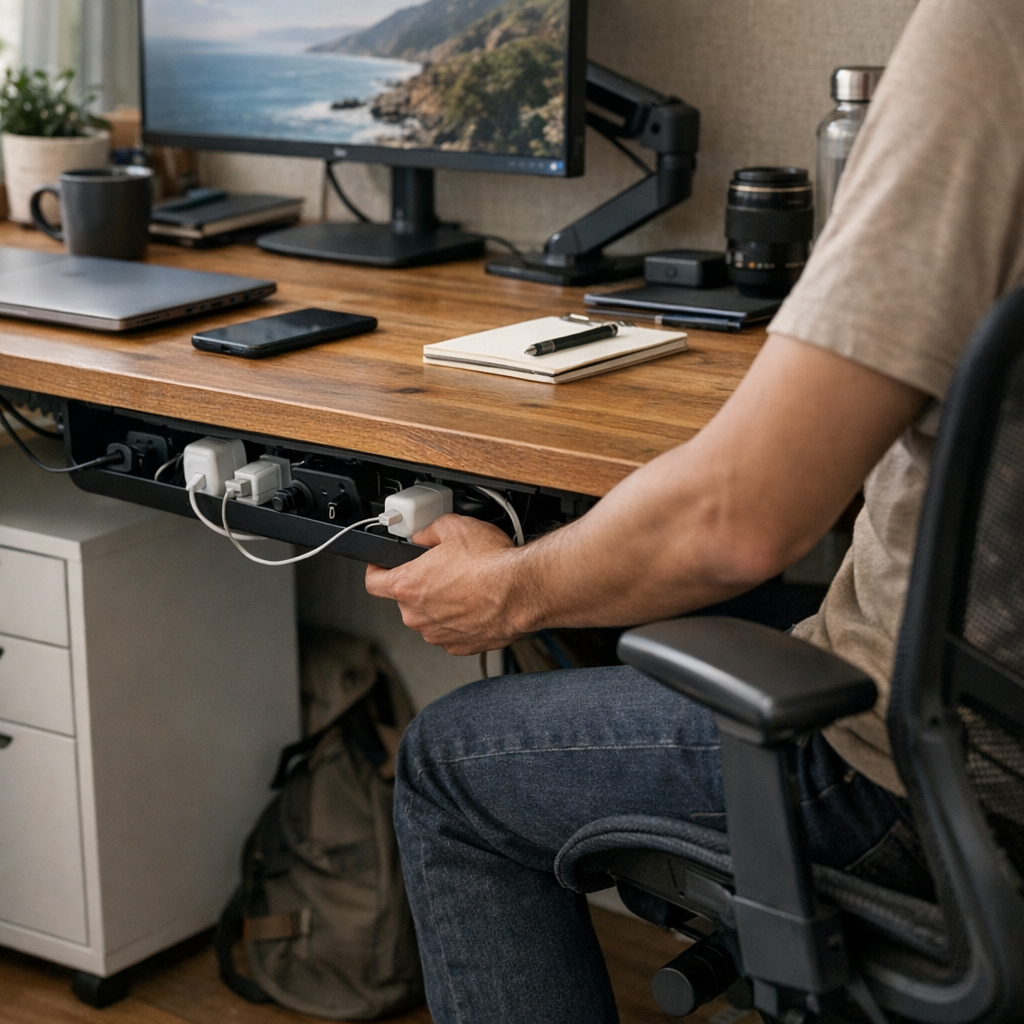
The neatest-looking desk can still bait you into a daily tangle. Try swapping one device, and the “organized” outlet corner turns on you: cables drag out, adapters bunch up under your feet, and that last bit of desk space you cleared is suddenly lost to another sprawl. Even with every cord tucked, every strip hidden, you’re still kneeling under the desk mid-task—searching for a plug, bumping a drawer, or yanking a whole cable mess loose just to reach your charger. A tidy setup lures you in, but in the crush of real work, the outlet corner is where order keeps eroding, and every fix seems to unravel faster than the last. It isn’t just a workspace issue—it’s the bottleneck the rest of the desk can’t ignore.
Why tidy-looking solutions keep getting in the way
Looks clean. Works awkward. That flush cable box or sleek tray delivers five minutes of calm—cables tucked out of sight, adapters masked, the illusion of control restored. But the next device swap breaks the spell: to trade one charger for another, you need to slide trays, pop lids, or wrestle coiled cords out of their slot. Closed organizers hide mess, but turn every plug-in into a thumb-wrestling match. Where you wanted friction-free access, you’ve built a micro-maze—especially if device changes happen more than once a day.
Actual workflow exposes the trap: set a notebook down, reach to plug your phone, move a monitor—within minutes, a “clean” corner holds you up. Cables resurface, plug swaps turn into little battles, and you break working rhythm just to reach power. A spotless look forces extra motions—none of them visible until you’re in the middle of a real task.
The repeat-realities that reveal where setups fall short
Hidden clutter, new friction. Fast-paced work punishes bad decisions fast. Let’s say it’s Monday: you dock your laptop, unfurl the monitor cord, go to charge your phone, then realize the ring light needs in. Suddenly, the box “organizing” your cables wants you to lift it, coax cords out, and—more often than not—it never sits back the same. Every mid-session tweak—new charger, loose cord, last-second accessory—becomes a clumsy reset just to maintain basic function.
The cost isn’t mere seconds. Each forced reach, dragged drawer, or clattering adapter wastes focus. Multiply that over a week: you start skipping device swaps to avoid the friction, letting clutter win back space inch by inch. The so-called efficient station is now quietly slowing you down—less of an upgrade, more of an invisible anchor on your routine.
Making the outlet corner invisible—and easy
The real improvement isn’t about hiding the problem—it’s about removing friction. Swap the closed cable box for a slim open-access tray, fixed below or behind the desk edge. Cords run clear in a single untangled path: out of sight from above, but one-reach accessible. Need a new device? Slide the plug in—nothing to lift, fish out, or push aside. Cables don’t fall or catch. No two-handed resets, no awkward fishing mid-task. Everyday plug-ins collapse from a sequence of steps to a single, smooth action.
This shift changes behavior: you no longer hesitate to trade chargers, refresh a connection, or add another cable for a pop-up task. The outlet corner fades—there when you need it, backgrounded when you don’t. Floor clutter vanishes, under-desk tangles are gone, and your line of sight stays clean without any corner drama creeping back into each session.
Everyday examples of the hidden difference
Morning setups get frictionless. Walk in, dock your laptop, stretch the cable over—there’s no pile to dodge or cable to fish up from behind a drawer. The first plug-in of the day feels like pressing a switch, not untangling a net.
Midday device changes don’t kill momentum. Snap from a call to a tablet session—charge ports are always in reach, no box lid to fight or charger to hunt down. You maintain flow between roles instead of resetting your space for each tiny transition.
Shared desks avoid compounding mess. Where people swap stations all day, open trays block the rise of cable nests and dangling adapters. Every user finds their port instantly. The cleanup before closing is a two-second sweep, not a five-minute cable sort.
Quick FAQ: Open-access outlet corners
How do I keep my outlet corner tidy without losing easy access?
Install a shallow, open cable tray beneath or behind your work surface. Position it where you reach forward—not below knee level—so cables stay hidden when seated, but can still move freely. This cuts floor tangles and ends the daily ritual of popping lids, shifting drawers, or ducking under the desk.
Why do sealed cable boxes keep snapping back to messy?
Because every hookup disrupts the setup. Closed boxes only hold their form when rarely touched. With daily swaps, wires stick out, lids get left half-off, and the whole shell traps yesterday’s chaos—putting the tangle out of sight, but never out of life.
What’s the most common outlet storage mistake?
Over-spec’d, under-used organizers: deep or lidded boxes in the busiest zones. You trade a row of cables for a barrier you have to navigate every day. The true upgrade is direct, nearly invisible routing—accessible but protected, hidden but not buried.
The outlet corner that stays quiet, session after session
The best desk setups don’t just snap into place for a photo—they stay frictionless when the real work starts. An open cable tray keeps the corner silent and low-maintenance, so resets happen in a blink and no cord pile creeps across your feet by Friday. The truly lasting difference isn’t how organized it looks, but how rarely you have to think about it at all. When the outlet area stops demanding your attention, the desk supports you rather than sets a trap—whether you share your space or work alone, the payoff is a routine that finally matches what you expected from a “well-organized” setup.