
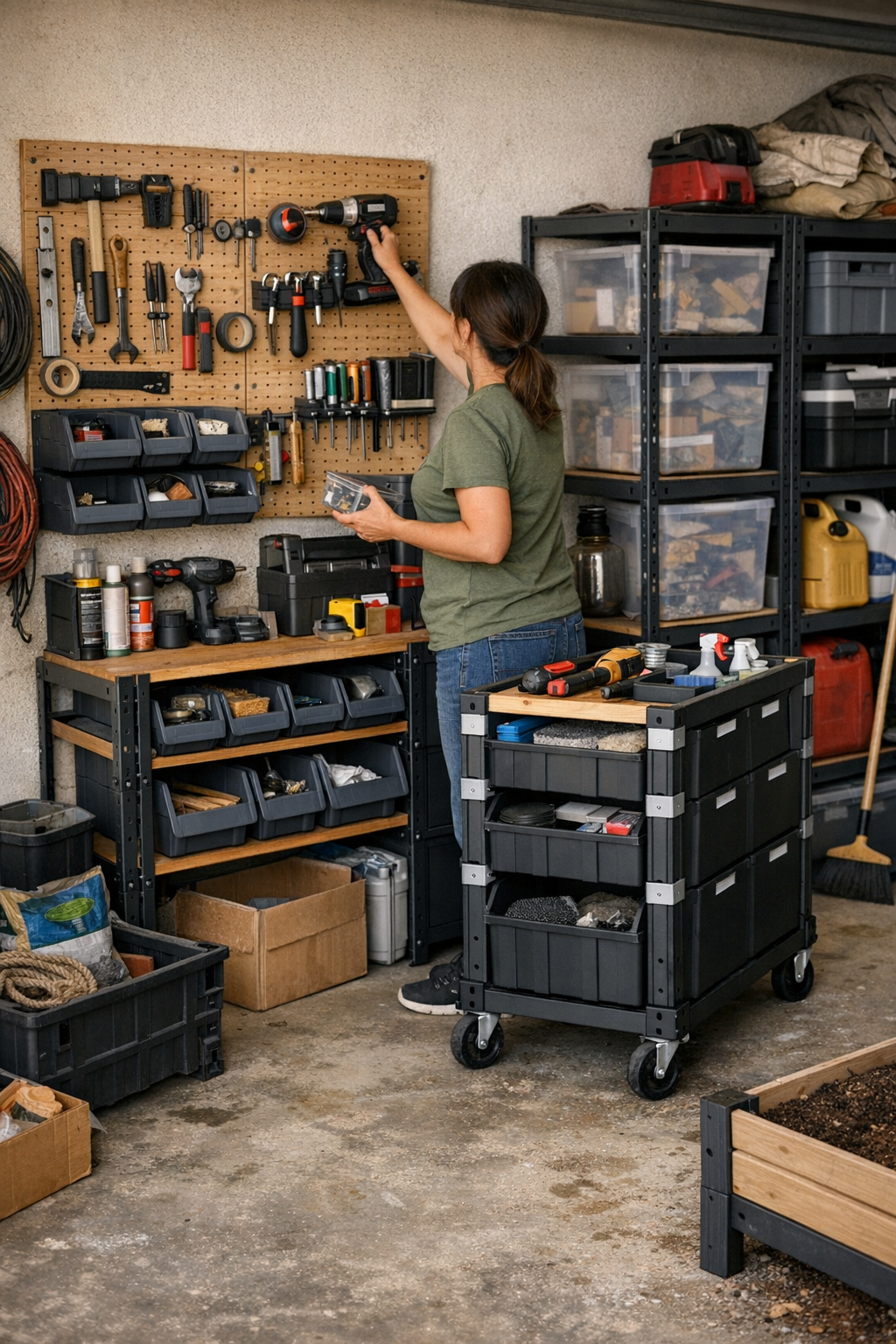
Most setups start with ambition—and then grind down under real use. Stand in any freshly organized garage or workshop and you’ll see the classic first-day layout: walls lined with shelving, carts snug against benches, storage bins stacked high, every tool slotted neatly onto rails or pegboards. Everything promises order. But clean lines and clever modules only last until reality hits. A month later, and the smooth setup you were proud of feels less like a system, more like a slow-motion obstacle course. The truth is, organization isn’t tested by how it looks at the start, but by how it survives the messiness of regular routine—and where it starts to get in your way.
How “Clever” Turns Into Clumsy—Fast
You rarely see the breakdown as it starts. The cart that was perfectly tucked beside the workbench? Now you’re nudging it out of your walking lane for the third time this week. That streamlined shelf by the back door hosts a sprawl of items that never found a better spot. Pegboards morph from sharp tool displays into gridlocked tangles—daily-use essentials squeezed together so tightly that pulling out a screwdriver means prying free a dozen other things first. These aren’t minimal setbacks. It’s the steady friction that comes from layouts built to impress, not built for motion.
If you’re sidestepping around bins that “fit” but block walkways, or rolling carts aside just to uncover your air compressor, you’re losing minutes and momentum—sometimes without even realizing it. A setup designed for visual appeal is one thing; a layout that makes every return and reach feel seamless is something else entirely.
Spot the Warning Signs in Your Own Space
Most setups don’t fail loudly. The breakdown comes in little glances and repeated workarounds:
- You drag the same mobile cart away from the door every time you need to get through, even though it was supposed to be “out of the way.”
- Overflow builds up at the end of your shelving run—an awkward dead zone that keeps attracting odds and ends you don’t want to deal with mid-task.
- Hooks and bins are so crowded that stowing a tool means rearranging the entire row, so you start piling items wherever there’s space.
- The shadowed corner behind the cabinet is basically a black hole for stray hardware that you only rediscover when you finally do a deep clean.
These friction points reveal the real dividing line: It’s not whether you have “enough” storage, but whether access and reset flow actually match how you move and work. Until the layout fits the way you return, reach, and cycle through your routines, the system fights you more than it helps you.
How Real Routines Expose Design Flaws
Sure, a dense pegboard covered edge-to-edge looks efficient. But work a few sessions and you’ll notice the annoyance: unhooking a wrench to get to a hammer, or dancing around clutter building at the bottom. Even spacing—just a couple extra inches—on heavily used hooks can make or break a routine. That’s not a design flourish; that’s the difference between grabbing and griping.
And carts—especially the “modular, mobile” kind—can be the worst offenders. On paper, they glide between projects. In reality, they hover awkwardly in high-traffic areas, drifting into prime walking lanes or settling somewhere that blocks your best return route. By the time you catch yourself parking and re-parking it, you realize: its supposed flexibility just slowed you down.
Even static wall shelving plays tricks. Spaces that seem generous at setup reveal themselves as dumping grounds. Zones far from your main table attract overflow, while the most convenient real estate crowds up, slowing you down every time you reset for the next job.
Reality Check: What Happened in My Own Garage
Take my last supposedly “final” overhaul. On day one, everything sparkled. By week three, my driver bits were buried—either tangled under clamps or occupying a shelf an arm’s length away from where I actually needed them. The rolling cart developed a habit of sliding into my main aisle, quietly tripping up my routine. Even when shelves were technically available, tools started collecting elsewhere because the return flow was blocked or the access just felt awkward. The result wasn’t chaos, but a persistent, low-level frustration that undercut every project.
Tweaks That Turned Setup Into a System
Fixing it didn’t mean buying new organizers. The watershed change came from confronting the daily movement habits my initial plan ignored. I cleared a section of pegboard—shoulder height, one hook deep—and gave it to the tools I grab every session. Hooks got more space. No more tangles, no more knots. Each tool could go back without a thought.
I repositioned the mobile cart just enough to stop it from drifting into the main walkway. Maybe it looked a bit less “optimized,” but for the first time, gear wasn’t in the way—resetting the space felt quick again. The fix wasn’t radical. It was just a matter of seeing zones as living spaces, not photo setups: who needs access, where does overflow creep in, what little blockages keep piling up? Small tweaks—scaling back, sliding a cart a foot left, clearing one overstuffed shelf—did more for my workflow than any new modular system ever did.
Real Test: Walk Your Flow, Not Just Your Layout
Before declaring any setup done, walk through your full routine several times. Where do you trip up? Which bins get moved most, which tools collect out of place, and what makes you double back or hesitate? Often, it’s not that you’re missing an organizer—it’s that a single dead zone or awkward parking spot has been sabotaging your efficiency. Clarify those spots and you’ll find your “organization” suddenly starts to serve your routine, not just your sense of order.
Real User Questions, Real-World Answers
How do I know my setup is slowing me down?
You notice the delay every time you reach for a must-have tool and hit a snag—be it moving a cart, untangling hooks, or squeezing past overflow that always piles up in the same spot. If you’re reshuffling just to make space for a simple return, your flow is off.
Why does my setup look organized but feel clumsy?
Arrangements built to look tidy almost always fall apart under real routines. Symmetry, tight stacking, perfectly filled walls—none of it matters if it interrupts movement. Daily use quickly proves where function trumps form.
Can I overdo modularity?
Definitely. Over-modular spaces become patchworks of mismatched bins, modules that slide when bumped, and panels that never quite settle in. More flexibility adds friction if pieces don’t genuinely fit your repeated habits.
The Small Shifts That Make a Setup Last
The best setups aren’t the ones ready for a photoshoot. They’re the ones that let you reset in seconds, keep walkways clear, prevent homeless overflow, and allow you to return tools without a second thought. Real efficiency shows up in the minor routines—the fast resets, the absence of wasted steps, the long stretches between deep cleans.
Over time, you’ll feel the improvement as less gear piles up on the floor, fewer tools wander away from their zones, and resets get shorter. The difference isn’t just surface-level neatness—it’s an everyday rhythm that runs smoother because your setup finally fits how you actually work.
See more practical storage solutions at StackNest.