
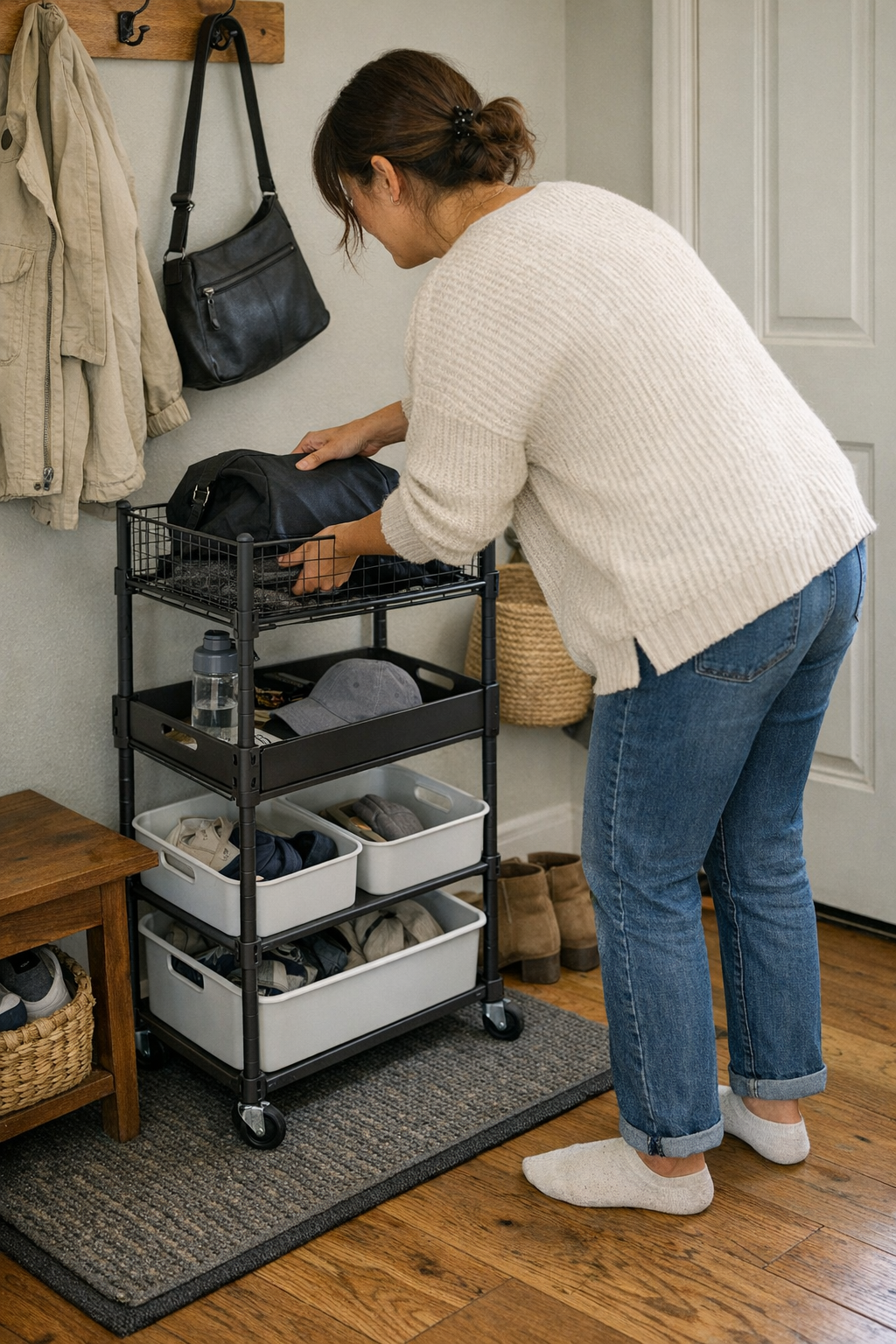
Every entryway starts out organized—until mobile storage gets unleashed. That rolling bin or gear cart has no true home base, so after a week of real use, the “tidy” setup collapses. Wheels drift, bins stall in high-traffic spots, and the area meant to simplify routines now blocks the way and slows you down. What seemed like a flexible storage win instantly becomes a recurring obstacle, especially once bags land in the wrong spot and never make it back.
The Invisible Drift: When Mobile Storage Loses Its Place
By Friday, any busy entryway starts showing the cracks. A rolling bin meant for catch-all containment now hovers halfway into the walkway, no longer neatly against the wall. The cart you tucked aside on Monday is now wedged near the bench—turning “grab and go” into a multi-step detour. In narrow halls, even a slight bin shift slices valuable inches off your walking path; sidestepping becomes routine. What begins as a minor inconvenience fast becomes a threshold traffic jam.
This isn’t just cosmetic clutter—it’s a creeping slowdown on daily life. Instead of passing straight through, you swerve around bins, nudge carts with your foot, or abandon a shoe drop because the path is cramped. The entryway, built to speed up exits and arrivals, becomes a holding zone for items that rarely return to their place. Each missed reset stacks up until the space starts working against you.
How Clutter Builds at the Threshold: Real Scenes from a Busy Week
It’s a simple chain reaction most entryways hide until you look for it:
- You rush home juggling bags, landing your main tote in a rolling bin “just for now.”
- Next morning, that cart—still adrift—becomes the easiest place for another bag or loose gear, sidestepping the crowded bench.
- By midweek, the workaround has turned into a semi-fixed pile, pinching the path and collecting whatever doesn’t have a real slot.
Multiply that small drift for every person and every day: shoes settle wherever they’re kicked off, carts hang out near the middle, bench surfaces morph into overflow drop zones. Resetting isn’t quick; one fix reveals another stray bin or a new bag heap clinging to an edge. The zone built for flow now holds a scattered set of micro-anchors—each claiming space, each eroding the original order.
Why a Home Base Makes All the Difference
Mobile storage doesn’t settle itself. Left unchecked, carts and bins follow chaos, not design; their “temporary” rest stops repeat until the reset becomes wishful thinking. Give them a fixed mark—a line next to the doormat, a bumper against the wall, a section of non-slip tape—and you build a return path right into the daily routine. Instead of improvising, each item actually has a “back to base” rule that sticks.
Anchoring isn’t decorative: it sorts out how the space actually works under pressure.
- Movement stays predictable: Door swings open, path is clear. No sharp detours to escape bin traffic as you bolt through with wet boots or groceries.
- Clutter isolates—doesn’t multiply: Anchored units stop seeding new overflow patches. Shoes and bags land where they should, not wherever the cart drifted last.
- Reset is routine, not recovery: You finish coming or going by rolling the bin to its mark. No guesswork, no hunting for lost floor.
Repeated-Use Reality: The Fragile Promise of Day-One Order
The first day with a new cart or bin always looks promising—lined up, floor open, every shoe and bag in its zone. Five real-world passes later? Someone pushes the rack out of line to sit, another person leaves it blocking half the bench, and pretty soon, routine movement is awkward again. Without a home base, every shifted bin or cart adds to the drift. Thursday comes, and even the most organized person hesitates—“Do I spend fifteen minutes fixing it, or just squeeze through and go?”
Stationary pieces stay put; mobile pieces multiply mistakes when resets aren’t automatic. That’s why anchoring isn’t a “nice-to-have”—it’s the only way mobile units earn their keep. In most setups, the fix is physical: align to a mat edge, lay down a subtle colored marker, drop a small bumper—anything you can touch and roll against. No more “good enough”—just done.
Small Anchors, Big Results: Practical Tips for a Stable Reset
- Leverage what’s already there: Use the line of a doorframe, step, or wall corner to anchor; visible edges help people stick to the habit naturally.
- Add minimal cues: A slip of non-slip tape, a bumper wedge, or a bold floor mat signals where “finished” really means finished—without adding more clutter.
- Block, don’t bottleneck: Ensure the home base leaves at least 16–18 inches clear for daily movement. Narrower, and every reset feels like a penalty.
- Make resetting automatic: Roll the cart back on arrival or before you exit—bake the motion into your process, not your to-do list.
What Happens Without a Base?
Letting mobile storage drift without a daily reset triggers compounding breakdowns:
- Short-term drop spots become long-term clutter—what you meant to fix “tonight” just becomes part of the landscape.
- Walkways stealthily narrow, waking you up to the problem when you finally trip or have to pivot with a heavy bag in hand.
- Kickstart resets turn into full-scale rehabs—what was a matter of seconds is now a full evening of unloading and shifting just to get through the door.
Wall Storage Helps—But Doesn’t Eliminate Drift
Wall racks and hooks do protect precious floor space; they’re ideal for overflow and vertical control. But they can’t anchor mobile units. Without a built-in reset, bins and carts wander to wherever there’s room, undoing even the best-planned wall storage. Reset habits have to be physical, not just visual.
Mobile vs. Stationary: The Flexibility Trade-off
Stationary cabinets and wall-mounted storage keep their ground—what you place there stays there. For homes where layouts change with the season or schedule, mobile storage is essential. But that flexibility self-destructs without consistent resets: what starts as a multi-use helper turns into a moving clutter zone. The structure only works if the routine reinforces the anchor; otherwise, you’re chasing your storage instead of using it.
You’re not after perfection—just a flow that survives reality. Even in the busiest, most clutter-prone homes, a clear base for mobile storage is the difference between daily access and daily friction. Shoes, bags, bins—they all reappear, but they stop blocking doorways or swallowing the bench, and the reset never feels like a punishment.
Lived-In Advantages: Anchoring Makes Everyday Life Easier
With an anchored mobile unit, the drop zone finally behaves. Instead of bumping or rerouting around stray bins, you roll one piece back to its spot and reclaim the path. Exits stay smooth, even in a storm. The contrast is obvious after a few cycles—a once-tidy space that always needs effort, versus one where order snaps back automatically and the entry really works, not just looks organized for a day.
Entryways That Stay Usable—Even When Life Gets Messy
Once mobile storage has a true home base, the entry zone actually withstands messy weeks. You stop tripping, squeezing, or reshuffling every time you come or go. It’s not about keeping up appearances, but about an entryway that recovers—fast—no matter how much life is thrown at it.
The setups worth copying are those that bounce back after five days of use—spaces that don’t demand a reset ritual to keep access open, and don’t punish you for real, messy routines. The difference shows up in daily movement, and the payoff is obvious every time you cross the threshold.