
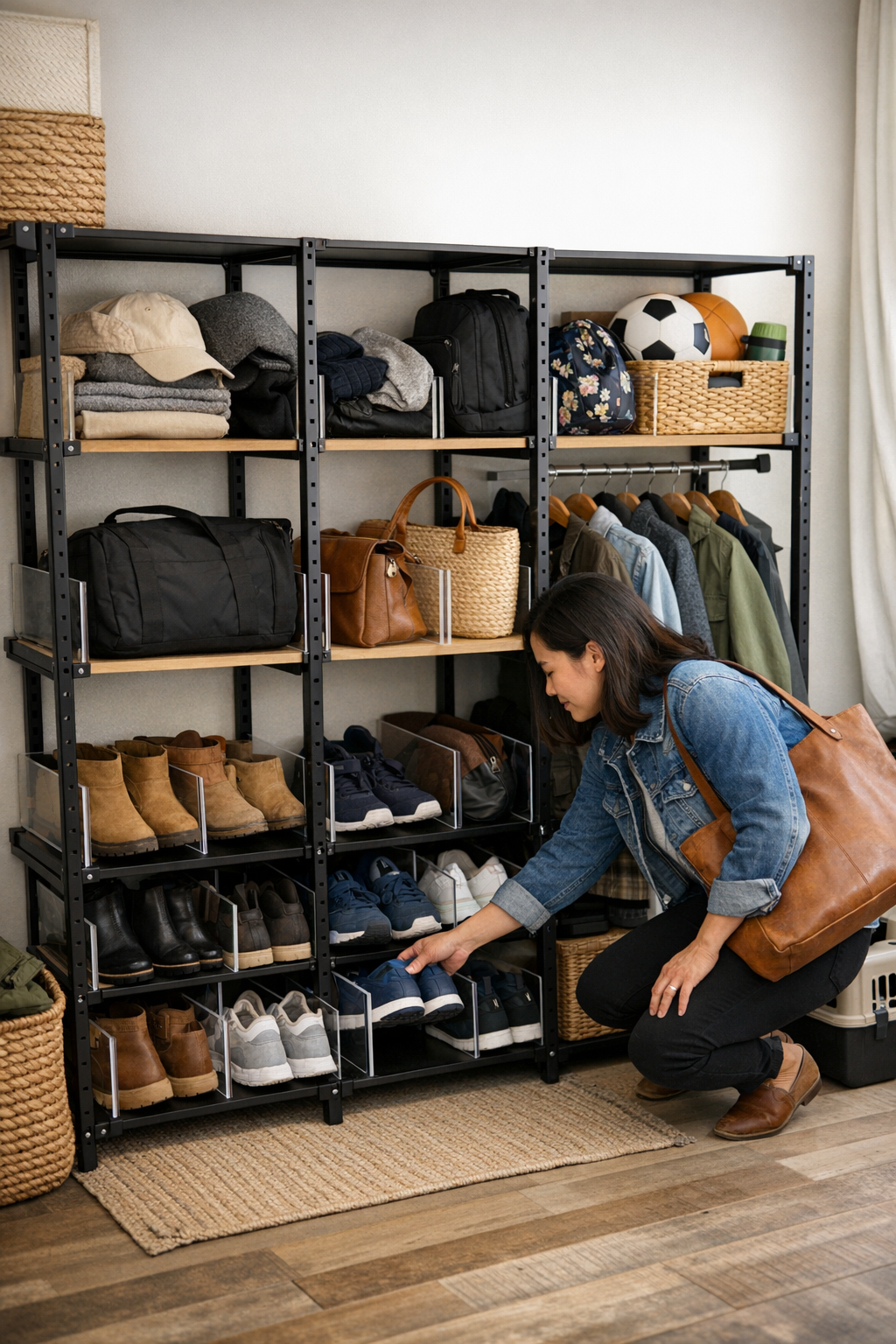
Every closet and entry starts out looking orderly—but daily routines have a way of shredding that order until the baskets and bins meant to “organize” end up hiding a slow, silent mess. Shared spaces are the worst offenders: shoes pushing into backpack zones, scarves curling up with hats, sports gear wedged wherever there’s an inch to spare. That first-day, photo-ready calm rarely survives a single frantic school morning. What works for show rarely works for life.
Baskets: The Surface Fix That Quickly Falls Apart
Woven bins line shelves, everything tucked away and labeled. It’s satisfying—but only if no one actually uses it. Give it three busy days and the story changes. Socks land in the shoe bin “just this once,” hats end up buried under reusable bags, and soon a single item buried in the wrong bin is left there, because fishing it out means dumping half a basket onto the floor. The more people use the space, the faster the categories collapse. What felt tidy starts to feel like digging through lost-and-found every time you need something.
The Quick Unravel: How Order Disappears
Consider a real entry closet: day one, you have boots in a shoe bin, hats each in their own labeled basket, gloves paired up and visible. But by midweek—after rushed mornings, muddy shoes, surprise detours, and no time to gently sort—a single shelf becomes a tangle. You’re stacking hats on top of shoes, cramming library books next to the pet leash, and pretty soon, just grabbing what you need means shoving stacks aside. The “organized” space turns into a daily shuffle, slower and more annoying with every use.
Boundaries Over Baskets: Why Clarity Wins
Open baskets look nice—until you need to find something fast, or put it away without thinking. Spaces with real, physical boundaries—fixed dividers, built-in cubbies, clearly marked shelves—offer something soft-sided bins can’t: clarity that lasts past day one. Instead of hoping family members will police themselves, you give every item a landing zone too obvious to ignore. Shoes have a shelf, not just a pile. Gloves get a slot that never fills with scarves by accident. It’s these simple dividers that quietly enforce habits, preventing chaos from leaking everywhere.
The Cost of Constant Reshuffling
Without boundaries, baskets turn into blending grounds. A week in, you’re wrist-deep in mixed-up gear, reaching through a pile just to grab the second mitten, always nudging aside what doesn’t belong. Every reset becomes a full-blown sorting session instead of a two-minute tidy. It isn’t that baskets are bad; it’s that daily use inevitably shuffles them into entropy unless the shape of the storage does the sorting for you.
Fixed Dividers: What Actually Survives Real Life
The real stress test for any organizing system isn’t day one—it’s what the closet looks like after five days of use. Fixed cubbies or vertical dividers absorb the strain of routines. When someone tosses the wrong item in the wrong spot, the boundaries keep that mistake from spreading. Even during the busiest weeks, everything still lives in roughly the same spot, and grabbing something is a direct reach, not a scavenger hunt. You reset by moving a single thing, not by restacking or digging.
Reset Speed: The Hidden Metric
Picture this: arms full of groceries, dripping umbrella in tow. With baskets, you end up stuffing things “temporarily” wherever they fit, vowing to reorganize later. Later never comes, and the disorder grows. With fixed sections—slots for shoes, a marked hook for umbrellas, a cubby just deep enough for hats—putting something away takes a second, not a sigh. The faster and easier it is to return things, the less likely you’ll face a collapsing system by the week’s end.
When Neatness Isn’t Enough: Choosing Order That Lasts
It’s easy to fake order with a few matching containers, but only physical boundaries truly tame clutter. When the closet mirrors your actual routines—with a shelf for each kid’s shoes, a no-skid divider for gym bags, space for “everyday” and “once-in-a-while” gear—your storage survives rush hour and resets almost on autopilot. The energy you used to spend reshuffling baskets or re-folding stacks goes somewhere else. You get a closet that’s more than “presentable”—it’s just plain usable, day in and day out.
Small Fixes, Noticeable Relief
You don’t need a renovation—sometimes a strategically-placed divider changes everything. One new shelf gives shoes vertical room to breathe. A slim cubby for mail and keys keeps every morning less frantic. Labels on shelves stop the cycle of “whose gloves are these?” Sharing a closet means you need rules the space itself enforces. Tiny, clear boundaries make resets faster, prevent categories from blending together, and cut clutter before it starts spreading.
Living the Difference: Storage That Works With You
The real success isn’t in how perfect things look after a major cleanup, but in the moments where you reach for a bag, a hat, or your sneakers and find them—right where you expect, nothing to move, nothing in the way. It’s when you actually use your space and end the week with the closet still working, not overrun. That’s the mark of a storage system built for your real routines—and it’s the moment you stop managing chaos and start trusting your space to keep up with you.
Find practical storage solutions built for the way you actually live at ClosetWorks.