
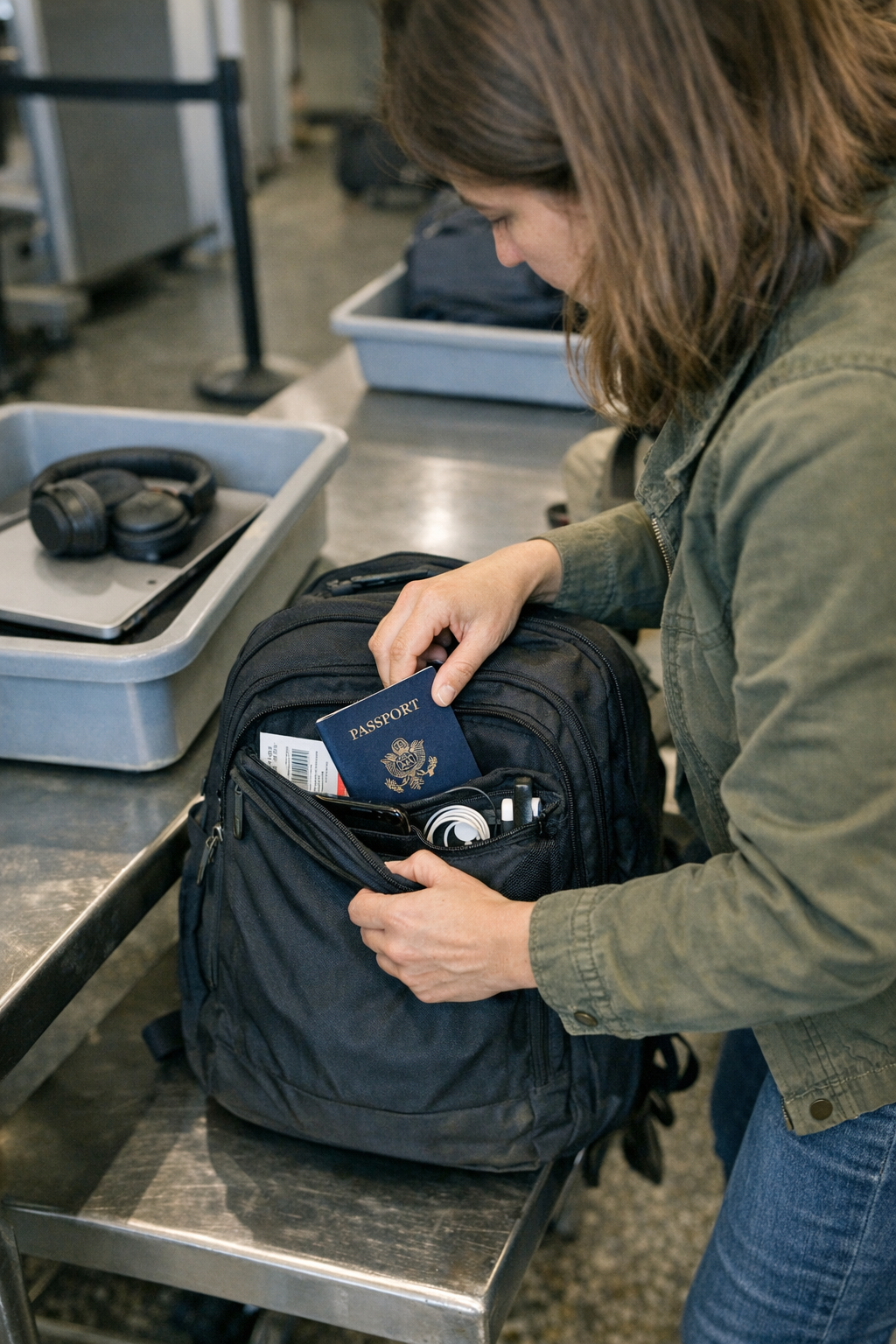
No bag escapes friction once real travel starts— not even the carry-on that looks sharp on a hotel floor. You may start with every cable wrapped, documents sleeved, and pouches in strict order, but that visual system collapses the first time a security queue accelerates and you have to tear through a tight zipper or unbuckle two layers for a passport. What looked “organized” in stillness breaks down fast: outer pockets stall at the checkpoint, the right document hides one pouch deeper than you remember, and each retrieval turns into a mini delay with other travelers pressing closer. The drag isn’t just aesthetic—every missed grab, every awkward repack, chips away at your motion and energy for the rest of the trip. CarryOnSupply’s whole world starts right in that gap: where tidy setups get stress-tested by airport routines.
Order on the Surface, Friction in Movement
Smart pockets and tight grids promise control. In use, they turn on you. A pen holder that impressed you when packing becomes a thumb trap when you’re already blocking the boarding line. The passport you filed neatly is now squeezed between a cable nest and receipts—good intentions bogged down by tight layering and misplaced access. Digging for headphones at your seat means contorting around two other organizers. In the moments that matter—security, boarding, the grab for a charger during a gate change—bags designed for visual order often act like walls instead of doors. The more “buttoned-up” you go, the more every access point becomes a new bottleneck. Looks can fake utility, but speed and flow are what you’ll feel—or lose—every time the pressure spikes.
The Real Cost of “Neat-But-Slow” Setups
Energy bleeds out in seconds: slow zippers, layered pockets, a charger in the wrong sleeve. By midday, what you feel isn’t just miles walked or a long layover—it’s the invisible tax of tiny repacks, the break in concentration each time you hesitate in front of a tray or boarding agent. If a single retrieval forces you through three compartments, your flow breaks. Multiply that by each checkpoint, every boarding zone, every in-flight shuffle, and the design flaw compounds. The airport isn’t what slows you; your own bag is what stalls your progress in repeated, friction-heavy bursts.
- Security line: The tech pouch that fits beautifully at packing becomes a puzzle box when the only way to get your laptop out is to pull three other things first. Bins crowd up. Eyes roll. Time slips.
- Gate boarding: A boarding pass buried for “safe keeping” now means an awkward fumble and a line that closes the gap behind you, tension rising with each extra second.
- On the plane: Cable pouches packed deep demand a full reshuffle—on your knees, elbow pressed into the seat, as the aisle crowd inches forward and your seatmate’s patience thins.
These are not rare emergencies. They are the background noise of travel fatigue—a bag that started “in order” but gets heavier and clumsier with every repeated reach.
Repeated Use: When Organization Backfires
What feels secure and clever at home becomes less forgiving in actual travel motion. That color-coded pouch plan? Two layovers in, you’re double-checking which organizer ate your passport. Each micro-task—dig, unzip, repack—amplifies every time you face:
- Multiple flights or short windows to connect
- Frequent ID and document checks
- Overhead-bin reshuffling, especially with quick swaps
- Transitions from train to terminal, curb to gate, seat to seat
Crucial items get isolated “for order,” but pressure moments expose every extra layer you built in. The bag that presents well on a bench falls apart when you’re speed-retrieving for boarding, or snatching a pen midsentence on a customs form. Organization that can’t adapt to repeated hand-off simply creates new patterns of friction—and travel makes you feel each one, over and over.
Single-Pouch Solutions: Why Accessibility Wins
The move that changes the day? Taking every recurring-use item—boarding pass, ID, pen, headphones, crucial cables—and staging them for single-motion access. That “messy” outer zone you worried would look cluttered? It’s your forward-motion insurance when lines are moving and fingers are cold. A single zipper replaces a five-step deep-dive. The improvement is immediate: you reach once, retrieve, and move—no stalling, no tray clutter, no mental lag. Now, you reset your bag structure in seconds, not after every access. Travel stops being a hunt and becomes a flow. That’s the real-world win: organization built for repeated disruption, not just for the moment the bag first zips closed.
Repeated Friction Adds Up—But So Does the Fix
Travel fatigue is cumulative. Each stop-and-dig adds tension you carry as you move through crowds, repack in cramped overhead spaces, or squeeze against strangers in line. The problem is rarely one big jam; it’s a hundred small barriers stacked by the design of your setup. Overlapping zipper paths, items sharing one pocket, or pouches set behind each other all combine to slow down the day. Changing your carry-on isn’t a cosmetic fix: moving high-frequency items into an “express lane” saves you from reflexively hesitating, freezing the line, or losing rhythm in the run-up to a gate. Tiny changes in pouch placement mean you move forward, not sideways, and finish each connection less “baggage-worn.”
Realistic Trade-Offs: Less Visual Order, More Functional Flow
Chasing perfect visual order often backfires once the trip actually starts. A bag that’s a Pinterest post at takeoff is soon “mid-battlefield”—pouches half-open, one outer slot a bit overused, a stack of travel scars on the quick-access section. That’s not mess. It’s evidence your setup is finally tuned for what matters: immediate, frictionless retrieval and minimal energy loss. If you’re reaching for the same item and not breaking your stride, you’re winning. After a few cycles, you stop wasting time wondering where things landed—your entire setup adapts to your actual, repeated trip rhythm instead of resisting it.
Recognizing When Your Setup Needs an Upgrade
If you catch yourself hesitating at every retrieval—palming pockets, feeling for a missing charger, growing irritated at a travel wallet that should be in reach—it’s the bag telling you it needs to change. The answer isn’t another round of pouch stacking; it’s moving repeated-use travel essentials into fast-access zones. By the end of a true travel day, count the number of times you have to dig for what should be at your fingertips. Every reduction is a win you actually feel—one less drain on your momentum and patience when it matters most.
Small Shifts for a Noticeably Better Carry-On
The difference between a carry-on that “looks organized” and one that moves with you is how it responds in stress. Stop measuring by internal neatness; measure by how few times you have to pause, re-sort, or apologize for blocking a walkway. Each step toward single-point retrieval is a step away from the slow build-up of travel fatigue. Organization isn’t about freeze-framing your gear; it’s about building repeatable flow for every hand-off, check, and transition, all day long. The best carry-ons aren’t just beautiful when static—they become more invisible, more useful, the more you move.
Shop CarryOnSupply for practical carry-on travel organizers and tools