
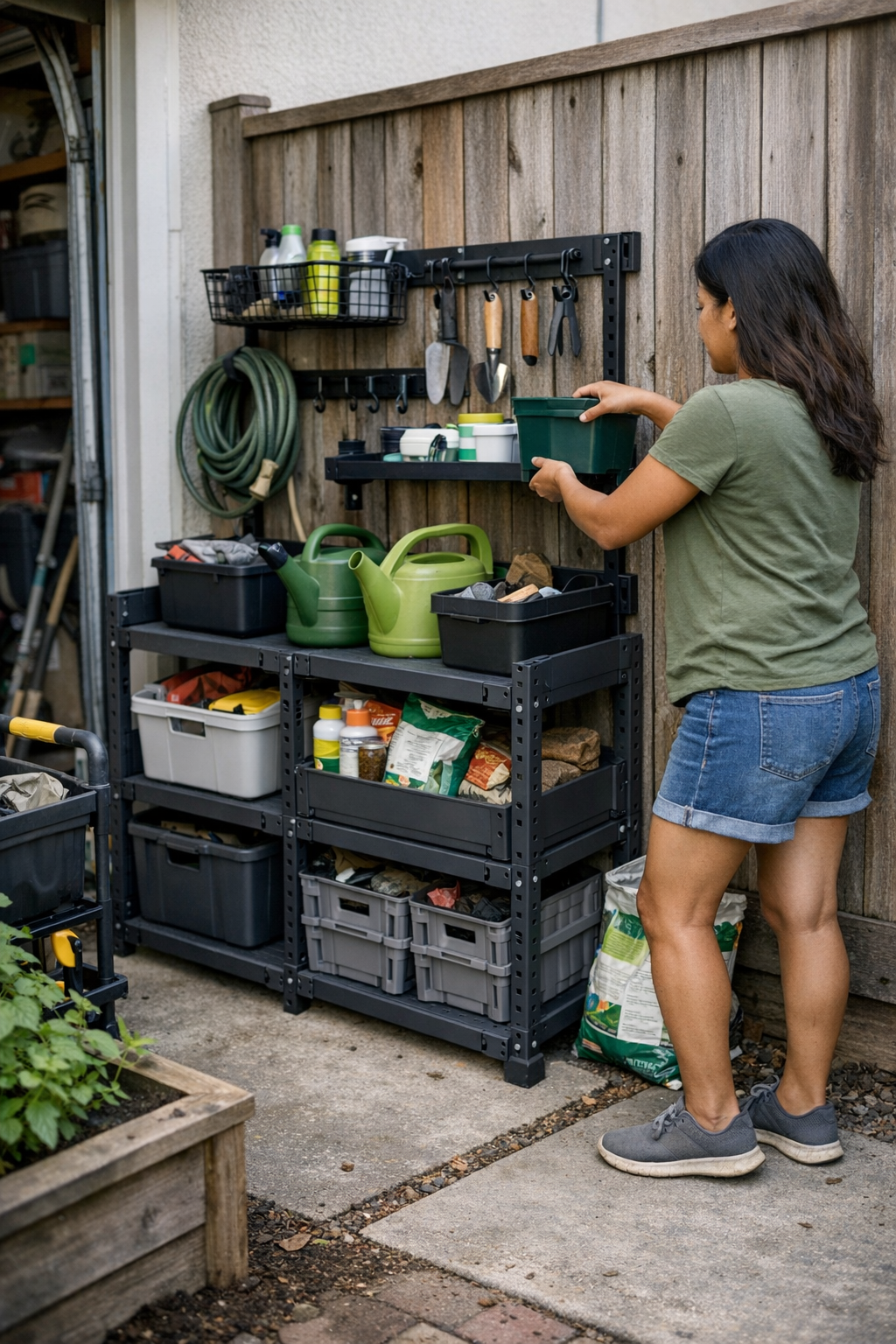
If you’ve ever stepped into an outdoor zone that was supposed to be “organized,” only to nudge a bin with your shin and sidestep a crate creeping into your walk path, you already know: storage that doesn’t match your real routine drags every reset into a grind. Most of the friction comes from what’s meant to help—bulk bins, crates, ground-level chests—sprawling into the space you actually need just to get through the day. Small outdoor zones, narrow side strips, patio edges: these setups turn “putting things away” into an endless loop of shifting and stepping around, until even a fast pick-up feels like a chore. It’s not laziness that lets chaos creep in. It’s a system that loses the plot every time gear drifts, tools get buried, and movement stalls against a wall of best-intentioned storage.
Where Ground-Level Storage Trips You Up
A weatherproof bin looks like an outdoor win—until the first busy week. Gear comes out, random tools drift in, and with every round you’re reaching over a new pile or dragging a crate that feels welded to the paving stones. By Saturday, the “organized” setup blocks your path to the gate or forces you along tight detours between bins that were never meant to stay put but somehow always do.
It’s not about careless habits. The layout itself creates mini choke points. Floor setups in family yards, garage thresholds, and shared side paths build up silent pressure: you think you have a clear run, but every use cycle re-scatters what you just fixed. What fits on paper crowds out movement in practice—especially when gear always winds up in the least convenient corner or right in front of where you need to go.
When Floor Setups Become Spillover Zones
Want the quickest reality check? Try walking your outdoor setup at the end of a busy week. If your walk is a zig-zag nudge-past—bins tight to the fence, tools splayed across paving stones, and “temporary” crates turning permanent—you’re living the cycle. The layout doesn’t push gear out of the way; it collects overflow into whatever live space you can’t avoid. Routine use just multiplies the shuffle. Nobody dumps debris into the walking line on purpose—it happens because the system only half works, pushing stuff out when it should be pulling it in.
Nothing sabotages tidy efforts faster than a system that breeds friction faster than you can clear it. See it all the time in side strips jammed with toys and hoses, patio corners where bins form a wall, or garage entries so thick with “storage” that every return trip means another awkward shuffle.
The Shift: Storage That Gets Out of Your Way
This is where wall-mounted racks and modular shelves reset the story. Take storage off the ground and you don’t just reclaim square footage—you fix the pattern. Hanging gear isn’t just neater; it controls the return flow. Suddenly, there’s an obvious hook for pruners, a visible spot for gloves, one quick reach for the soccer ball. No fumbling past piles. No guessing where things go when energy is low or the rush is on.
Seen in real use: a side yard used for dog gear, garden tools, and pool toys was a bottleneck of crates after every busy weekend. Swapping those bins for a mounted rail and baskets along the fence turned the walk from an obstacle course into a straight line. Now, the shovel always returns to its hook, the leash basket greets you at the gate, and even after a chaotic day, the reset takes a quick sweep—not a full reshuffle. It’s not about “spotless.” It’s about never needing to fight your setup just to find the walk path clear again.
Wall Systems: Real Boundaries, Less Drift
The temptation is to think you’re just pushing the mess higher. But when a wall storage system fits your actual flow, it draws a bright line: if there’s a hook and a bin right where you finish an outdoor job, stuff goes up—not down. You don’t have to think twice; gear has a visible home. Wall racks along the central path, shelves at the edge of a patio, or a vertical gear zone by the back door—all anchor their areas and suppress that creeping migration of stuff back into the middle of your path.
Setups That Don’t Collapse Under Pressure
Ground bins break down when routines get wild. Busy Saturdays mean everyone’s grabbing balls, hoses, yard tools—no one’s pausing to restack the pile each round. By late afternoon, the footprint of your “contained” storage has doubled and nothing is where it started. The work comes back on you: reset turns into a search party and a pile-juggle just to get back to baseline.
Systems that build in minimum pathways—rails that border, not block; shelves that only take as much wall as you can spare—reduce spillover by architecture, not wishful thinking. No more accidental piles resting by the side gate. After a high-traffic day, each zone keeps its shape because the system doesn’t let “just for now” storage clog your movement tomorrow.
Mobile Units: Flexible or Just in the Way?
Rolling crates or portable bins sound clever but often turn rogue—unless there’s a defined “dock” and a habit of returning them, they end up clogging the last good corner. It’s a classic pivot: you move the tote to “clear the path,” forget it, then spend the next week detouring around your own flexibility. Mobility works when the reset is as frictionless as the use. Otherwise, you’re just rolling your problem from one corner to the next.
Real Patterns Show What Works
It’s easy to be fooled by a perfectly-staged yard right after a weekend reset. The test comes after four or five rounds—are you resetting again and again just to get paths clear? Does some cluster always dodge organization, no matter how many bins or hooks you add? Durable systems do a few things differently:
- Return points are unmistakable: you don’t have to think about where anything goes back.
- Walkways are protected by the layout itself, not just the hope that people will step carefully.
- Wall space isn’t just filled, but solves an actual zone need, not just looking “busy.”
- Overflow zones are contained, not allowed to become the new status quo.
Try this real-world check: measure and enforce a minimum walk path—in tight yards, 32 inches is often the make-or-break width for unblocked movement. Mark it if you have to. If you find yourself stepping around a bin or letting “just for now” gear drift into the path, that’s your system failing under real pressure—the kind that builds every week, not just when you’re watching.
The Difference Between Looking Organized and Working Cleanly
A setup is working—not when it’s photo-ready, but when you can walk your path at day’s end and nothing needs explaining or re-stacking. “Home” for gear feels obvious, and resets are a matter of two minutes, not entire afternoons. The real improvement isn’t pristine surfaces; it’s a routine you don’t have to fight, even when the week throws some chaos your way. That’s the shift: moving from storage you manage to storage that manages itself, even after a rush, a storm, or a half-dozen passes by different people. If the space flows, the system works.
For more practical ideas on making outdoor spaces easier to live with and reset, visit TidyYard.