
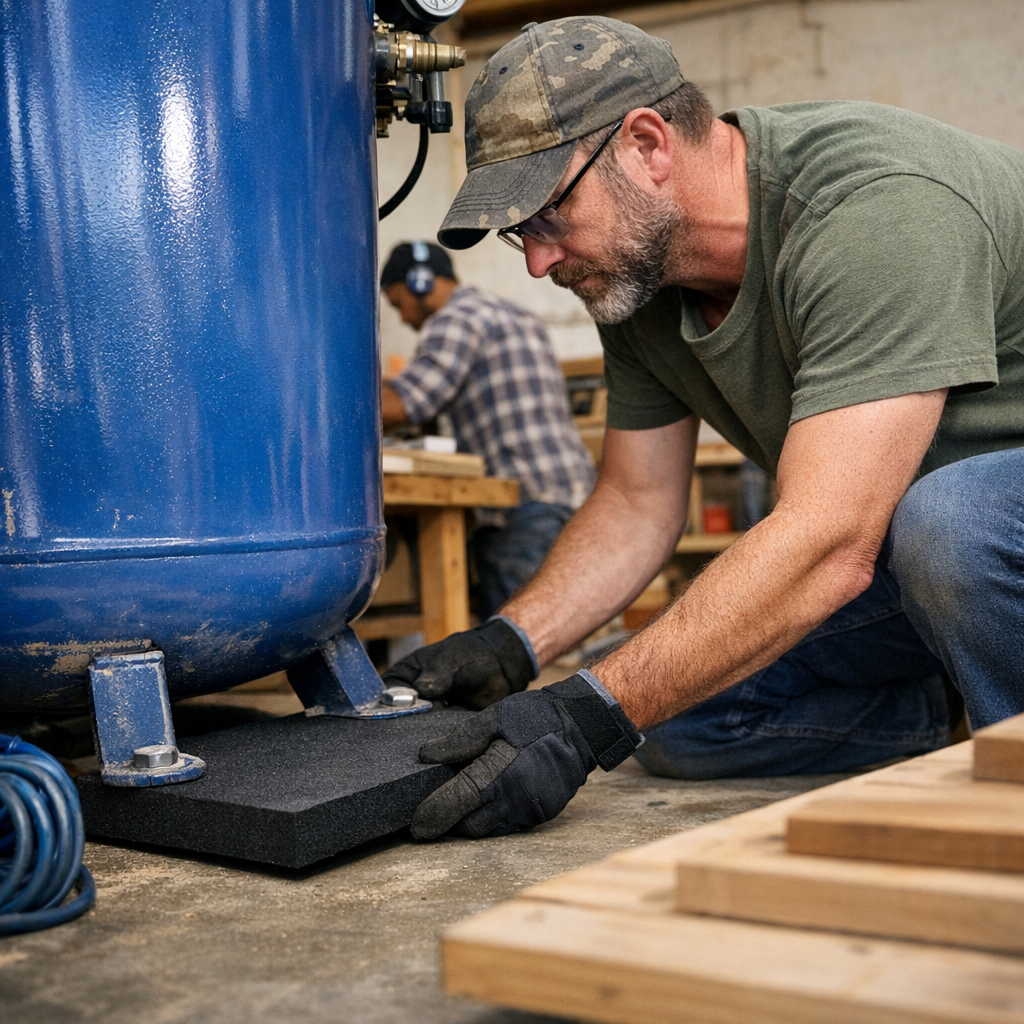
If you’ve spent any real time on a shop floor, you know the dull pulse of an air compressor isn’t just background noise. At first, it fades beneath the shriek of saws or the punch of a brad nailer. But by midday—after hours of trimming, fastening, and sanding—the throb turns intrusive. It creeps through the concrete, shakes your bench when the compressor cycles, and before you realize it, small details start to slip: that mitre line never quite closes, dust drifts back across a finish you just wiped, and glued joints quietly shift out of square the moment you reach for a clamp. What’s behind these tiny headaches? Nine times out of ten, it’s the stubborn, silent transfer of vibration every time the compressor kicks on—especially if it’s planted bare on concrete instead of padded feet.
How Compressor Vibration Disrupts Real Work
The trouble doesn’t stop at the compressor. With every cycle, vibration radiates straight into the floor slab. If your compressor is unpadded, that steady pulse travels out and upwards—straight into benches, tool stands, and assembly tables. Over a typical shift, those invisible tremors multiply. They shake clamps just enough to loosen alignment, coax fine dust from cracks into wet finishes, and force you to recut a board because your stop block shimmied while drilling for hardware. The difference isn’t dramatic, but it’s everywhere—just enough to slow you down and nudge jobs off track.
While a hammer drop or router startup is obvious, compressor vibration is the slow leak in shop accuracy. One pass, maybe it’s harmless. But when you’re cutting a dozen cabinet rails, mortising for hinges, or batch-sanding trim, the margin for error shrinks—and suddenly you’re chasing problems that shouldn’t exist. Out-of-square assemblies, hinge holes drifting just off mark, joints that won’t pull tight and hold. That persistent “just barely” wrongness eats at both precision and patience.
Isolation Pads: The Quick Fix That Holds Your Accuracy
Most shops treat compressor pads as an afterthought—until the work starts to suffer. Dense neoprene or heavy-duty rubber pads, properly placed, do more than just make the shop a touch quieter. They block much of the vibration at the source, guarding your bench and your work from the compounding, invisible shake. The difference is measured not in decibels, but in boards that don’t need recutting and finishes that don’t need a second pass.
Real Example: Compounding Problems in a Fast Shop
Take a typical Wednesday in a busy trim shop: cabinet doors lined up for glue, clamps closing in, and the compressor whirring to life every few minutes as drivers fire. Things look smooth—until you spot one door frame just slightly out of line and dust sticking to a finish you know you wiped. So you tighten clamps, re-square the frames, brush, and vacuum again. Next cycle, the dance repeats. What changed? In this case, cheap closed-cell foam pads under the compressor feet were already mashed flat and useless. Swapping them for 15mm neoprene pads stopped the micro-shake instantly. Suddenly, clamps gripped tight, frames stayed flush, and that finish went on smooth. The tools did their job; this time, the setup let them.
Where Pads Solve the Most Headaches
Not every tool is sensitive to a shaking slab, but when it matters—it really matters. You’ll spot the payoff (or feel the frustration) in these routine jobs:
- Sanding and finishing work: Table vibration shakes grit loose, ruining a just-laid coat and forcing you to sand and refinish the patch—again.
- Precision drilling: Micro-movement shifts jigs, nudging holes out of true. Just a millimeter off is enough to ruin hardware alignment in doors or cabinetry.
- Long glue-ups and clamping: Persistent low-level shake pushes boards just out of plan, leading to open seams or edges that require extra sanding and adjustment post-clamp.
- Fastening and assembly: Repeat vibration ramps up fatigue and makes it tough to keep nails, screws, or pocket holes perfectly flush—especially over a run of pieces.
Let the unseen vibration slip back in, and you’ll feel it in wasted material, double-checks, and tool fatigue—not to mention the slow drag on morale by late afternoon.
Material Matters: The Downside of Makeshift Padding
It’s tempting to reach for that foam scrap or flattened packing rubber under the bench. But these fixes fail fast—compressing into uselessness and letting vibration return before you know it. You’re stuck thinking you’ve solved the problem, but the accuracy issues sneak back in anyway.
Quality pads—thick neoprene, specialty rubber—spring back and survive repeat compressor cycles for the long haul. That resilience means consistent vibration control, no matter how many times the compressor fires. Each foot should have its own equal, level support; a single thin pad, or one corner that sags, is all it takes for vibration to find its path again.
Shop-Tested Advice: Watch for Pad Fatigue
If you find vibration creeping back after a few months, don’t just blame the tool. Get low and check for permanent compression or splits in the pads. Replace as soon as you spot it—results are immediate, with sharper cuts, steadier glue-ups, and smoother sanding from the first job on.
Skipping Pads? Know When It’s Safe—and When It’s Not
If your compressor fires up just for the odd brad nail or the stray tire, you might get away with bare-floor mounting. But as soon as your workflow chains benches, carts, or racks together on the same concrete, that gamble vanishes. Stability is the goal: a work surface that holds all through flush cuts, careful drilling, or a marathon clamping run. When precision matters—like installing hardware in hardwood, setting hinges, or getting face frames perfectly level—the cost of vibration is real, and chasing accuracy after the fact simply wastes time and energy.
Don’t Let “Almost Right” Turn Into Costly Corrections
The most common frustration in the shop isn’t the major blowout—it’s the slow bleed of tiny, repeating misses. You shouldn’t have to sand away a rough glue line three times, or re-drill because vibration shifted your template. Yet that’s exactly what creeps up when the setup isn’t stable. Batteries drain, blades dull, hands tire—controlling what you can early means the rest of your workflow stays smooth. Starting with the compressor feet isn’t glamorous, but it protects the effort you pour into each piece. It’s not about perfect conditions, just giving your tools a stable platform to perform at their best—one cycle after another.
Discover tools and site solutions built for straightforward, repeatable results at Gumboll.