
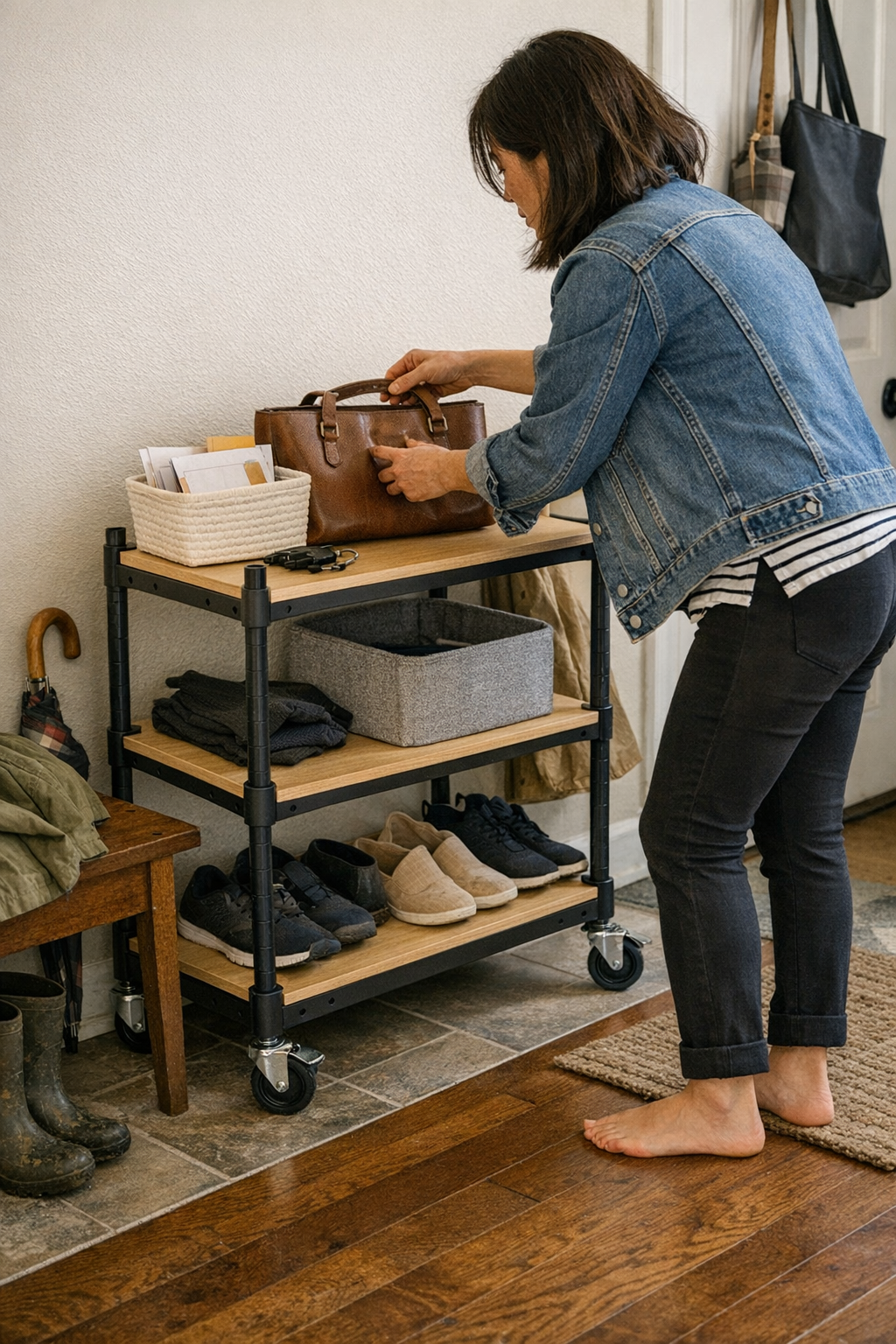
Mobile carts promise entryway order, but in real transition spaces—where traffic repeats, hands are full, and routines collide—the wrong wheels turn that promise into constant frustration. The minute a cart can’t hold its ground, mobility stops helping: instead of flexibly shifting out of the way, it drifts back into paths, clogs the drop zone, and interrupts the flow that makes crossings manageable. The tidy look vanishes the second daily use begins—and every uncontrolled shift eats into time, space, and patience.
When a Rolling Cart Slides from Solution to Obstacle
Every return builds tension at the threshold. Shoes multiply in the same band of floor. Bags and coats land in a pile that redraws the edge between the clear path and lived-in chaos. A mobile cart looks like relief, but as soon as its wheels won’t stay put—especially when nudged during real traffic—it becomes an active problem. Push it aside while juggling groceries, and it rolls back just enough to block the shoe lineup or slice the walkway. The inconvenience repeats:
- Drop a bag, and the cart edges toward the utility bench, narrowing the route and splitting the zone.
- Sit to tug off boots, only to find the cart drifted, turning the shoe row into a two-deep mess you need to tidy again before leaving.
- Mail, keys, and stray gear layer up, the cart sabotaging whatever boundary you meant to hold—creeping into door swing or taking over a previously cleared corner.
Initial neatness collapses into slow, repeated resets—quietly turning flexibility into a cycle of backtracking and blocked movement every time the entry fills up.
Why Locking Wheels Aren’t Optional in Transition Spaces
Drop zones are where movement pressure and storage needs collide. Storage has to shift for sweeping, but when everyone arrives together—or routines stack up—mobile furniture without anchored wheels can’t control the flow. Each small nudge or accidental bump sends the cart off course, demanding correction just to keep the walkway clear or recover lost shoe space.
Wheel locks redraw this outcome. A cart you can push into place and anchor with a foot tap becomes a reliable wall: it marks a stable edge, lets you drop bags or align shoes, and holds up even as the threshold crowds. Flexibility still exists—the cart moves when you want—but only on your terms. When the wheels lock, temporary placement stops and stable order holds.
Scenes Where Wheel Locks Make All the Difference
Most failed setups don’t look failed—until the threshold fills. Picture a wet evening, hands full of mail, everyone dropping gear:
- Drifting creates pile-ups: As you unload, the cart slides forward under the weight. Shoes start spilling beyond their intended line, and the clear zone collapses into a slow squeeze for the next person.
- Overnight migration: An unanchored cart slides past tile lines, quietly inching into household space, blocking the swing of the door or making the entry bench unusable until someone shoves everything back.
- Locking wheels hold the border: When locks work, the cart absorbs as much daily pressure as needed but stands firm. Bags stack, gear drops, but the organization holds. Real use stays visible—rows don’t collapse, and there’s no guessing whether the cart will drift mid-routine.
The Hidden Cost of Unanchored Carts: Constant Resets
A mobile cart that can’t anchor signals its failure in the daily shuffle: its placement slips a little farther out of line with every use, and the gap between entry order and threshold reality grows. Bags block the bench instead of resting beside it. Shoes start mixing with hallway traffic. The entry looks controlled for a day or two, then deteriorates to semi-permanent pileup. Every reset takes longer—first you find the cart, then you clear the blockage, then you can actually tidy up.
With locking wheels, this cycle shrinks. Entry gear lands in predictable places, and restoring order means sliding a shoe or shifting a bag—not undoing a week’s worth of scatter. Walkways stay clear; drop zones remain functional. The real value is felt in not having to fix the same chaos repeatedly.
Testing for Genuine Stability: A Quick Routine
True mobility works only if it doesn’t turn into drift. A practical check: roll the cart to a visual marker (tile line, floorboard edge), engage the locks, and nudge it sideways or forward with your foot—hands-free, like during an unplanned entry. If it shifts, the hardware is weak. Strong wheel locks hold under real entryway pressure, letting the cart remain where you set it, resisting even those distracted bumps that mark real routine use.
Practical Tip: Maintenance for Reliability
Wheel locks only work when free from grit. Small gravel and dust build up, undermining even the best lock. Every few weeks, run a quick check: pop the locks on and off, wipe away any debris. This simple habit keeps the cart’s anchors effective and the reset cycle shorter, directly protecting the flow of your drop zone.
When Are Locking Wheels Essential, and When Can You Skip Them?
If your cart stays parked at the edge of a zone and rarely enters the main traffic path, standard wheels may be enough. But once a cart becomes central to daily unloading—especially in narrow thresholds or high-rotation entries—locking wheels become non-negotiable. They decide whether you have order or end up with clutter that outpaces every tidy-up. When mobility cannot be controlled, flexible storage turns into permanent inconvenience—a frustration visible in every blocked path and every delayed reset.
Order, Flow, and the Unseen Work of Threshold Storage
The true job of mobile entryway storage isn’t just containing shoes and bags—it’s about holding a line against drift, supporting clear passage, and keeping the drop zone resilient under daily use. Wheel locks look like a minor feature, but under threshold pressure, they’re the difference between living in a reset loop and keeping order in a space that never stops moving. In real routines, storage that stays put when it matters most gives you back time, clarity, and lasting calm in the busiest two square meters of your home.
See more threshold storage designed for real entryway routines at Betweenry.