
Midway through the job, it starts—the subtle resistance, the telltale pause, the first few nails not driving cleanly. You feel it before you see it: a finish nail sits a sliver too proud, your spray gun spits instead of blending, and suddenly you’re second-guessing every cycle. If you rely on an air compressor to drive fasteners, paint, or sand, you know the agony isn’t about flashy specs. The difference between smooth progress and a late-night patch session almost always comes down to pressure stability—how well your compressor keeps up, not just the size of its tank or its top number printed on the side.
Spec Sheets Can’t Warn You About this Problem
Specs make shopping look easy. On the shelf, two compressors match up tank for tank, riding the same PSI numbers. But roll them out on-site and let the real work begin—a dozen rounds of trim nailing, stapling under a deadline, or carving through plywood while the garage bakes in the afternoon sun—and that’s when true performance reveals itself.
Jobs aren’t won on a single blast—they’re lost in the rut of repetition. What the data points miss is the way a compressor holds (or loses) pressure across a string of activations. If your pressure swings wildly—7 to 10 psi between cycles instead of holding close within 2 or 3—it’s not just numbers. Suddenly, fasteners need hammering, you spend time correcting spray sags, and seams that started snug begin to open up. It’s a slow, sneaky tax on both quality and time.
How Pressure Drift Chips Away at the Workday
The real trouble never feels explosive. For the first handful of cycles, everything fires smoothly. The gauge is in the sweet spot; you think you’re winning. But hoses warm up, your rhythm quickens, and by cycle twenty the first head sits proud or a cut stalls for a split second. By cycle forty, misfires and half-done seams have you swapping out tools or reaching for sandpaper again.
What you’re fighting isn’t a dramatic blowout—it’s an incremental drag. Every small pressure drop means fasteners don’t drive flush and need a second hit. Cuts burn or chip out. The spray gun starts spitting, so you double back with fine-grit or filler. The job gets longer while the finish suffers, and you feel it in your hands and your schedule.
Fastening Under Pressure: A Scene from the Floor
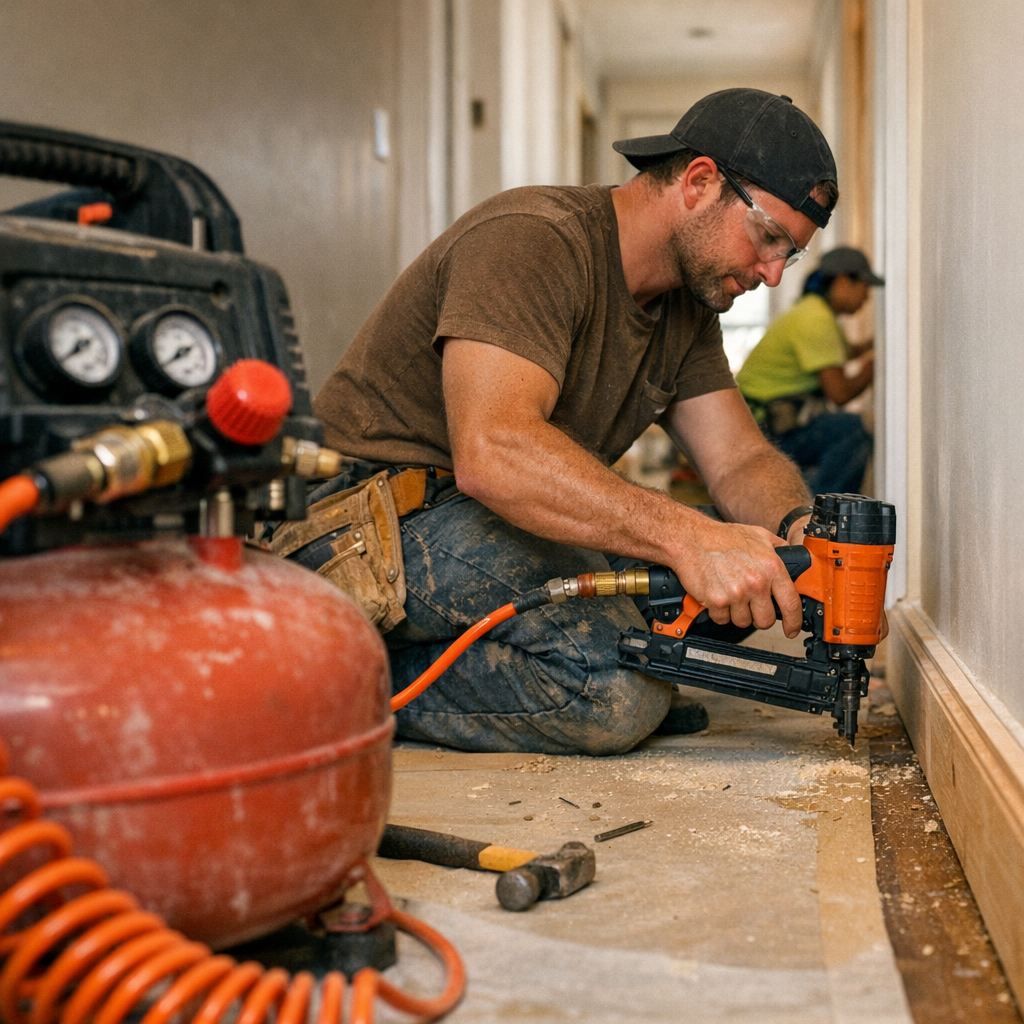
Picture this: You’re running baseboards through a hallway, knee pads scraping tile, peace shattered by the compressor wheezing to keep up. At first every nail zips in. Then you speed up, and before you know it, the finish gun hesitates. You can feel pressure lag through the trigger—not just noise, but your workflow stumbling. A couple of staples stand proud, the hose is warm to the touch, and now you’re spreading filler and prepping for a round of sanding that never should have been needed. One hallway becomes an hour of extra work, all because pressure slipped at the wrong moment.
Instability that Wears Tools—and Patience—Thin
The slow breakdown is the worst kind. It’s not just nailing. During cabinet assembly, drilling repeated pilot holes, or long runs with a sander, hidden pressure swings show up as skipped cuts, torn-out grain, or motors straining to keep up. Spray finishing? That perfect early pass turns unreliable as the pressure dips, making you tip the gun, overspray, or chase patchy coverage. Work overhead and you’ll find drive consistency evaporates—raised nails and missed drills you only notice on teardown.
Spot the Creeping Signs Early
Notice yourself waiting for the compressor to catch up? Do you pause after every string of activations, or wonder why some nails bury deep and others won’t set? That’s unstable pressure eroding your control and adding repairs to your list. If you catch that rhythm—adjusting your pace for the machine’s recovery—it’s not just annoying. It’s robbing your efficiency and tiring both you and your tools faster than you realize.
Quick reality check: If your workflow is bending to fit the compressor’s recovery—not the other way around—the real problem is hiding in plain sight.
The Real Upgrade: SCFM Where You Need It, When You Need It
The leap wasn’t swapping up to a bigger tank or chasing the highest possible PSI. The true fix came from finding a compressor that delivered steady, repeatable SCFM at actual working pressure. Compare a 2.6 SCFM machine to one confidently running 4.0 at 90 psi: the difference is felt over fifty uninterrupted cycles. No stubborn fasteners, no tool lag, no patching nail heads. The last cut matches the first, and momentum carries you—not the compressor’s delay.
When pressure stays rock solid, you spend less time sanding, less time re-drilling, and far less time in post-job cleanup. Tools run brighter, jobs end cleaner, and—maybe most important—you’re less fatigued, both mentally and physically, at the bell.
Choose with Real-World Work in Mind
If your day is packed with repeated activations—trim, cabinetry, sanding, drilling—focus on SCFM delivered during runtime, not just in a manual’s boldface. Ask yourself: will this compressor keep pace through twenty, thirty, fifty cycles, or does it sag, forcing you to circle back for rework? Don’t be fooled by top-line stats. Dig for what holds up under true, repeated use.
One overlooked trick: Gauge pressure not just at the tank, but where it really counts—at your tool, especially during heavy runs. Upgrading to a shorter, higher-quality hose and checking your couplings can squeeze out that last bit of consistency and make tough sequences more manageable.
The Number One Workshop Bottleneck
Real shops aren’t perfect. Dust sneaks in. Weather swings. Someone else plugs into your air line. The compressor you trusted for casual weekend jobs staggers on a high-output day or when tool demands overlap. Try dividing your attention between sanding and nailing off a panel with a wheezing tank—you’ll watch momentum vanish quickly.
Pressure stability doesn’t just smooth out your workflow—it shields you from backtracking, wasted effort, and avoidable fatigue. If you’re spending more time fixing than finishing, that’s the sign: invest in a compressor proven to stay the course, not just make the cut on paper.