
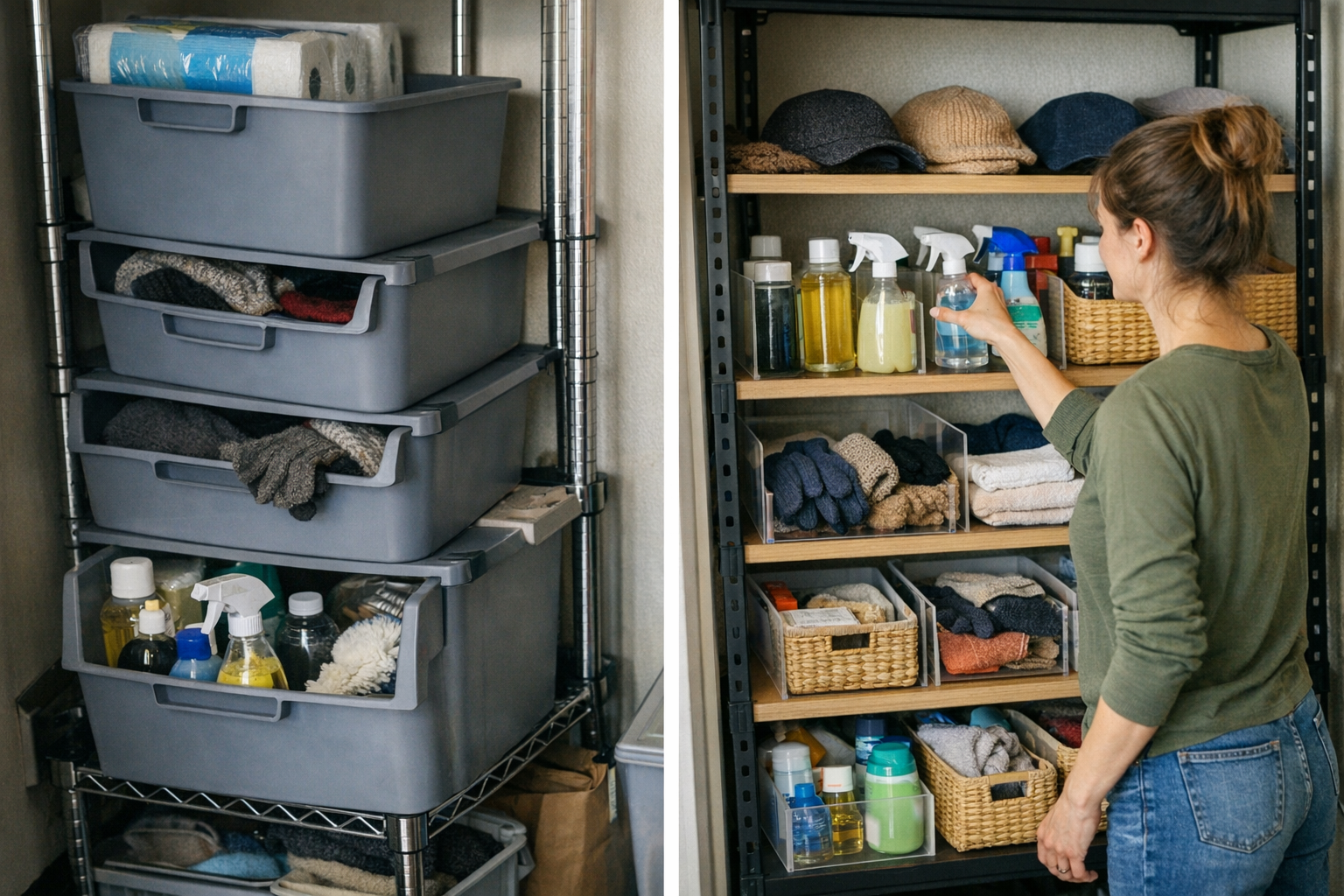
The first glow of a freshly organized closet or utility space fades quickly the moment you need to grab something in a hurry. That crisp stack of closed bins, those neat modular organizers—suddenly, they’re not just décor. They’re the last barrier between you and the one thing you actually need when you’re halfway out the door. In these moments, the difference between open shelves with dividers and closed storage isn’t just about style—it’s about whether your organization holds up against daily life’s clutter and time crunch.
Where Organization Breaks Down: The Friction of Everyday Reach
On day one, closed bins and airtight lids offer an illusion of control. Everything lines up, the shelf edges are clear, and it feels—briefly—like you’re in charge. Then real life takes over. You’re rushing for laundry detergent with wet hands, or digging for a winter hat as the temperature drops. That’s when the cracks in closed storage show: to reach that detergent hiding in the middle bin, you end up shuffling stacks, unsealing lids, nudging three other containers aside. The more often you reach, the more chaos creeps in—because that “just one quick grab” turns into a tiny avalanche of displaced items and off-kilter stacks.
Closed bins are great at hiding clutter, but they’re even better at hiding the things you need most. A new pack of batteries tossed on top. Last week’s receipts wedged behind. A stray cleaning spray balancing on the lid because pulling out the whole bin feels like too much work. Before long, what sits flush and perfect on organizing day becomes a layered puzzle in daily use.
The Slow Slide: From Picture-Perfect to Unwieldy
After a handful of real-world retrievals and returns, the shelf loses discipline. Bins once packed by category start to blend. A scarf lands on the cleaning caddy. Batteries migrate into the sewing kit. Folded stacks lean, lids wobble, and overflow crowds the shelf edge—items with no clear home pile up anywhere there’s a gap. You still see order on the surface—stacked bins, closed lids—but every grab-and-go means more silent reshuffling and less actual clarity.
This slow drift is sneaky. Organization doesn’t implode overnight; it unravels one overlooked shortcut at a time. The warning signs aren’t dramatic but unmistakable: longer rummages, items slipping out of place, and that creeping sense of “I just put this away—why can’t I find it?” It’s not just about tidiness; it’s about speed and certainty when you need to rifle through your own stuff.
Open Shelves with Dividers: Clarity You Can Hold Onto
Swapping out closed bins for open shelves with dividers changes the rules of the game—especially in spaces you touch every day. Each item gets a visible “lane.” Gloves have their clean slot. Spray bottles sit upright, no pile balancing required. You see what’s there—nothing burrows down or gets stacked out of reach. If something wanders, you notice and reset before the clutter takes over.
One-motion grabs matter. Need the lint roller? It’s not an excavation—just reach and go. Returning items is just as foolproof: the shelf itself enforces the boundaries. If a scarf sprawls into the next section, you see it instantly. That visibility doesn’t just keep things tidy; it makes resets automatic and quick, rather than a future chore.
Real Closets, Real Results: A Week in Use
Imagine an average week: Monday, you grab a flashlight from a closed bin, toppling a few odd-shaped chargers along the way. Midweek, the shelf’s surface is blocked by bulky grocery bags you dropped in haste—now you can’t slide out the lower bins at all. By Thursday, you’re burrowing for an umbrella, moving everything twice. By the weekend, categories blur, items end up where there’s space, and even a quick grab feels like work.
With open shelves and dividers, the same week plays out differently: gloves, umbrellas, flashlights—each in sight and reach from the start. Dropping something back is a second-nature reset because the shelf itself tells you when something doesn’t fit or belong. Overflow isn’t invisible; it’s instantly obvious and easily corrected. Day-to-day, minor messes get caught and reset before they seed larger chaos.
Spotting Storage Friction Before It Slows You Down
Systems rarely implode, but subtle signals warn you when your storage is fighting back:
- Endless reshuffling — shifting stacks and opening lids just to reach one thing, or rearranging three bins for a single spray bottle.
- Category blending — finding hats with cleaning rags, lightbulbs where gloves were supposed to be, and no clear separation between zones.
- Overflow stacking — items perching on bin lids or creeping across clear spaces, making everything harder to access and more likely to spill over.
- Loss of visual lanes — overcrowding that blurs where one category ends and another starts. Edges get soft, resets become a bigger job each time.
These aren’t dramatic breakdowns, but they drag on your time and chip away at the satisfaction of “being organized.” A system that requires workarounds is one you’ll quietly avoid using—or spend too much time fixing.
Keeping Function Ahead of Appearance
Make your storage purposeful, not just tidy. Priority items should be visible and within effortless reach. If a bin always needs shifting or a pile always needs rebalancing, consider carving that space into an open lane with a simple divider.
Spot and solve for repeat clutter spots. Watch for where clutter piles up day after day—entryway shelves, closet bottoms, right inside the door. Open shelves with intentional dividers make these resets nearly mindless, catching drift before it spreads.
Don’t chase catalog neatness—chase real-life resilience. The goal isn’t a frozen display, but a setup you can trust to recover quickly after a rushed morning or a messy week. A shelf that forgives misfires and invites fast correction will outlast anything that requires “just one more minute” every single time.
The Real Benchmark: Does Your System Stand Up to Real Life?
The best organizing setups aren’t the ones that look perfect for a photo—they’re the ones that stay usable when life spins you in a dozen directions. If you can see, reach, and reset your top-use items in seconds, your storage system is working. If you’re tired of reorganizing every few days, consider ditching the high-walled bins for a more open, divided approach. Over time, you’ll notice resets get quicker, things stay where they belong longer, and your shelves signal right away when it’s time to tweak—instead of waiting for another overhaul.
Your daily space isn’t a display case. Let it breathe and flex with what you actually need, and organization becomes less about fighting clutter—more about making every grab, stow, and reset that much easier.