
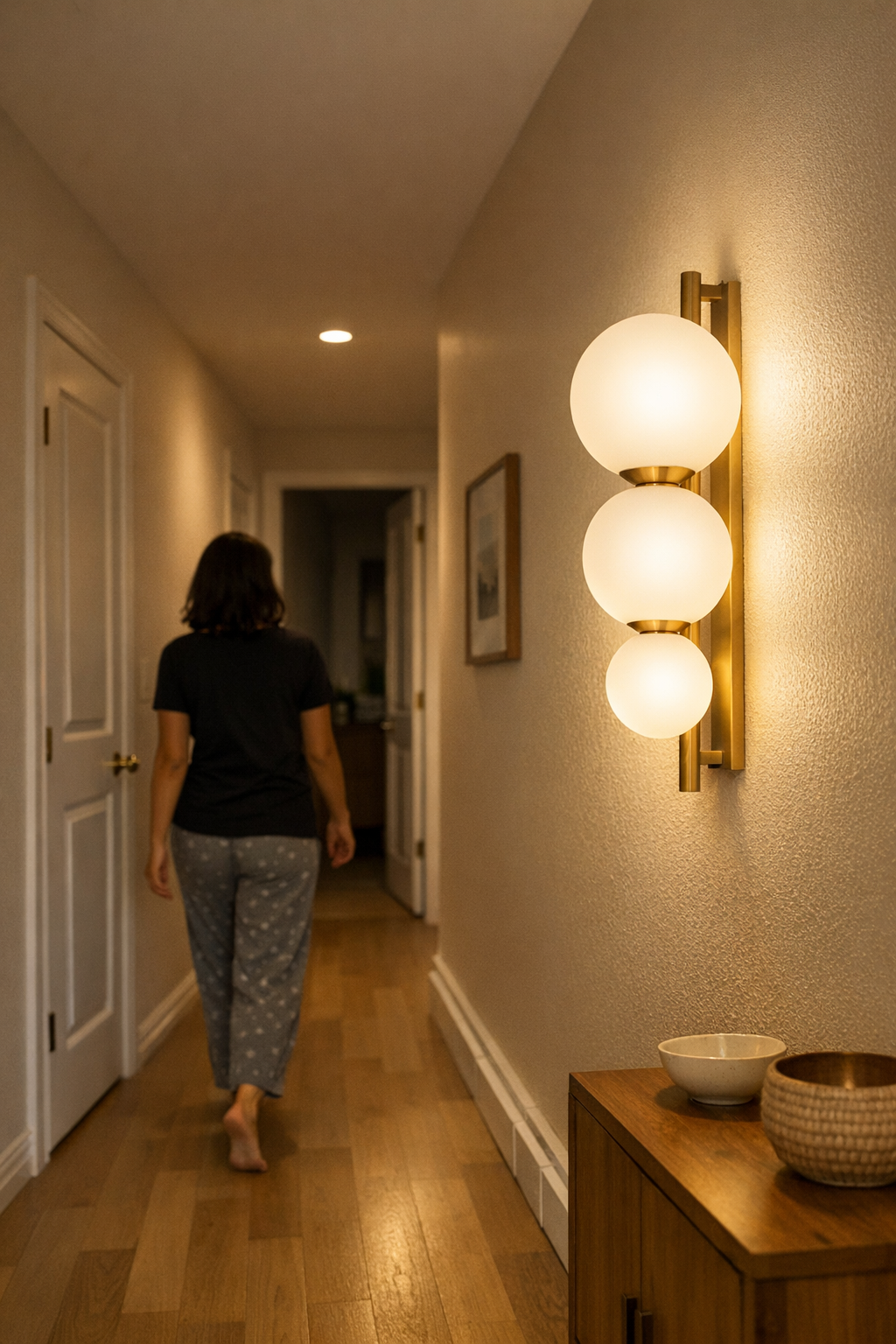
Hallway lighting failures don’t really announce themselves until the rest of the house goes dark. During the day, flush-mount panels and wall lights can look clean, maybe even finished. But at 2 a.m., that “minimal” install turns on you: exposed cords lie directly in the path, glare bursts across a glossy closet door, and a dim strip fails to cover the hallway edge where your foot lands first. What seemed resolved in daylight now drags you into the middle of the night routine—sidestepping hazards you approved yourself. The weak spot is clear: a hallway is a pressure test for lighting and its support, especially when your eyes, feet, and patience are half-awake.
How Small Flaws Turn into Daily Friction
You can’t tell on install day how a cable run or mounting bracket will shape your next hundred crossings. Maybe the cord hugs the wall—until it shifts loose after the third round of cleaning. Maybe the fixture looks balanced in CAD but leaves a gap where the hallway narrows. The difference barely registers at first, but two weeks later, your heel catches a loop, or an unlit patch greets every late walk. These snags aren’t just ugly. They slip into your routine, changing how you move, tugging at your focus, and turning a hallway into a silent obstacle course. The missteps you accept during the day quietly accumulate into nightly friction.
None of this is theoretical. Shadows pooling by a closed room, a flash where light hits the wrong angle, or a cable that migrates just enough for toes and vacuums to find it—these shape the way you move long after you stop thinking about aesthetics. No install looks good enough if you’re still side-stepping old problems with every step after dark.
The Core of Dependable Hallway Lighting
Dependable hallway lighting comes from three essentials:
- Even, non-glaring illumination from entry to end
- Cables routed, locked, and hidden—never just “straightened”
- Stable mounting that doesn’t shift with use or cleaning
If even one fails, routine use exposes it. A fixture can look minimal and sharp on day one, but if its cable sags or the mount loosens after a month, the setup fails its real test. Hallways aren’t display spaces—they’re working routes, repeatedly cleaned, crowded, and crossed. “Looks good” only matters if, after the tenth vacuum or hurried walk, no old risk has crept back in. Minimalism means nothing if the cable dips into traffic or lighting falls short of the far corner where footing matters.
What “Clean” Setup Means After Dark
Aisle lights, wall sconces, or slim LED bars might sell on “finished” looks, but the real difference only shows with use:
- A cable that’s just tucked away at install rarely stays that way. A half-fixed wire migrates, lets shadows creep back, and becomes the most visible detail in the house after dusk.
- A setup with all cables channeled behind a baseboard, all fixings stable and out of hand-level sight, doesn’t just look put together—it never asks for a second thought with every pass, even on cleaning days or late-night walks.
Nighttime reveals the failures. Does the cable stay locked down week after week? Does the light still hit the whole walkway, or did a bracket slip just enough to throw a shadow by the door? “Minimal” only works if the whole structure resists daily disruption. A tidy edge at install is nothing if the job unravels six days later.
Recognizing Problems in Daily Use
The gap between “clean enough” and reliable becomes concrete, not abstract. Have you found yourself nudging a cord back after every cleaning? Noticed the same three feet of dimness along the baseboard late every night? Stepped gently to keep from waking someone, only to trip over a hidden cable? These aren’t one-offs—they’re what most hallway lighting delivers when support logic fails. What could be out of mind instead becomes routine irritation. It’s not until you have to dodge your own lighting for the third time in a week that the difference becomes unavoidable.
Real-World Example: When a Support Change Makes All the Difference
Consider a hallway where a basic plug-in light trailed its cord loosely by the door. By day, it seemed passable—just out of the way. By week three, it had slipped enough to catch a foot or broom, while glare fired off the closet door and left one end in shadow. The small inconveniences grew until fixing it was unavoidable. Swapping in a bracketed LED bar, running the wire tight through a baseboard channel, and mounting the fixture above eye-line ended the hassle overnight. Weeks later: no cord in the way, no cleaning-day resets, no patchy darkness. The right support—not just the right light—quietly erased the problem.
Tips That Last—Not Just for Day One
Choose the Right Light, Then Support It Properly
Mount indirect or frosted fixtures near any reflective surface. Glossy closet doors or mirrors fire back harsh glare when you skip diffusion or precise positioning. Prioritize control over glow.
Don’t settle for “tidy”—lock every cable in place. Cord channels and baseboard tracks solve long-term hassle, not just short-term neatness. Even one loose cord loop increases the risk that cables will reappear or move. Add wall clips in every transition and check stability after a week—the real test of setup comes with repeated use.
Plug-in fixtures demand real anchoring. Months of cleaning, rearranging, or even regular walking work every unsecured cord loose. Hardwired lights or firmly bracketed installs beat visual fixes by actually surviving your routines. If you have to nudge or tuck after every pass, the support isn’t good enough.
Function Over “Finished Look”
The brightest or prettiest light means nothing if the cable you hid last weekend slips back into traffic on Monday. Good mounting and cable management erase risk, not just appearance. The goal isn’t a perfect “look,” but a setup you never need to notice again. When the hallway’s best feature is that you move without thought—no glare, no trip, no reset—your lighting and its support are actually working. Every home is unique, but one pattern repeats everywhere: strong support outlasts any first impression. If something in your lighting routine needs regular correction, look below the fixture—and reinforce what keeps your hallway working for you, not against you.