
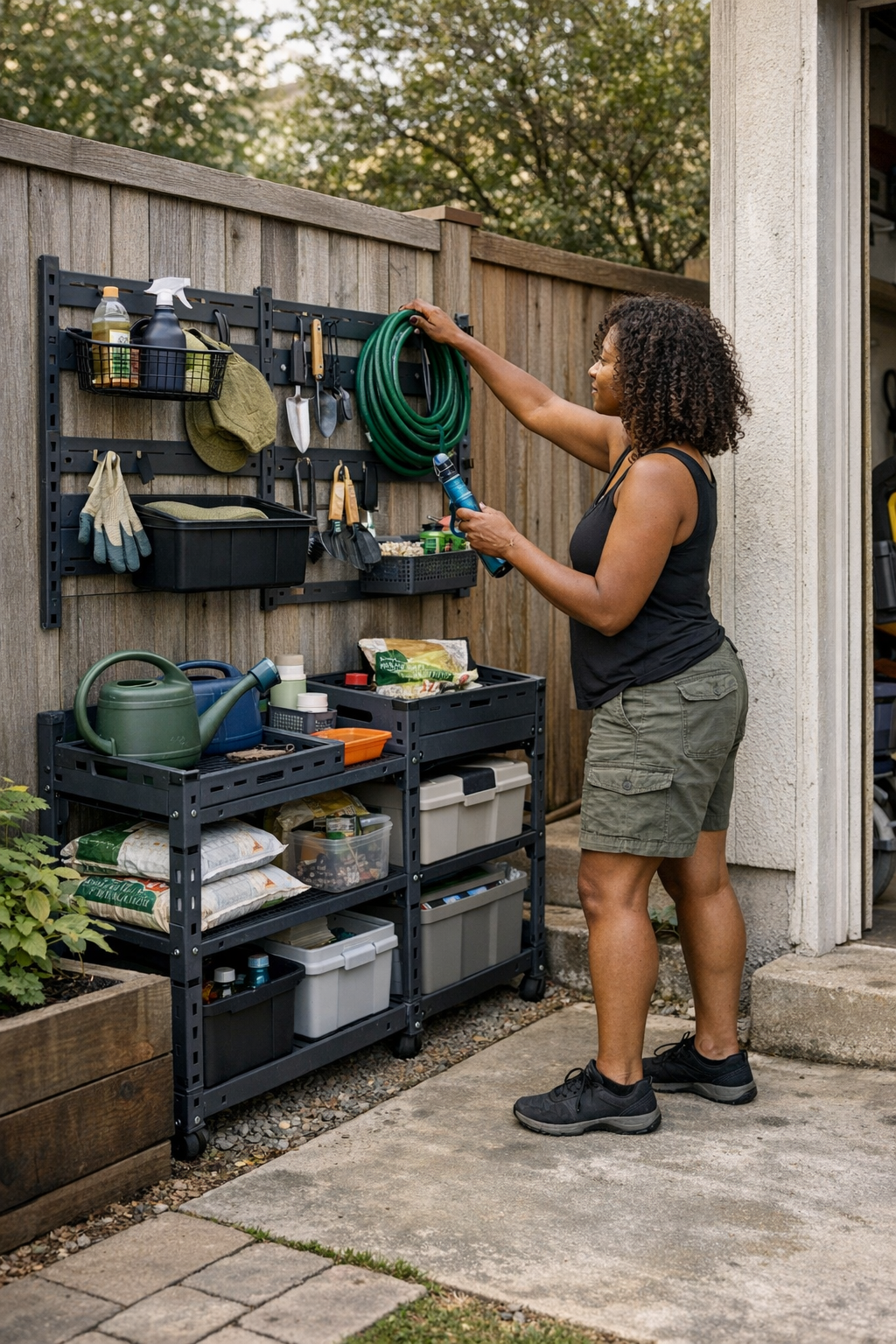
Small backyards and skinny side yards don’t let storage mistakes slide. One lopsided chest or floor bin and suddenly everyday movement grinds down—footpaths shrink, trash bins get blocked, and what looked tidy on Sunday turns into a daily reshuffle by Tuesday. You notice it fast: the return path gets clumsy, corners start to swallow tools and balls, and what felt “organized” in theory now interrupts you in practice.
Why “Good Enough” Storage Fails Fast Outdoors
The illusion kicks in fast: stack two clean bins, clear the patio slab, line up a shelf, and it all seems sorted. But as soon as the week restarts, the old friction creeps in. Grabbing a soccer ball means shifting a mower; a scooter return jams the line to the gate; garden tools get buried under more “just for now” piles. Floor bins promised convenience but now cut the narrow path in half. Wall units installed a shade too high are ignored by kids, and open shelves designed for flexibility quietly tempt overflow to crash the walkway. The proof isn’t in the storage volume—it’s in the way the setup smooths or snags your routine.
How the Wrong Setup Makes It Harder—One Move at a Time
Picture the side yard acting as your main thoroughfare: bikes up from the garage, trash bins headed out, outdoor toys coming and going. Now drop a deep storage box at the end. Sure, it looked out of the way—on a diagram. But tomorrow, you’re taking an awkward detour just to pull out a helmet; two hands juggling the heavy lid, nudging sports gear just to close the thing. Suddenly, one returned scooter blocks the trash can, and your neat path fills with slow-moving clogs and “temporary” piles. Resetting means:
- Moving two things to put one thing back.
- Battling with stuff left out because putting it away isn’t worth the extra steps.
- Watching the corner next to storage quietly fill with overflow that never really returns home.
Momentum disappears. That subtle penalty—a nagging pause before returning something, a reluctant sidestep to reach the fence—isn’t about clutter, it’s about disruption. By the weekend, you’re not clearing up; you’re excavating what felt “organized” just days ago.
The Consequence of Bad Boundaries in Tight Spaces
Large yards can absorb sloppy storage. Tiny outdoor set-ups can’t. Every inch counts, and every misstep quickly becomes visible. A bulky unit on the ground quietly steals walking room. Any gap left “for later” pulls in overflow—turning into a default drop zone you keep meaning to sort. Without clear vertical zones, your return flow stalls; items drift across spaces, and no storage system really sticks.
Two Walls, Two Outcomes
Swap that chest for modular rails or racks, mounted at the heights you actually use. Now the daily loop changes: you come through the gate hoisting a bike, the helmet hooks back in one move, the ball drops straight into a sling at your side—done. No need to angle around a lid, no stash-pile in the way, no stretching for an upper shelf. Essential gear sits at natural reach, deadweight stuff goes up and away, and your walk-through stays open. There’s nothing decorative here, just a boundary that blocks clutter instead of your footsteps.
How Setup Design Unblocks the Return Flow
When storage is right where you need it, and doubly obvious on the way out, excuses vanish. You’re more likely to hang the hose, stash the padlock, and get the ball off the ground as part of the movement, not a separate routine. Simple wall hooks beat closed bins because there’s no lid, no lift—just a habit that happens in passing. Every extra step or lift gets skipped. That’s the difference between tools returning home and tools drifting to that one messy corner—again.
Modular wall panels and slides bring you more than flexibility—they shrink the endless reshuffle. Adjust one section for winter boots, drop another lower for spring garden gear, shift rails when the kids’ routines change. It’s easier to keep the path open because storage adapts, not you. You’re not burning time shifting one pile to reach another or moving bins again just to take out the trash.
Tip: Return Paths Should Guide Themselves
Fix a hook at eye-height by the exit—now, helmets, leashes, and bags find a place without thought. Use slim basket slides low for kids, and dividers so that nothing “temporarily” spreads into the walking path. Set clear zones: daily gear close, occasional stuff up high. The easier it is, the less energy resets require—and even the most reluctant helpers can’t miss the logic.
The Trap of “Looking Organized” Without Working
Tidy at first sight doesn’t mean tidy in practice. Many setups fool you with symmetry or clean lines, but by Thursday, the layout breaks routine—forcing return detours, stacking new clutter, or asking you to explain the “system” every time a guest needs a ball. Real organization means each item has a self-evident path, especially at the end of a busy day. If reshuffling becomes standard, overflow always lurks, and the floor fills before the week is out, the unit isn’t working for real life—it’s working for appearances.
In real outdoor setups, effective storage acts as a silent helper: never blocking your walk, never drawing you into slow resets, never asking for a rethink mid-week. Set up that keeps your flow clear by default—that’s when small yards start to feel spacious again, and one easy return matters more than a perfect first impression.
See practical storage systems tailored for real outdoor spaces at TidyYard.