
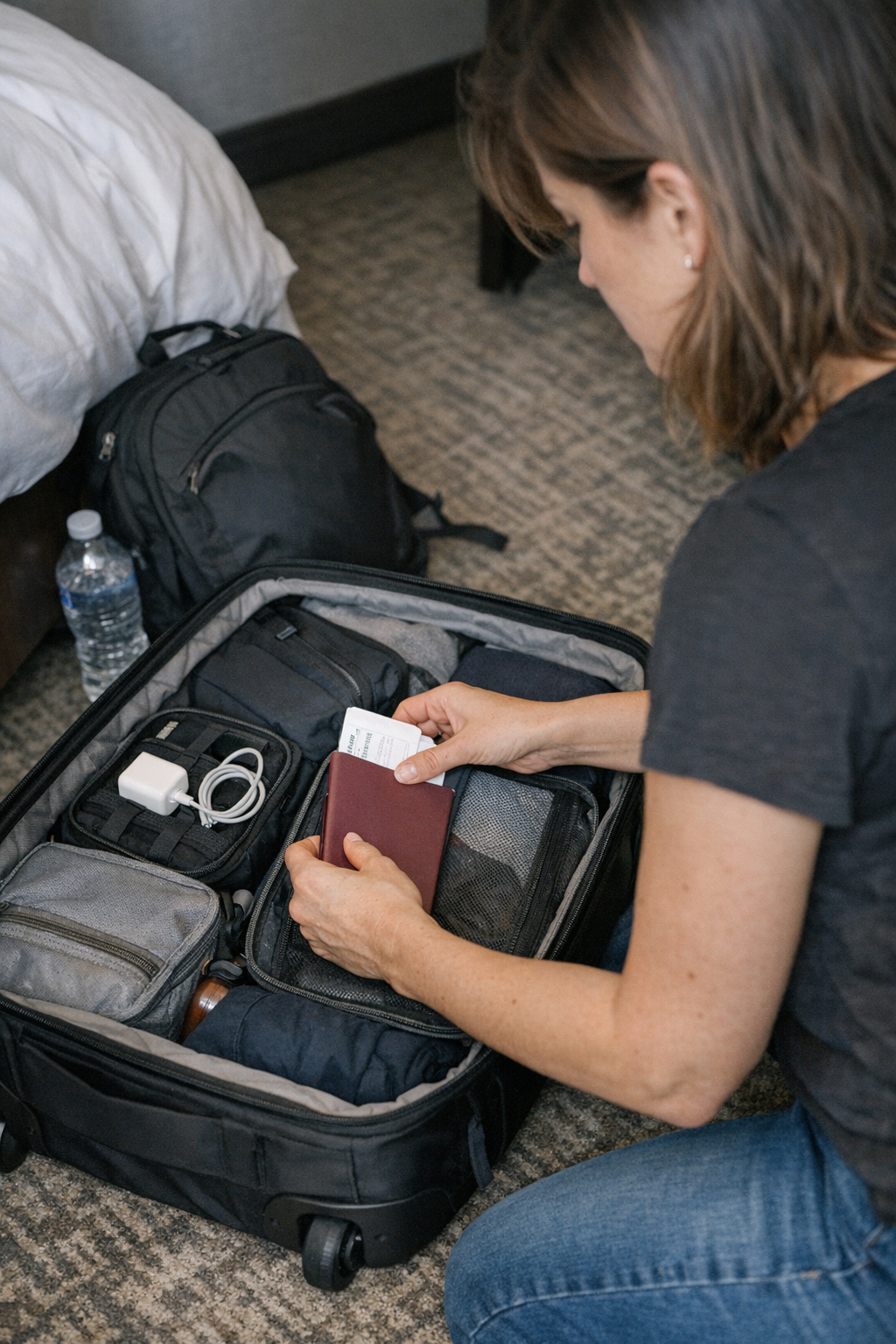
Every traveler knows the setup: you zip your carry-on, admire those tidy packing cubes and crisp pouch lines, and, for a moment, everything looks ready for anything. But one flight in, the real challenge hits—your phone charger goes missing under a shirt, travel documents stick behind a repacked organizer, or your toiletries bag buries itself midway through the main compartment. The inconvenience isn’t dramatic. What breaks your flow is the slow, constant friction—pausing to dig for a passport as the security line inches forward, fumbling through layered pouches at boarding, or losing rhythm every time you need to grab something fast. Even when your bag looks under control, your sequence still gets interrupted, one awkward hand-search at a time—the silent drag that follows every so-called “organized” carry-on.
The Hidden Drag of a ‘Visually Organized’ Carry-On
Visual neatness fools almost everyone: on day one, your bag looks intentional, each pouch slotted by category. But the illusion shatters at the first checkpoint—suddenly, the items you thought would stay put aren’t where you expect. Pulling out your ID at security, you now have to move a pouch that slid sideways during transit. At the boarding gate, a needed cable or hand sanitizer is buried under cubes that looked logical before you started moving. The bag might photograph well, but inside? Pouches slide, documents drift, and outfits compress unpredictably. The problem isn’t visible chaos. It’s the internal disorder that begins as soon as you actually use the bag, not just zip it closed.
This gap—the difference between “packed right” and “works right”—emerges quickly. A bag that feels effortless at home falls apart with just a few retrievals: the tech organizer ends up under a jacket after TSA, your travel wallet gets wedged when hustling through a gate check, and suddenly you can’t trust your muscle memory to guide your hand. You repack in ways that seemed fine for looks but don’t survive a real trip’s rhythm. Each useful category—chargers, masks, snacks, documents—loses its spot after just two or three quick access moments, and your setup lags behind your actual travel needs.
Every Transition Exposes Slow Spots
The danger isn’t one big mess—it’s the chain of small delays that seize up your travel sequence:
- Security lines: Your passport was in an easy-access pocket at home. Mid-trip, it drops below a pouch or gets blocked by an organizer that’s shifted. Now you’re disrupting the entire line as you shuffle layers at the scanner.
- Boarding: You reach for your boarding pass or headphones. Instead, you find them buried under a tablet or stuck behind a half-open cube. The boarding lane presses forward while you repack with your elbows in the aisle.
- Hotel arrival: Exhausted, you unzip for your toothbrush—only to face a stack of cubes you have to remove in sequence, turning a thirty-second routine into an awkward unpack-and-restack on the floor of a dark room.
None of these moments are “disasters”—but they chip away at your composure. Each micro-delay compounds tension throughout your trip, especially when every checkpoint, seat entry, or tray transfer depends on seamless motion. The carry-on that stays pretty on the surface interrupts travel at every layer beneath.
Order That Survives Movement—Not Just Day One
Adding organizers or cubes won’t fix the real issue if the underlying structure fails under pressure. What actually changes the game:
- Essentials—chargers, passport, hand sanitizer—live in assigned, repeatable “zones” next to the zipper or in reliably shallow pockets.
- Pouches face outward and are never stacked in a way that blocks direct access; the right move feels obvious, never hidden.
- Every high-frequency item is one motion away—unzip, reach, retrieve. No secondary digging, no guessing, no second-guessing.
This isn’t about arranging everything for a flat lay. It’s about a structure that holds up when the airport tray scrambles your packing, when narrow aisles force awkward reaches, and when late-night arrivals make you operate on instinct rather than perfect memory. Practical setups mean your charger always comes out cleanly from its pocket, your toiletries bag flashes through security instead of forcing a full unpack, and every document sits ready for one-move access. The carry-on’s order becomes muscle memory, not just visual design.
What Happens When Items Lose Their Path?
Start returning items wherever they fit and your hand loses the “map”—so you waste seconds, then minutes, retracing” the route just to find a charger or ID. The setup isn’t technically messy: it’s just unsupportive. Each time you’re tired, in a hurry, or carrying an extra cup of coffee, the bag gets in your way instead of out of it.
Real-World Scenarios: Repeated Friction in Practical Use
Notice how these ordinary moments expose the difference between theory and repeated use:
- Security line stall: You set your documents for quick access, but after your first tray check, a cable pouch blocks the way—and now you’re the reason the scanner queue slows down.
- Charging during gate wait: Grabbing a phone charger turns into a public shuffle—your neat layout from earlier is now a mixed pile of cubes and cords in the middle of a crowded terminal bench.
- Seat entry: The bag that looked slim now jams under your seat because you stashed headphones in the wrong spot. You kneel in the aisle, annoyed and visible as the flow behind you builds.
- Nighttime repack at the hotel: Poor, tired layout means you upend everything just to get that travel-sized toothpaste. Five minutes gone, energy spent, and still a chance of leaving something behind during the tired re-stack.
Every pause adds up. Over multiple flights, trains, and rooms, the supposedly “organized” setup gives you more to fix and less calm—erasing any early confidence your packing system gave you.
How to Identify Weak Points in Your Carry-On Setup
Test your setup before the next trip—no templates needed:
- Put your bag on a flat surface and try to retrieve, in turn, your charger, toiletries, and travel documents.
- If you have to shift other items—even one layer—for any of them, that small obstacle multiplies when you’re fatigued, crowded, or rushed.
Organizers stacked for looks or “safe” stashing out of sight create drag long before the third or fourth access. A carry-on’s tidiness means nothing if every grab interrupts your momentum.
Building a Carry-On Setup That Works for Your Real Travel Rhythm
Workable structure isn’t maximal packing—it’s intentional order. Anything you need repeatedly lives next to the zipper or in a fixed outer pocket. If you always put essentials back the same way, they stay in reach, not buried by repacking in a rush. Stop letting your setup force you to move a cube every time you need your passport, or lift out your toiletries before you can reach anything else. When the order of your trip matches the structure of your carry-on, every transition—security, boarding, arrivals—gets lighter, faster, and less stressful.
With the right structure, travel stops feeling like a series of small obstacles and starts to run as one flowing motion—repacking, retrieval, and access become second nature, not a constant reshuffle. It isn’t just about aesthetics; these choices pull friction out of travel itself and finally let your carry-on perform at the pace you actually move.
Find carry-on-ready organizers, document holders, tech pouches, and packing tools built for the realities of repeat movement at CarryOnSupply.