
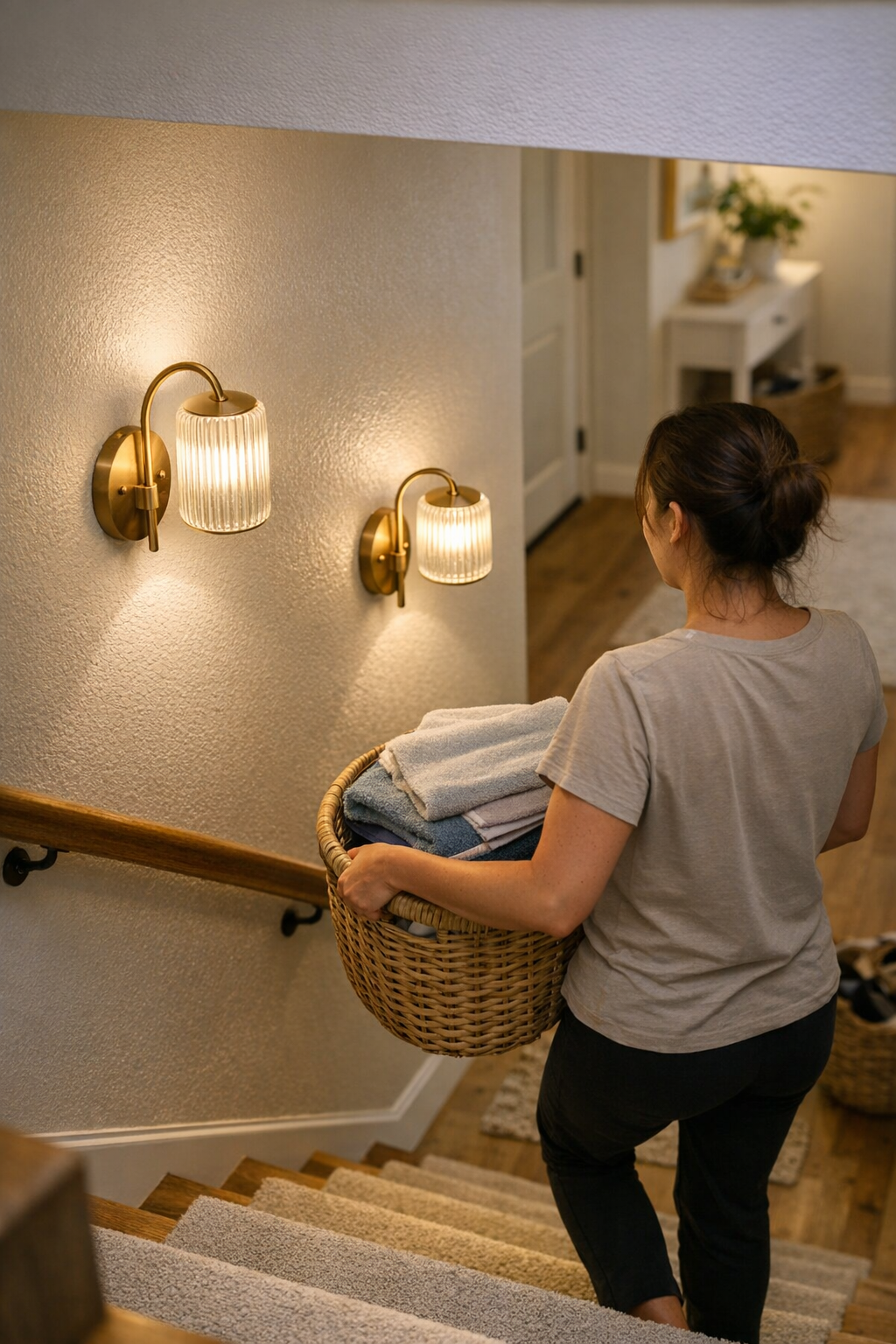
The moment you call a room “bright enough” is usually the last moment it actually is. Install a flush-mount ceiling light in the hallway, and it seems fine—until you’re taking laundry up the stairs with one hand, pausing at a shadowy turn because the final step slips into darkness. A week later, the frustration repeats: the edge of the countertop vanishes under a stretch of cabinet shadow, or one side of your face blurs in the mirror, half-lit and uneven. These small but steady interruptions don’t just reveal bad lighting—they stack into routines you start to dread. Indoor lighting that looks solved on day one can unravel into friction at every stair edge, countertop, and reflection once daily movement puts it to the test.
When Everyday Routines Expose Lighting Weaknesses
Lighting almost never fails during a quick glance. Its weaknesses become obvious when your hands are full, your eyes are adjusting, or your path needs to be certain—like pausing mid-stair because shadow falls exactly where you step, or wiping down a kitchen counter only to discover, in the morning sun, a streak of missed spills kept hidden by angled glare. Lighting that claims the space with nice output on paper can fail the first real test: repeated, imperfect movement where confidence is required.
Lighting passes or fails in motion and repetition, not in a showroom photo. If you find yourself hesitating or shifting to avoid a shadow, what “looked bright” on install is quietly derailing your routine.
The Real Gap: Looks Bright vs. Works Right
A room can glow on first power-up and still fall short. Many flush or semi-flush ceiling fixtures pour light into the center but leave edges dim, corners faded, and surface tasks half-lit. Your laundry basket stays in shadow unless you hover directly under the fixture. Navigating a corridor, you might feel the distance to the side wall as patches vanish from sight, making every open cabinet or doorway feel riskier at night. The illusion of even light vanishes when real movement or work is required, and the unlit zones become predictable sources of slowdown.
Bathrooms and vanities especially show this: an overhead fixture can leave your face split between glare and dullness, making shaving or makeup a trial in second-guessing. With time, you unconsciously accept these awkward imbalances, learning to lean in, squint, or mentally map out which areas just never quite light up the way you need.
Where Lighting Actually Trips You Up
Specific friction points repeat in lived spaces:
- Stair turns: The ceiling fixture throws a tight shadow with your body, forcing hesitation at the step—the pattern repeats whether it’s midday or evening.
- Hallways: One end remains dim; even with a strong bulb, the far wall retreats into gray, and safe footing along the edge never feels certain.
- Utility counters: Under-cabinet shadows hide what cleaning missed, while a sharp glare bounces from a glossy counter and baits you into moving your head instead of your hands.
- Mirror glare: Overhead bathroom lighting dodges half your face, so the reflection you actually work with becomes unreliable—every attempt to “get in the right light” turns into subtle gymnastics.
When lighting works against you, it slowly disrupts every repeated action—movement, cleaning, grooming—until you start working around the light instead of with it.
Matching Lighting to Daily Patterns and Obstacles
Adding more lumens alone rarely fixes these weak points. What matters is targeting light to exactly where routine friction shows up. When a stair turn forced daily hesitation, replacing the sole overhead with two slim wall sconces at step height changed the entire path: sudden clarity revealed dropped gloves or toys before a foot ever landed. The friction wasn’t just visual—it was navigational, and the fix was placement, not power. Now, moving through that stairwell requires zero extra attention, even exhausted or distracted.
In the kitchen, switching on under-cabinet strips means the full run of countertop is visible—you can instantly see spills, crumbs, or utensils right at the edge. No more leaning in or guessing at what’s hidden in the shadow cast by the upper cabinets. Likewise, a pair of hardwired vertical mirror lights in the bathroom removes the daily scramble for good light; the whole face appears evenly, with no need to adjust your angle or give up on fine-grooming at night. It’s the structure and location—and how they respond to actual movement—that recasts lighting from obstacle back to support.
Moisture-Prone Areas: Where Standard Fixtures Fail Quietly
Bases in bathrooms or laundry corners often look fine at first but falter under real use. Steam and condensation break down ordinary fixtures fast, fogging up output and leaving visibility patchy after every hot shower or heavy laundry run. Upgrading to damp-rated lights is less about specification and more about simply making sure the fixture actually stays functional—so the room doesn’t slowly slip into shadow or flicker the longer you own it.
Spotting—and Solving—Hidden Lighting Problems
Recurring slow steps, side glances at mirrors, or a habit of nudging open a cabinet to find what the counter missed—none of these are quirks. They’re the real audit: if you adapt your movement, squint, or double back to “find” what light should reveal, your indoor lighting isn’t supporting your routines. The weak spot is usually in the spread, angle, or position of the fixture—not the headline wattage.
Quiet diagnostic: If you shift, pause, or hesitate in the same spot each day—the bottom stair, entry corner, sink edge—track exactly how the light falls and what gets missed. In many cases, a modestly placed wall sconce or a cheap under-cabinet strip outperforms a new, brighter ceiling bulb at banishing these everyday gaps.
Lighting That Simply Works (and Why It’s Rare)
Good lighting almost never draws attention to itself—but the wrong fixture forces you to notice, usually at the worst possible moment. You should be able to walk, clean, cook, or check the mirror without tracking shadows or bracing for glare. The correct strategy isn’t chasing bigger bulbs or trendier hardware; it’s recognizing the mismatch between fixture style and the way rooms are actually navigated. Every lighting decision should begin with a stubborn look at where routines fail—at the stair you always slow down for, the face half-missing in the mirror, the counter that never quite feels finished after cleaning.
When you shape lighting structure around honest daily movement—layering flush or semi-flush, wall lights, under-cabinet, or damp-rated fixtures where old friction appears—you stop propping up bad routines and let rooms quietly do their job. The relief isn’t just visual. It’s practical, trust-building, and hard to ignore once you’ve lived with the difference.
Explore practical lighting solutions for daily routines at LightHelper.