
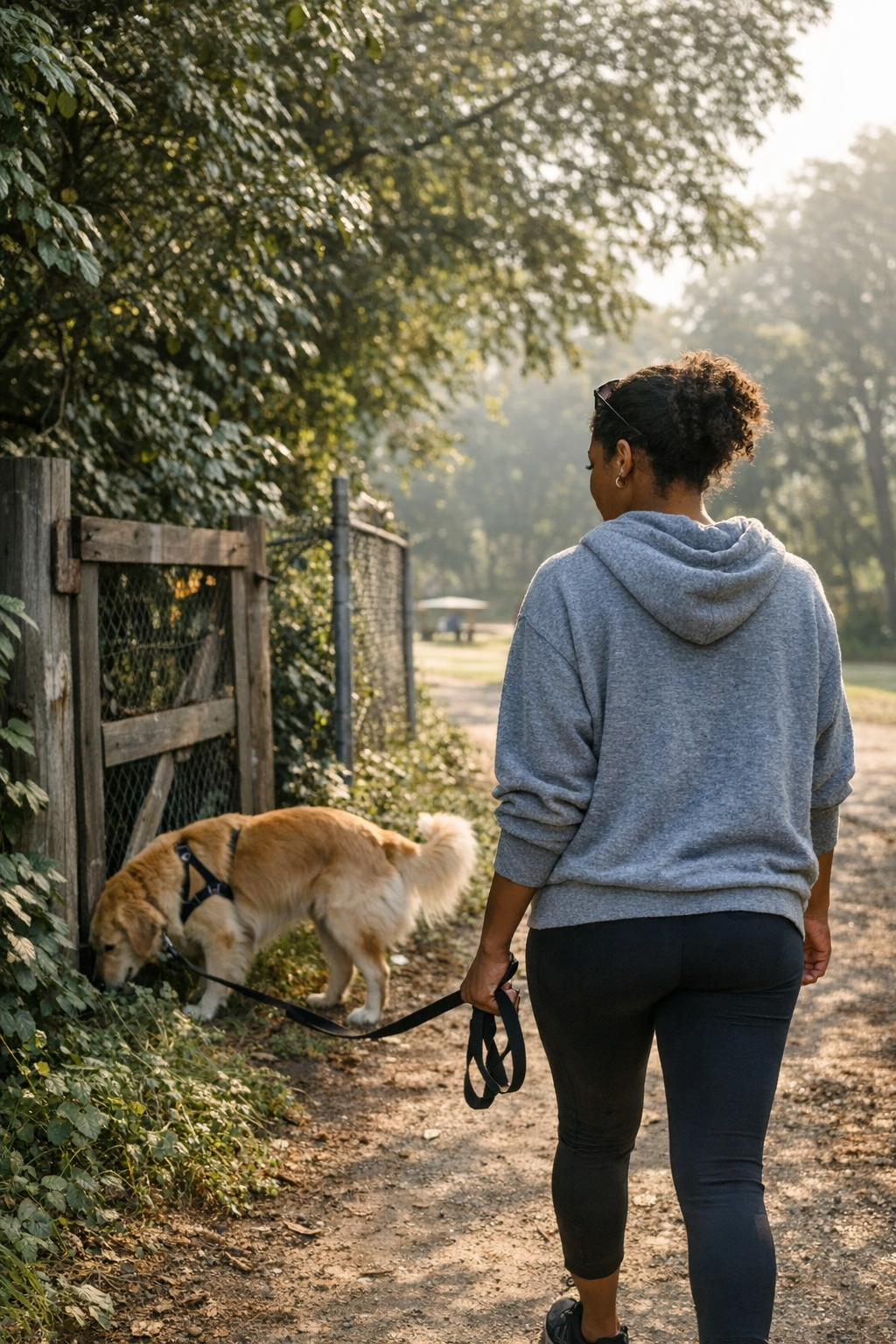
You know the routine: leash by the door, shoes on, and you’re outside—same route, same return, convinced the predictability should save time. But after a week, the cracks show. Each walk interrupts your morning for all the wrong reasons: feet stuck at the same gate, leash snagged behind a backup harness, towel always out of reach when muddy paws land. What looks “ready” by the door hides a line of friction points that slow you from first step to the last bowl wipe. DogPile’s world makes one thing clear: the tangle isn’t from chaos, but from routine setups that look neat but stall your actual flow.
Why Familiar Walks Still Get Stuck
What holds you up isn’t just your dog’s curiosity—it’s a routine that keeps bottlenecking itself in the same stubborn spots. If you can feel leash tension tighten before you hit the usual corner, you’re not imagining it. That patch of grass or battered trash can—your dog makes a pit stop, you brace for a pause, and seconds leak away. These stalls aren’t random; repeat them enough times and they carve delays right into your daily reset, no matter when you try to move faster.
Even a route you know blindfolded builds friction where it doesn’t show on paper: a fence with lunging dogs freezes your leash arm, your own dog digging in, and then a crosswalk hesitation stalls everything again. The real price isn’t “lost enrichment”—it’s morning minutes leaking into breakfast, chores, and the mad scramble to regain your home rhythm.
The Small Delays that Undermine the Flow
A walk that’s supposed to be simple never quite is. The hold-ups aren’t one-offs—they stack, checkpoint by checkpoint: a fire hydrant held hostage for sniffing, a driveway that’s always a dramatic pause, a mailbox claimed as a daily ritual. The route repeats, and so do your dog’s stalls.
- Stuck waiting at an intersection, your dog scanning for something invisible while you look at your watch.
- Trying to gently tug your dog forward while she turns cement into an anchor at the same old gate.
- Finally moving on, only to pause again as she fixates on a lamppost—meanwhile, you’re reworking your mental checklist on the fly.
Each pause ripples: your breakfast sits cooling, wipes are where you can’t grab them, and your coffee break shrinks because the “efficient” walk has thrown off your entire schedule.
Efficiency Isn’t Always What It Looks Like
A tidy entryway hides the traps a repeated routine leaves behind. Predictable walks should mean faster resets: leash off, paws wiped, water down, back to business. But a perfect setup on the surface—leash hung straight, treat pouch set, toy bin tucked—only hides the actual interruptions that come from lived use. The moments that count don’t happen where you thought, especially after several days of the same start-stop drama. One misplaced harness turns reaching for the leash into a fumble. The towel is somehow never on the right side of the door, again. Or worse: your just-cleaned mat gets soaked because your dog cuts off your step at the water bowl the second you walk through the door.
Visual order means nothing if your repeated actions keep getting blocked. Where bowls, towels, and gear actually land in your setup—whether on purpose or by shrugging convenience—decides whether your routine keeps you moving or quietly jams the flow every single morning.
Why Sticking Points Keep Coming Back
You expect that with routine, the sticking spots will fade. But when the route stays the same, the same stalls don’t just persist—they become built-in. By week’s end, you know your dog will anchor herself at the fence or fixate on the trash can, even when the clock is ticking. These aren’t training mishaps; they’re the cost of repetition, embedded right inside the structure. The more familiar the path, the more your dog confirms those as “approved” pausing spots. The walk isn’t getting easier—it’s quietly locking down your flexibility, making the idea of a “quick walk” a memory.
The Ripple Effect: One Stall Can Reshape Your Whole Morning
Delays on your walk don’t stay outside—they drag into every step that follows. A run of pointless stops means your reset at home comes derailed. Breakfast bowls go missing under cabinets. The towel you need for muddy paws isn’t by the door when it matters. Suddenly, you’re kneeling, stretching, managing a leaping dog, and realizing that your time-saving routine is stealing time at every stage.
Real-World Example: When Routine Fails the Reset Test
Say you use the same route every morning. You fudge the timing because you know the routine bottlenecks—a fence, a gate, a familiar patch of grass. But one morning, it all runs late anyway—ten extra minutes lost because your dog dug in even harder than usual. Back inside, you’re stuck searching for the right towel, fishing breakfast bowls out from under the cabinet as your dog paces impatiently, and nothing feels reset. The setup that looked efficient added two new interruptions before you ever sat down with coffee. The friction wasn’t random—it repeated right on cue.
Adding Variation: Small Shifts Make the Routine Work Again
Breaking bottlenecks doesn’t require reinventing your whole setup. Sometimes a tiny shift resets the flow. It might mean sliding water bowls out just far enough that you’re not crouching or risking a spill on your way in. Or switching your walk start to a different door, so the most stubborn stall comes earlier—or later—instead of at the worst possible moment. Shake up the route, and your dog’s predictability blunts. She can’t anchor to the same old distractions. The walk finishes cleaner, with fewer backtracked steps and less frustration carrying over to feeding, cleaning, or settling in after.
Variation Adds Interest—But Also Practical Flow
Dogs hunt for friction points. Shake up their “auto-pause” cues by varying direction or switching up the handoff, and you’ll spot shallower stalls and fewer planted paws. This isn’t about fancy novelty—it’s about making sure your morning doesn’t trip over the same weak spots, day after day.
Fix What’s Sticky, Not Just What’s Messy
Neatness and flow are different battles. It’s not the visual mess that kills your speed—it’s the hidden traffic jam where gear, toys, and walk tools stack just wrong. Look at:
- Toy baskets nudged too close to the crate, forcing a shuffling act every time your dog comes home for a break.
- Leashes tangled together so the one you use most takes three tries to grab—or causes you to drop everything else on the way out.
- Cleanup wipes always almost within reach, but never quite where your hand lands as you step through the door with muddy paws.
If your hand has to hunt, pause, or sidestep, the “tidy” routine is already slowing you down. The friction’s built into the layout—not your habits.
When Short Walks Backfire
Cutting your loop down to ten minutes, thinking it’ll buy you margin, only works if the routine actually gives back that time. But identical routes mean identical stalls. If your dog comes home restless or starts pacing right after a “quick” walk, the time saved is lost at new sticking points—restlessness, poor reset, or splashes into other routines that needed a smooth handoff.
Efficiency is more than just minutes on the clock; it’s how the routine sets