
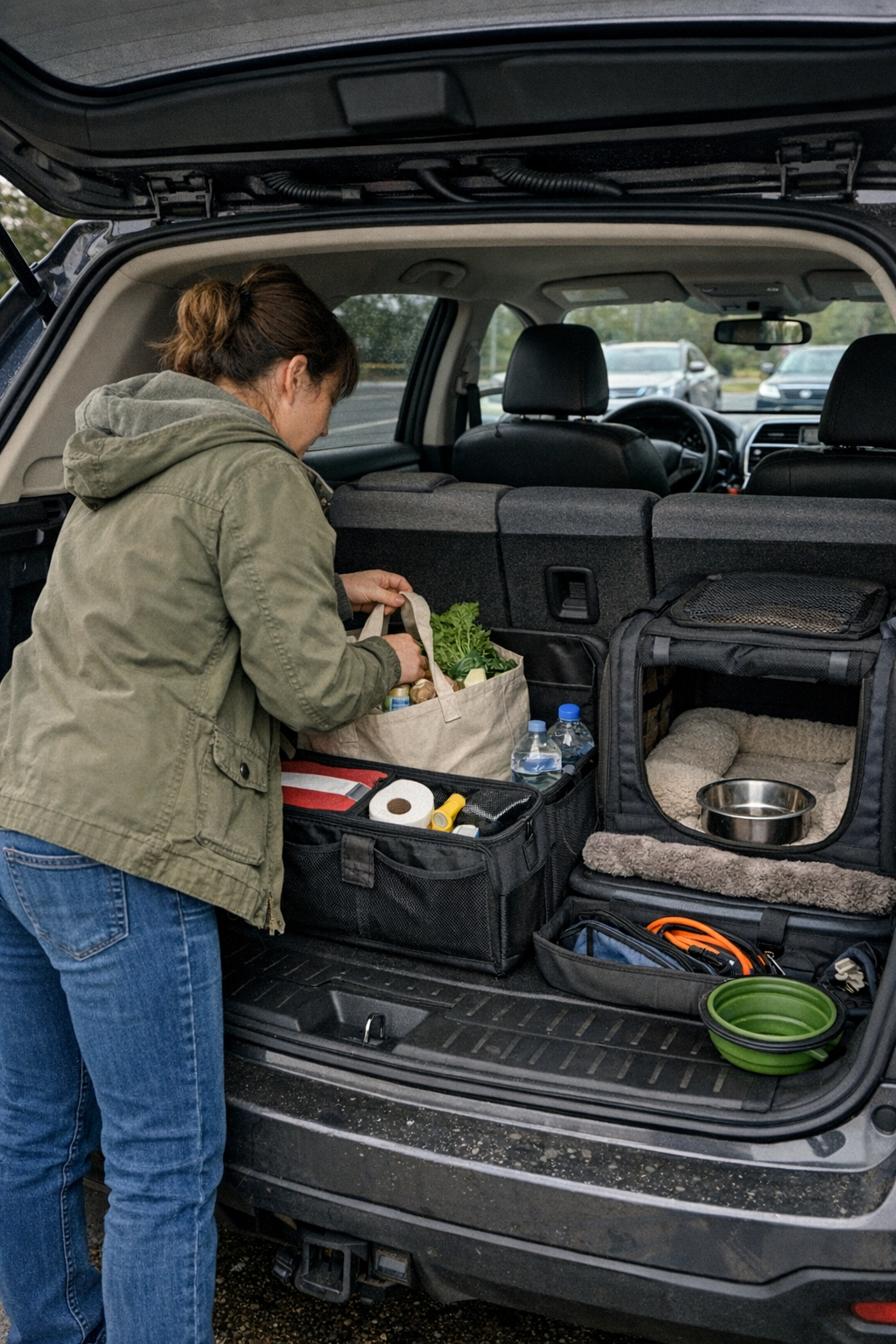
Everyday car use breaks “tidy” faster than you think—especially if you’re in and out of your car a dozen times a week. Step in after work, quick errand, or a kid drop-off: cables are tucked, wipes in their tray, phone mount set just so. But as soon as you pull out, what seemed organized in the parked car quickly turns inconvenient. One charging cord catches your knee. The sanitizer bottle slips from door pocket to footwell. Coins from your “decluttered” tray slide toward the shifter. The reality isn’t mess—it’s the steady grind of having to adjust, nudge, or move the same pieces again and again. That’s when you realize: the steering wheel area isn’t a design showcase; it’s a stress test for any car setup.
Why the Steering Wheel Area Falls Apart So Quickly
This zone wants to hold everything—phone holder, charge cord, sanitizer, keys, parking pass—and still let you drive safely. Even after you organize it, the cracks show fast: a cable slides loose and tangles near your pedals, a bottle knocks loose on a curve, or a mask wedges itself against the cupholder. In most cars used daily, the friction returns within days. No major spills, just repeated, low-level interruptions each time you settle in. By week’s end, you’ve done ten “quick fixes” and the area still fights you during normal re-entry or a fast parking-lot stop.
The Hidden Cost of “Tidy” That Doesn’t Work
Visual order isn’t operational order. If you regularly nudge the same cable aside, reposition a mount after it slides, or notice pocket organizers failing to stay put after a routine drive, your system is costing you time and focus. Most setups don’t collapse, they just leak: each shifted wire or half-blocked cupholder means another micro-adjustment. These pressure points might seem minor, but with repetition, they become routine obstacles—especially when arms are full, roads are wet, or you lose daylight. Any car zone that can’t hold up to genuine repeat use isn’t just “not ideal”—it’s a slow drag every trip.
What Real-World Car Use Actually Feels Like
Picture this: Rainy errand, bag in one hand, the other swiping for navigation. The phone mount stays, but the charging cable slaps across your knee. Hand sanitizer, meant to be handy, clogs the only clear grab point. You try to shift, but a coin tray wobbles, receipts drift into the shifter slot, and you’re doing low-level cleanup before you even buckle in. None of this reads as “mess,” yet it breaks flow—a week of these moments stacks up into a pattern: driving begins with a mental note about what to fix next time, instead of focusing on the road.
The Subtle Problem: Good-Protecting Solutions That Still Interrupt
Every “fix” risks causing another problem. Run a charging cord under the mat for a neater look? Now when the mat slides, the wire sneaks under your foot. Add an organizer to the dash? Maybe you’ve slowed your reach for parking passes or GPS access. You swap one interruption for another; the routine never works as smoothly as it looked on day one. The real difference isn’t “looks organized” vs. “looks messy”—it’s whether your setup creates fewer interruptions on the third, fifth, or fifteenth use, instead of quietly adding new ones you tolerate until you hit your limit.
Making a Setup That Handles Routine and Distraction
After too many trips where the cable wrapped around the pedal or the phone mount blocked defrost controls, I rebuilt for single-move, zero-hesitation returns. Phone mount fixed left of the wheel—quick glance, quick grab. Charging cable clipped high, always just above the mat—never drifts, never dangles near my leg. A slim pocket slid between seat and console: sanitizer and keys land there without rolling loose. Does it look as staged as a car commercial? Not even close. But every high-touch item cycles back instantly, no hesitation, no surprises—rain, shine, or arms loaded with groceries. Critical reach lines—seat to wheel, wheel to shifter—stay open on every entrance.
Car Organization That Survives Actual Use
The only setups that pass the daily test are the ones that let you return, grab, and go with one motion—even when distracted or rushed. Good organization happens when nothing blocks the seat or pedal path, the cable never swings out of line, and no pocket sags or dumps its contents because the last drive was bumpier than expected. Any fix that still interrupts your re-entry or return flow is unfinished business. End-of-day reality: the best system is the one you forget exists because it doesn’t demand one more adjustment, clean-up, or workaround—regardless of how many times you get behind the wheel.
Find gear designed to survive repeated car use at DriveWellSupply.