
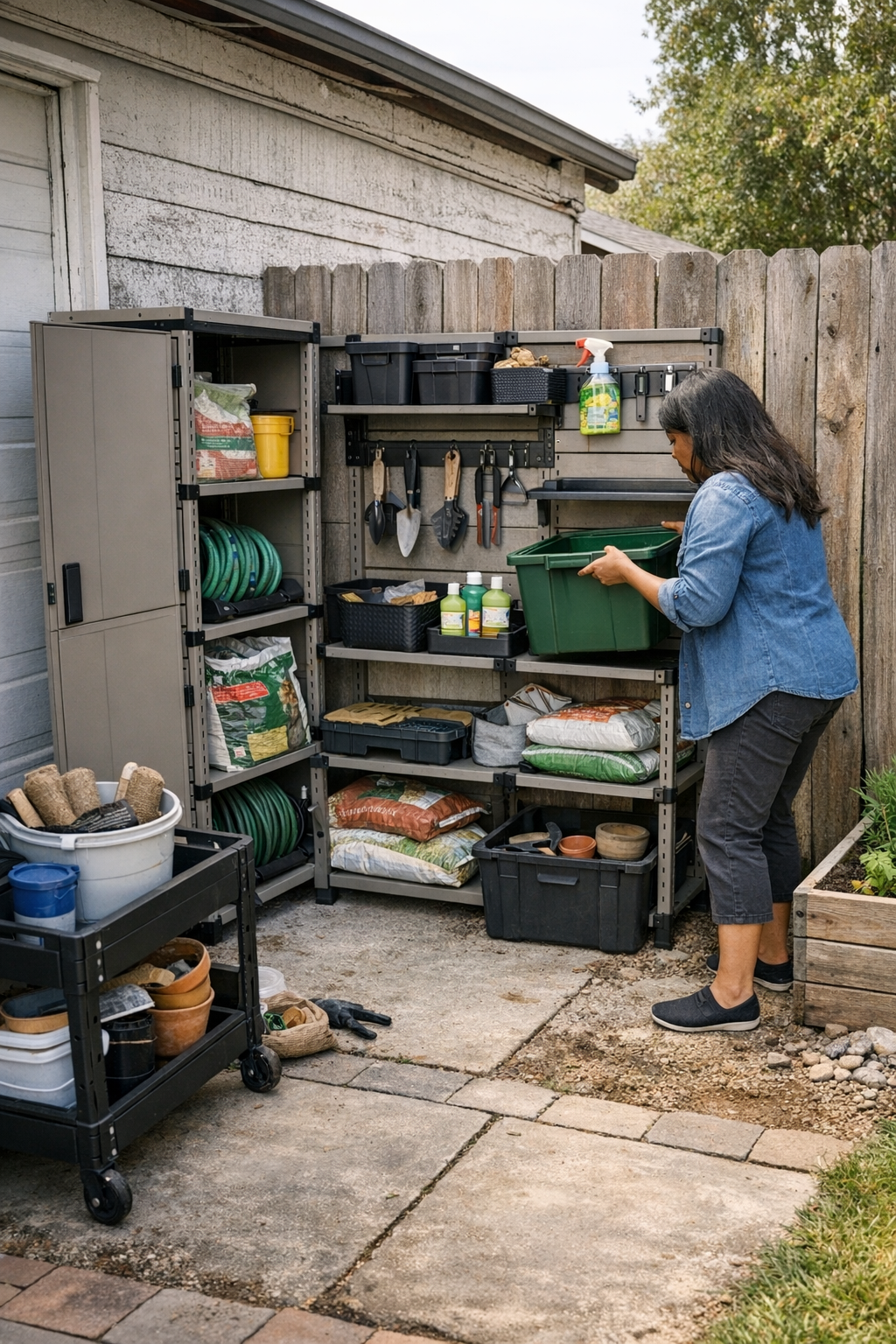
Step outside and take a second look at your setup: The storage shed you swore would fix the chaos, the tidy rack hanging tools along the fence, the new cart parked near the garage—they’re supposed to fix everything. For a few days, it almost feels true: shed doors glide shut, hoses loop smoothly onto hooks, the side-yard isn’t a maze. But sooner than you expect, those clean lines blur. Tools end up stranded by the bins. The walkway narrows with each new pile. Setup friction creeps back in, and your backyard begins to feel like a test of patience rather than a functional space.
When “Organized” Isn’t Built for Real Use
Outdoor order rarely unravels in a single afternoon. More often, it seeps in through the small cracks—one rake wedged awkwardly into a too-tight slot, bins nudging out into main paths, a shed door blocked by overflow that wasn’t supposed to exist. Suddenly, putting away one trowel means relocating two buckets first, and the supposed “system” turns into a daily workload. The problem isn’t always too little storage—it’s storage that doesn’t align with how you actually use the space.
Overflow and Pinch Points
Freestanding units grab square footage without warning. At first, they swallow scattered gear—patio cushions, hoses, bikes. But their rigid shape rarely flexes when seasons change and habits pile up. Soon enough, tarps sit draped over shut lids, boots and chairs line the perimeter, and the actual path to the shed is blocked by what was meant to be hidden. Every extra task—planting, cleaning, hauling bins—turns into a mild shuffle. If every “reset” requires shifting heavy bins just to reclaim a walkway, your storage is silently fighting your routine.
Wall Systems: From Tidy to Tangled
Wall racks offer hope: tools up, puddles gone, floors clear. But that order holds only if every last rake and hose gets returned to its labeled spot, every time—rain or shine. In reality, wall systems often break down after a burst of use: gear sags into a pile against the base, hoses slip free, stray trowels appear near the threshold. Now the “clear floor” is a clutter magnet, and you’re dodging scattered tools just to reach the gate.
How Setup Friction Shows Up
Sometimes the signs are obvious—a shovel you trip over, a door that won’t open without a gear shuffle. Other times, friction creeps in quietly until you’re spending more time moving items than actually using your yard. Watch for these early warnings:
- Walkways taken hostage: A hedge trimmer pokes out from a bin; a bucket blocks the gate. Setup is quietly losing its grip.
- “Just for now” stacks: You leave a hose coiled on a step or a tool off to the side because returning it feels like a chore—move two things to hang one.
- Cluster traps after a rush: One rainstorm, or a crowd in the yard, and everything ends up dumped in a corner or behind a door where order used to be.
- Awkward returns: Needing to lean over bins, reach behind racks, or push aside carts to store a single trowel—the setup doesn’t match the real flow of bodies and tools.
Let these small battles warn you: the “organized” look isn’t holding up under real, repeated life.
The Toll of a Storage System That Doesn’t Flow
You won’t notice the weak spots until they trip you up, literally: having to move bins just to reach the mower, side-stepping fences to fetch a hose, rerouting around storage units that looked right on paper. Over time, these pinch points turn organization into another job to dread.
Freestanding Units: Trapped by the Footprint
Large sheds and storage boxes can shelter the mess—until their rigid footprint traps movement. In tight spaces, even a decent-sized unit can block short routes or force repeated “gear swaps”—pulling three things to get to the one you want. Instead of clear space, you get a shifting gauntlet of overflow along the edges. The promise of order fades every time you have to work around your own setup.
Wall Systems: Brief Relief, Easily Broken
Wall storage is a savior in narrow or high-traffic strips—garage edges, tight side-yards—where every foot counts. But this only works if tools actually go back up and loose ends don’t slide down. The first time someone leaves a shovel at the base or dumps a coil of hose by the fence, the zone becomes another tripping hazard, not a solution. Tidy turns to tangled faster than anyone expects.
Mobile Carts and Modular Racks: Moveable, Not Always Useful
Rolling racks and carts promise quick resets and seasonal shifts. Move them out in spring for gardening, swap them in fall for covers and lights. But without boundaries—visual, habit, or actual marked zones—they wander. The garden cart blocks the path to the trash bins, the storage rack parks in the way of the bikes. Mobility helps, but drifting storage becomes just another obstacle if it isn’t anchored by how you actually use the area.
What Everyday Pushback Looks Like
Here’s how it plays out: You finish with the hedge trimmer. But the shed is blocked by the mower, so you wheel that out first, carrying a layer of grass clippings into the walk. The side-yard narrows because bins from trash day are still drifting back into place. Or you reach for a bike in the morning, but a cart of gardening tools is pressed up against the garage threshold. Nudge it over, and now you’ve closed the path to your bins. These little dances happen more than you think—reset after reset, proof that your setup’s footprint isn’t built for repeated returns.
Overflow Corners and Resilient Dump Zones
Some outdoor corners seem to attract sprawl no matter what: the dead patch near the patio step, the fence-line behind a shed, the cramped edge of a garage wall. If your setup doesn’t match the movement of tools, bikes, and bins, these areas become quiet landfill zones—slowly collecting the overflow that has nowhere else to go, only cleared out when chaos wins and a weekend gets sacrificed to a mega-cleanup.
Reset Without Regret
The best setup isn’t the neatest on day one—it’s the one you stop noticing because it doesn’t slow you down. A truly functional outdoor system makes putting things away frictionless. Walkways stay open, every item lands in a spot you can reach without a struggle, and anyone—family, guests, roommates—can see what goes where. Racks with smart dividers and visible shelves keep the flow obvious, and subtle floor markings can quietly tell carts and bins where they belong, lowering the odds of everything migrating into the paths you actually use.
Choose What Actually Works in Real Backyards
It’s tempting to buy the biggest, shiniest storage unit or the most intricate wall rack, but what counts is what you can keep organized, not just what you can organize once. The right system absorbs overflow without reaching into walkways, supports resets after storms or playdates, and lets your household move through the space the way you always meant to. If you’re always apologizing for “the usual mess” or giving quick tutorials on your setup, it’s a hint: the system needs to bend to your routine, not the other way around.
Find outdoor organization that actually fits your yard, your corners, and your habits at TidyYard.