
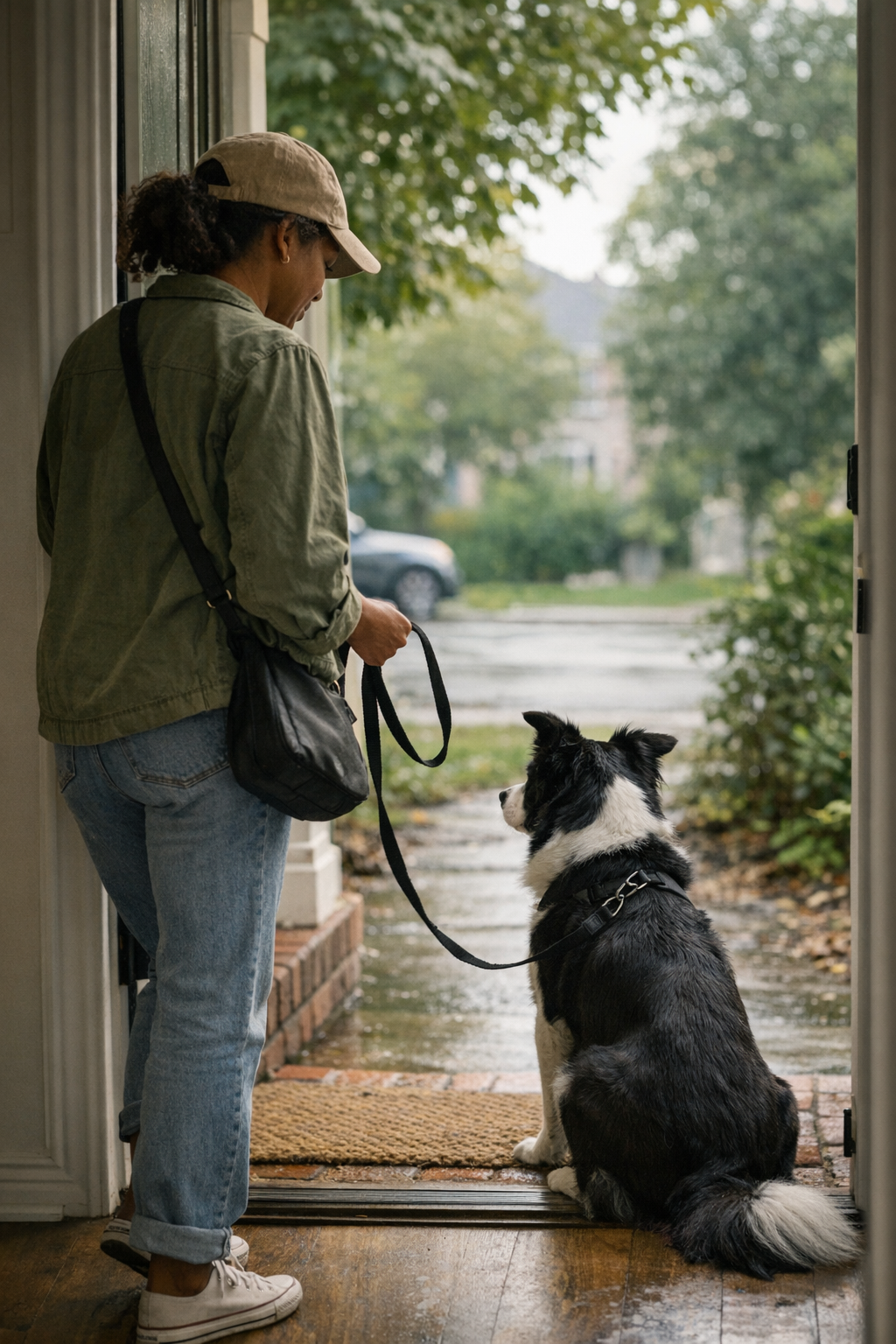
You know the drill: leash clipped, hand on the knob, dog at your side—and still, you’re not out the door. The leash snags, a tote catches your shoulder, your dog hangs back, and the clean “out-we-go” never quite clicks. That tiny doorway pause gets dismissed as nothing, but it drags on the whole routine—nudging every walk to start with a hitch instead of a flow. Stack those snags over a week, and you’re not just losing seconds—you’re battling a routine that feels clumsy, one frustrated reach at a time. The friction isn’t always where you expect: that supposed “quirk” at the threshold signals a breakdown you can feel long before you hit the sidewalk. Efficient routines don’t come apart in obvious ways; it’s the slow grind of a stubborn pause that sours repeated use.
The Hidden Costs of Doorway Pauses: Beyond the Two-Second Delay
Most dog routines aim for smooth exits, but the first problem often happens before you even step outside. That initial hitch at the threshold isn’t just a delay—it pulls the air out of the whole outing. At first it’s just a small check: dog’s ears up, one paw lifted, nose scanning for what’s new. You stand there, leash slack, already feeling yesterday’s awkward launch. By the third day of door-edge fumbles, you barely notice the buildup—but now you and your dog depart out of sync, walking with tension instead of stride. The pause becomes routine, and “quick exit” slides into recurring bottleneck. The worst part? You stop noticing how much drag it adds to every attempt at a fresh start.
Letting these doorway hurdles fade into the background means accepting mismatched walking rhythm and more leash tangle—problems that didn’t start on the sidewalk, but right at the door.
Routine Stumbles: Why the Pause Creeps Into Everyday Walks
Leash-up routines look simple—clip, reach, go—but real life scrambles the choreography. Most owners are wrangling keys and bags with one hand, leash with the other, eyes on the dog, and a quick scan outside for distractions, all at the same time. The dog’s pause isn’t just a hiccup; it flags a transition that’s jammed before anyone takes a step.
The hitch flares up during rush hour or bad weather. You’re late, trying to hustle, but a hanging leash or bunched-up mat blocks your flow. Or your dog sniffs the air for half a beat longer in the rain, making your patience stretch thin. That initial hesitation doesn’t just slow you down—it sets the tone for the next block: choppy, start-stop movement, leash snagging on corners. Frustration builds because neither end of the leash is fully ready—and both of you sense it.
Missed Signals: Not Every Pause Means Stubbornness
It’s easy to call any doorway slowdown “stubbornness” or a weird quirk. But door pauses almost always mean your dog is gathering themselves—not plotting resistance. Most dogs stall to process what’s new, or to transition from inside calm to outside stimulus. If you respond by yanking or rushing, the pause morphs from gentle check-in to everyday standoff—and the cost shows up in jerky walks, more leash tension, and zig-zagging from step one.
The “problem” isn’t random; it’s a feedback loop. Pulling through a hesitant pause plants seeds for the next tangled leash or off-beat stride before you leave the porch.
How Everyday Setups Can Make Things Smoother—Or Trickier
The struggle starts well before your dog hesitates—usually with a snagged reach or cluttered grab. If your leash tangles around a hook, a toy blocks the walkway, or a bin sits just out of reach, a calm exit is wrecked before it begins. “Organized enough” sometimes means: not actually workable. Over a week, shoes drift, bags pile, a crate jams the exit, or the treat pouch goes missing—and each tiny obstacle inches up your frustration and your dog’s uncertainty. That’s how five-second pauses stretch into a haze of hurry, shuffling, and apologizing to your own routine every morning.
Real entry setups shouldn’t just hide clutter—they should cut invisible barriers. The difference shows up in those urgent moments: can you actually grab, clip, and step out with one hand, or are you forced into reshuffle mode every time? The gap between “looks tidy” and “works under pressure” grows with every repeated use.
Resetting the Start: Routine Adjustments that Respect the Pause
Most threshold struggles don’t come from bad gear or a difficult dog—they stem from routines that snap instead of flex. When the pause repeats, so does the urge to hurry, tighten the leash, or force momentum. But precise, repeatable tweaks can reset the pattern.
Whenever you hit that doorway pause, pick one steady cue—maybe a quiet “let’s go”—and hold still, leash loose. Resist the urge to urge. If your dog lingers, stay neutral. The “fix” is in predictability, not force: a pause that gets the same response every time loses its edge as a source of tension.
Change won’t thunder in overnight. But as you stack outings, you’ll feel the pivot: the doorway becomes a checkpoint, not a blockade. The routine gains elasticity—you’re not fighting your own setup, or your dog’s instincts. Outings pick up flow. Friction that lived at the beginning gets crowded out by a smoother launch, and the rest of the walk follows suit.
The Ripple Effect: How Doorway Friction Shapes the Whole Walk
Don’t underestimate that two-second doorway stall—it can define the walk’s next fifteen minutes. A clumsy start infects momentum: leash tangles, dog lunging off-pace, owner attention jumpy. Most of this isn’t “bad dog behavior”—it’s energy stuck at the threshold, bleeding into every block. Remove the awkward entry and you nudge every other sticking point downstream—less need for reset mid-walk, fewer strained corrections by the curb.
A smoother start pays back at other pinch points too. Coming back inside, you’re less likely to scramble for a towel buried behind the crate or to trip over gear that multiplied since you left. What was only “neat” is now reliably ready—less shifting, more doing. Function rises as micro-obstacles fall.
Real-Life Tweaks from Repeated Friction: What Actually Works Over Time
You don’t need a fresh build or a showcase entryway. What matters is repeat viability. Keep every walk tool—leash, bags, wipes—within immediate reach. If you can’t grab it without a shuffle, it’s in the wrong spot. Do a reality-check after a standard week: what are you always stepping over, moving, or losing track of? Does your dog have true standing space, or does each movement send you both off-balance at the door?
Watch out for these creeping friction points:
- Hooks that look smart but need twisting or two hands to unclip the leash.
- Dog gear or toys leaking into the walkway, forcing awkward sidesteps at go-time.
- Cleanup wipes easy to find, but never right when you need them for muddy paws at the exit.
- Household clutter flowing into the threshold zone, making “waiting” blend into chaos instead of action.
What trips you up most days? That’s where setup should adjust. The right fix isn’t a one-time reorg—it’s a reaction to repeated friction. Reshuffle with routines in mind and weak points fade—not just in appearance, but in actual, daily function.
When to Worry (and When Not To) About a Doorway Pause
The standard doorway pause is rarely a refusal—it’s a moment to check in before the next environment. Typical hesitations mean the dog is deciding, not dreading. Only when you see your dog back away, shrink, or flat-out avoid the threshold do you need to dig for bigger causes—too-tight harness, real anxiety, or a trigger outside deserving more attention.
For almost all ordinary, repeated pauses: don’t yank, don’t rush. Hold the space, offer a steady cue, and set the stage for smoother movement right at the start. These adjustments aren’t about training—they’re about design, attention, and building a daily flow that doesn’t crumble under repeated use.
For setups that actually match real routines, and gear designed to reduce silent friction before you step out, see what’s new at DogPile: DogPile.