
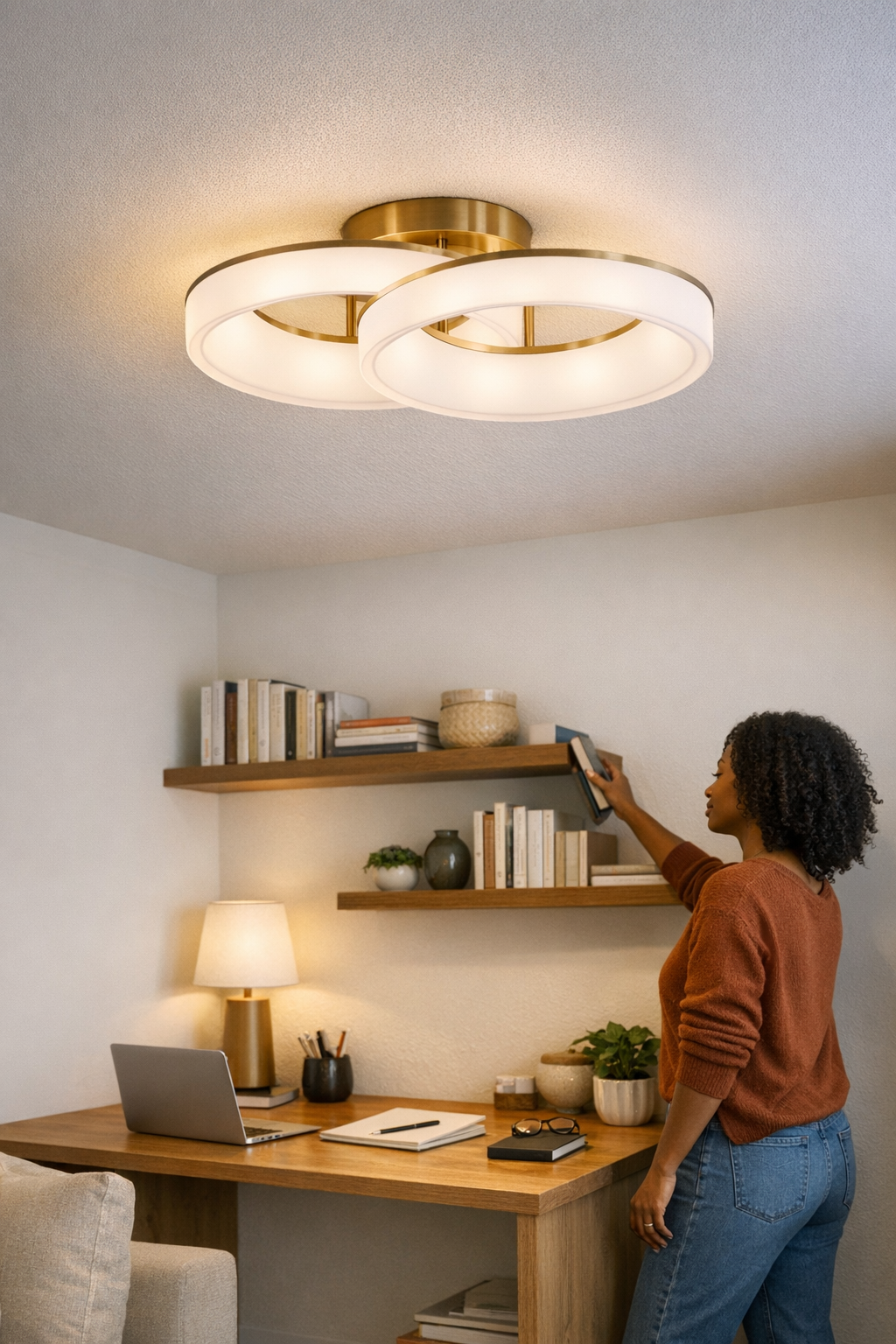
A workspace that looks finished can still feel wrong within days of real use. The problem isn’t just a question of “enough” light—it’s where the bright zones hit and where convenience falls apart. You shift between tasks at a desk squeezed by a walkway, reach for the edge near a shelf, or push your laptop back after lunch, and run into the friction: glare slices across your screen, cables drag where your arms need to move, and that supposed upgrade overhead leaves the same dim border where your mouse always travels. Lighting that photographs as “clean” can still interrupt every routine, exposing support mistakes and coverage gaps that surface only after repeated use—the drag that signals your lighting and support logic needs more than an appearance boost.
When an “Upgrade” Only Shifts the Problem
The fresh fixture goes in—maybe a crisp LED panel, a more modern linear, anything to banish the old bulb. Day one, the difference feels like progress. The desk lights up, the setup looks tidier. But by the second week, as you move through real work, new friction appears: shadows return to the corners, glare traces the papers whenever the sun shifts, and cables—pitched as discreet—slide into sightlines or tangle the gear. Classic domes and spotlights do this in familiar ways:
- Desks with a bright center but edges that never leave shadow
- Walkways half-lit while glare interrupts the main work zone
- Loose cables crossing surfaces, always just in reach of elbows or peripherals
Function that looked “solved” feels less stable as routines settle in. The working edge gets dimmer; cables pull focus; your eyes work harder in the exact spots that matter most. At some point, it’s not background annoyance—the design is failing in repeated use.
What Linear and Panel Ceiling Lights Actually Fix
Broad-beam ceiling panels and linear lights promise a more usable room: smoother coverage to the full edge of shelves or desks, and less jump between brightly lit and underlit patches. They help most where real patterns test the setup:
- Low ceilings compress fixture spread, raising the odds of annoying halos or dark outer corners
- Mixed-use rooms demand even light from surface to shared area, not just over the “main” zone
- Edges matter—where books, gear, or hands actually end up day after day
But that promise breaks fast if the details miss. A panel sized for looks instead of coverage leaves the final few inches stubbornly dim. Cables that aren’t routed tight, or bracket supports angled for speed, shed the illusion of tidiness, pulling distraction into every routine. An exposed wire grabs attention just as fast as a patch of shadow in the wrong place. What’s supposed to “solve” the surface instead sets up the next round of minor workarounds.
The Overhead Trap: Looks Tidy, Feels Awkward
A slim fixture overhead often hides the same flaws as old domes—a tidy appearance isn’t clarity at the work level. Common misses become obvious in the flow of the week:
- Weak edge coverage: Light lands where you don’t work, leaving hands or notes in a half-shadow you can’t eliminate by shifting your chair.
- New glare lines: Panels reflect on smooth or glossy surfaces, tracing bright streaks across your direct sightline whenever you check documents or adjust screens.
- Cable and bracket distraction: Extension lines drop into view or brackets land at eye level along a shelf, so every walk-by or reach risks a snag or unwanted visual anchor.
“Clean” up top quickly becomes a practical burden where lighting and support aren’t mapped to how the space actually gets used. The clarity you expected slips as soon as annoyance sneaks back in from cables, clamp points, or missed zones.
Where Small Annoyances Turn Routine Into Work
Friction often builds quietly—by Friday, the same space that looked sharp on Monday wears you down:
- A corner desk gets an overhead upgrade, but the print zone always sits in stubborn dimness. Each time you shuffle paper, a heavy shadow follows your arm, undoing the promise of “full” coverage.
- A shallow shelf blocks the panel’s spread, so the desktop center is bright while the edges are drained of useful light. When you reach for books, glare kicks up at just the wrong moment.
- Cables tucked cleanly on install begin to sprawl after a week of moving power adapters or sliding monitors. Mouse movement meets fresh resistance, and that “unused” desk edge collects dust and frustration in the poorly lit margin.
These slipups aren’t exotic—they repeat as routines change, as hands, eyes, and devices react to unfinished setup logic. Repositioning a lamp, sliding accessories, or learning to ignore cable drag may feel minor, but the toll compounds every hour the habit persists.
Smart Adjustments That Restore Comfort and Order
Some fixes show results the same day—and keep working as use shifts:
- Panel placement: Redefine the fixture’s angle or lateral position to prioritize edge coverage, not just central brightness. Suddenly, that persistent shadow line gives way and the whole surface becomes usable—not just the showcase area.
- Cable re-routing: Reposition runs along walls, under shelving, or behind main zones. Use smaller, higher brackets to remove sightline clutter—a shelf-top cable is easy to miss, one mid-wall never is.
- Support tweaks: Move brackets or mounting points a couple of inches off the “obvious” spot to avoid snags or blockages where you write, swipe, or reach. Small geometry changes eliminate daily fidgeting that would otherwise erode focus.
With clear, physical logic behind each support and cable line, the space becomes easier to use: the surface stays evenly lit; transitions between zones are smooth; and visual noise drops away as function matches how you actually move through the day.
What Causes Panel or Linear Lights to Fall Short?
Even good fixtures create new headaches when installed without room awareness:
- Panel too narrow: Edges of the surface remain off-limits, and the setup becomes “nearly” right but never quite comfortable.
- Mounting in the line of sight: Brackets and wires cut across areas where you look, move, or reach, increasing daily friction instead of reducing it.
- Insufficient throw in tall rooms: Panels that work in compact spaces lose strength when ceilings rise, washing out for ambiance but falling short for real work zones.
- Reflective mishaps: Any high-gloss or polished finish amplifies stray light, setting up unwanted streaks or spots in the path of your hands and tools.
The room’s actual conditions—not just abstract needs—set what a fixture must solve. Only when placement, spread, support, and cable logic sync with day-to-day use does the benefit of panel or linear ceiling lights really show up.
Which Rooms Benefit Most?
Compact rooms under nine feet, crowded work-plus-life areas, or any desk/shelf run where every inch is worth using will almost always gain from a logical, well-set ceiling panel or linear light—if the install treats edges, cable path, and support as recurring decisions, not just a first-day reveal. Big, open, or tall spaces need stricter mapping: more panels, distributed brackets, sharper cable control—to sidestep the “almost finished” feeling that drags on every routine.
Quick Practical Tips:
- Start with your own routine: Map where you move, reach, and pause most often. Watch for shadow pockets or flashes of glare that mark incomplete coverage.
- Route cables after living in the setup: Wait a week before final cable and bracket choices—premature tidying always misses how surfaces are really used.
- Edge audit: After several work sessions, check whether you avoid the last visible inches of desk or shelf. If shadows, cable crossings, or glare make you shrink from the edge, the setup isn’t tuned yet.
The Real Standard: Does the Setup Stay Easy to Live With?
Lasting clarity—and comfort—grow from setups that make light, cable runs, and bracket positions quietly invisible in repeated use. Linear and panel lights can solve most shared or edge-dependent surfaces, but only when matched to the way the room flexes through daily shifts and not just to what looks better overhead. The real test comes a week later: if your hands, eyes, and gear all reach further without friction, the setup is finally working.
Explore more lighting and support solutions for real-use spaces at LightSupport.