
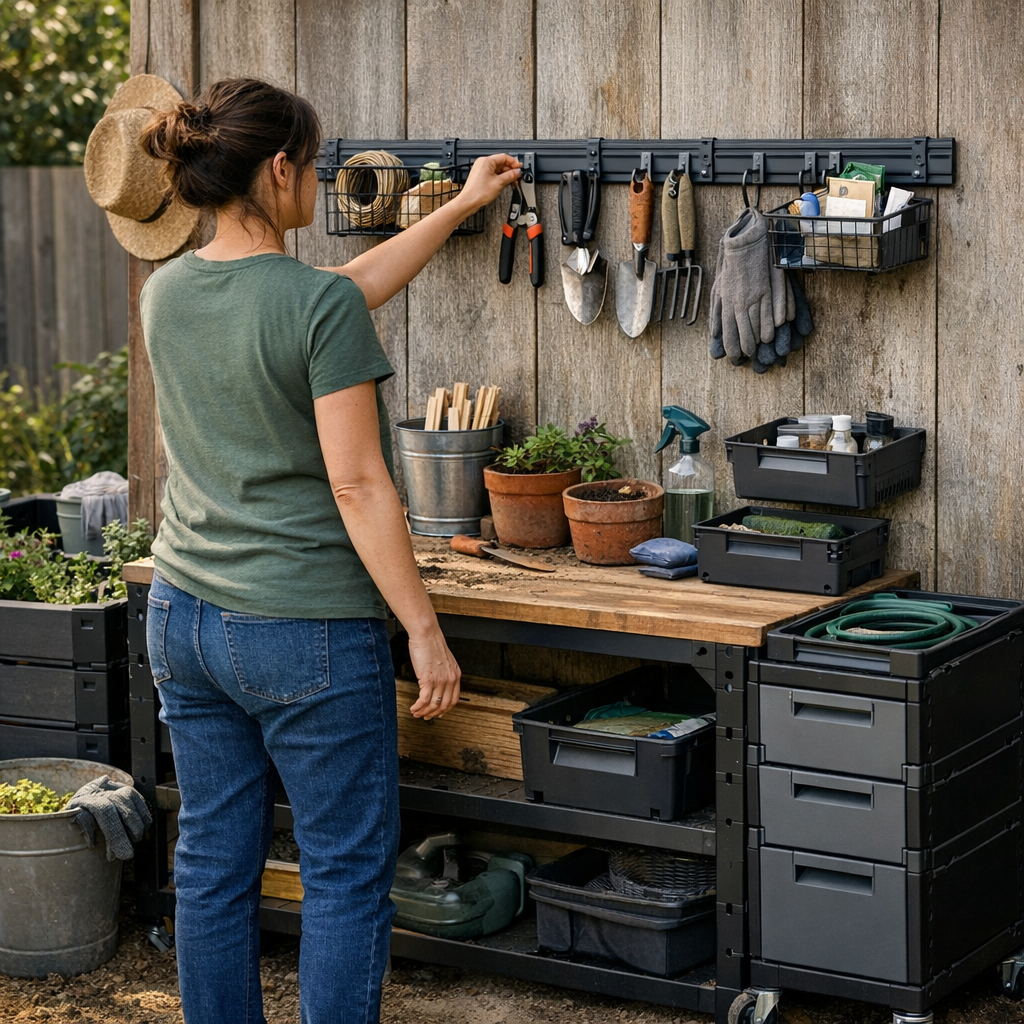
That clean wall rail setup is supposed to solve the mess—so why do you still find yourself rearranging tools just to get work done? The illusion is persistent: on day one, hooks and baskets snap into perfect formation, and for a few brief hours, your garage, shed, or workshop looks “fixed.” But real routines don’t run on symmetry, and as the days stack up, that sense of control quietly unravels. You end up standing in the same spot, shifting a cart to reach a shovel, or retracing steps to the same overstuffed hook, wondering where all that planning actually went.
Where the System Breaks Down: The Slow Creep of Routine Friction
The unraveling rarely feels dramatic. It starts as a daily pause—that moment you hesitate, tool in hand, because the closest hook is blocked or you’re reaching behind one cabinet edge for the third time today. Gear slides into the high-traffic zone, stacking on itself. Overflow seeps across the most convenient reaches, while pockets of wall—clear on paper—never actually get used.
This is the story in every real utility corner, not just garages: a garden rack above a potting bench, storage rails in shed corridors, utility hooks at the car wash corner. Items cluster wherever the path is shortest, leaving awkward dead space where your arm never naturally lands. After a month, that “organized” wall looks less like a system and more like another source of lost time.
Visual Order vs. Actual Flow
Most wall rail kits set you up to chase the look of order—spaced hooks, even rows, every inch accounted for. The trouble is, real life doesn’t cooperate. Daily use punches holes in the theory, exposing the system’s weak points instead of hiding them.
Your go-to tools—the hammer, the garden fork, that pair of gloves—move in a tight orbit around your main work zone. Everything else gathers dust or monopolizes a corner you almost never visit. No matter how much storage you add, the pattern is stubborn: the area nearest your routine fills instantly, and the farthest hooks are ignored or become a dumping ground for overflow.
Everyday Setup Friction—Up Close
- You have to edge a heavy hose cart away—again—just to get to the only open hook for the rake.
- High-use hooks turn into clutter islands, hidden under mittens or random off-season gear.
- That promising far corner stays pristine, because it’s always half a step too far when your hands are full.
- Returning tools gets sloppy: you wedge a shovel behind a basket “temporarily,” and days later, nothing’s back in order.
It’s not just mess that signals a problem—it’s the fact you keep tripping over the same small obstacles, losing seconds here and there, until the system feels like more work than it’s worth.
The Hidden Cost: Dead Space and Routine Bottlenecks
Imagine a backyard wall rail above the potting bench. The first weekend: trowels, gloves, and plant ties are spaced with surgical precision. By week three, the left section is still empty—nobody wants to stretch for it—while the hooks above the center are packed tight. Need your favorite pruners? Plan on unhooking gloves, shifting a basket, and maybe knocking over a spool of twine on the way.
The limitation isn’t how much you can store—it’s where and how you do it. Clutter here is often silent: the subtle spillover, the extra shuffle that interrupts your set-down-and-go rhythm, the way dead spots remain clean but useless.
Resetting for Real Use: Small Tweaks, Real Results
The real fix doesn’t come from adding more rails or accessories—it’s reshaping how your wall rail actually fits your repeated movements. Forget perfect spacing. Shift high-use tools within arm’s reach of your main work path. Let the rarely grabbed gear occupy the dead ends. What used to be a two-foot “neutral” gap can become a single honest buffer, freeing the rest for what you grab ten times a week.
Here’s where it matters: suddenly you’re not shifting things aside to make space, or parking tools wherever they land “just for now.” The tools you need most take the direct route home. The time-sinks—the little stutters and resets—fade. The wall looks less magazine-ready and more like something you actually use, because now it is.
Real-World, No-Nonsense Adjustments
- Watch out for forced detours: If you keep moving a cart just to reach a hook, move the hook—not the cart. Convenience beats symmetry every time.
- Embrace flexible zones: Some hooks will go dormant in off-seasons. Let your wall rail adapt as your routines shift through the year.
- Leave intentional breathing room: Not every inch needs a hook. Gaps let you return items faster, buffer overflow, and clear the reset pathway.
The Goal: A Setup That Feels Natural—Not Just Looks Organized
Anyone can make a wall system look sharp on install day. The real challenge is a month later, when the test isn’t visual—it’s whether your flow gets easier or your steps multiply. Efficiency isn’t always pretty; sometimes it’s a dense cluster of hooks where the work really happens and open wall where your elbow needs to swing.
Walk through your wall setup after weeks of actual use. Where do you slow down? What collects overflow? What spots stay empty by habit? The best wall rail setups absorb these realities—and morph to fit your reset patterns, helping you reclaim time and motion without constant tinkering.
If your system “looks” organized but you still stumble over gear or reshuffle hooks every week, that’s your real signal to make a change. Your goal isn’t showroom symmetry—it’s a setup you can’t help but use well, because it fits the way you move, not just the way you want it to look.