
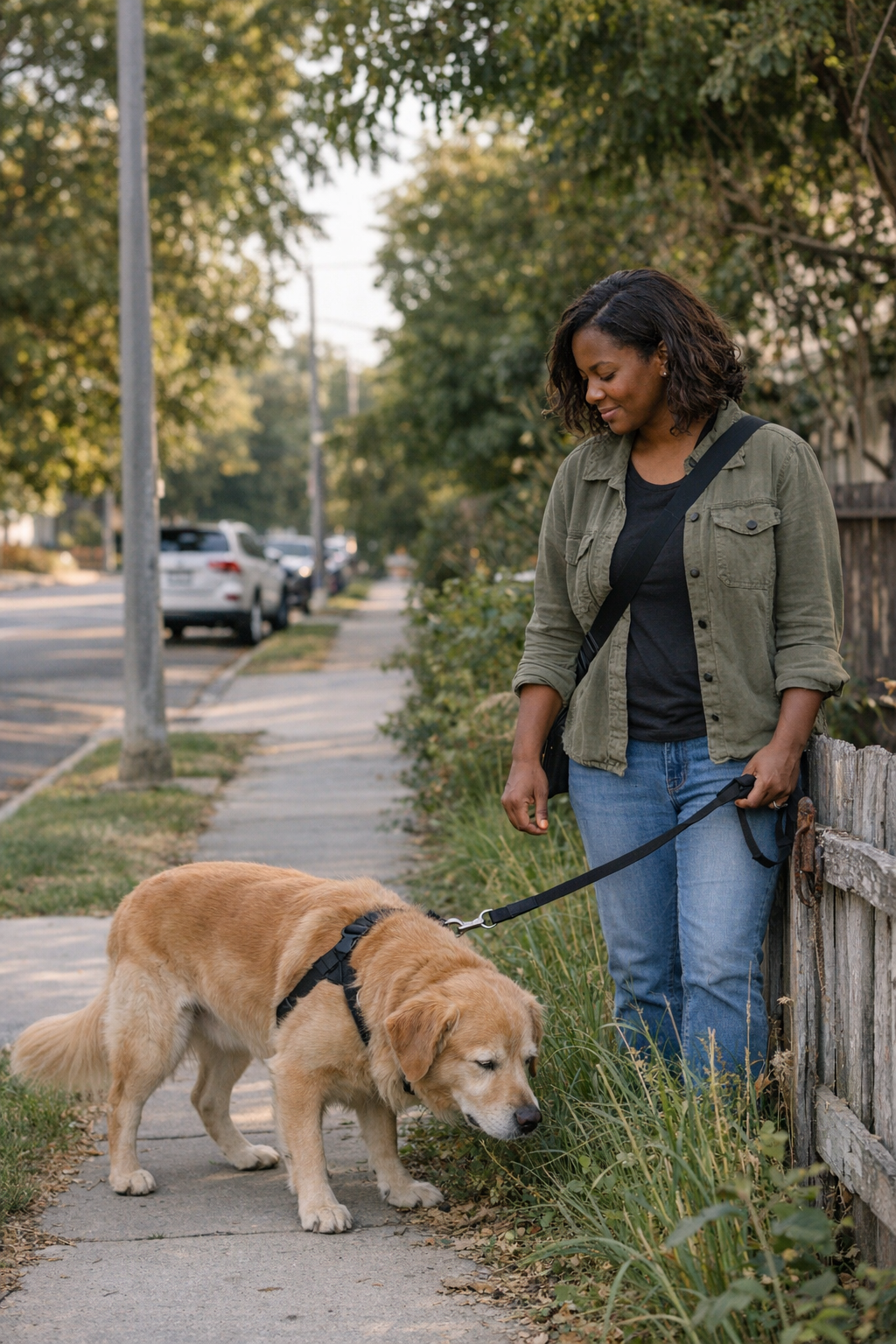
Right before you reach the last corner on your dog walk, there’s a small, stubborn pattern: your dog lets out a deep exhale—same spot, same time. You barely notice. You hold a tangled leash, a clunky treat pouch brushing your hip, already thinking about the next stop. But that exhale is not random. Ignore it, and the rest of your walk turns from smooth to jerky, with more leash pulls, awkward redirections, and mounting friction that makes every return home feel heavier. Finding and handling these routine pressure points signals the difference between managing daily chaos and actually resetting both you and your dog—no matter how organized your entryway looks.
Small Signals with Big Consequences: The Overlooked Dog Exhale
Repeat the same loop enough times, and your dog’s pattern becomes obvious: leash slack near Mrs. Bailey’s fence, a pause at that weed-patch, the almost involuntary sigh just before the last block. You might explain it away as boredom, or shrug and walk faster. But if that sigh always shows up at the same place, it’s no coincidence. It’s a warning: friction builds here, and it quietly increases every outing.
You see it less when juggling your own routine. Your leash hand is already twisted, the treat pouch tips off its hook, and your brain skips ahead to errands. Missing the exhale cue might seem harmless, but it’s the trigger point for the walk’s unraveling—little disruptions that don’t just vanish after a few steps.
Friction Builds When Patterns Are Ignored
The fallout is rarely dramatic at first. Maybe you grip the leash tighter, power ahead, tell yourself your dog “just needs a faster pace.” Instead, within a block, things get rougher: the leash tugs too early, redirection gets clumsy, every curb takes more attention. The easy, fluid rhythm of your best walks turns patchy. Repeat this for a few days, and every exit feels like starting over, with more mini-standoffs and less confidence you’ll finish with a calm dog.
This is real-world friction: not just one big problem, but a slow build of micro-struggles. The leash doesn’t glide, your dog checks out and lags or bolts in tiny bursts, and every five seconds becomes a new decision point—none disastrous, all draining. The routine stiffens, not from mess but from a pattern that quietly takes over if ignored.
The Feedback Loop of a Skipped Pause
Skip your dog’s routine reset—like hurrying past the exhale marker—and you pay for it immediately: weaving around parked bikes becomes more reactive; the next “quick” pause spirals into a drawn-out sniff-and stall. By home, the outing is sliced into awkward segments instead of smooth progress. It’s not one big argument, but a dozen small stumbles that stack up and leave the routine feeling crowded and tiring instead of settled.
It’s not about a single mistake. Miss enough of these micro-moments, and you’re caught in a loop of false starts and mounting friction—a walk that quietly wears both of you out, even when the distance is short.
Why That Landmark Exhale Means More Than You Think
Your dog isn’t sighing at that spot for no reason. The repeated exhale marks real boundaries: the edge of the habit zone, a trigger of anticipation, or the start of new distractions. It’s grounding—a dog’s way of bracing for the next stretch, whether that means meeting the neighbor’s dog at the fence or leaving the safety of familiar blocks. Miss it, and you lose your shot at a smooth reset right when it matters most.
For owners, this signal is practical: push past it, and tension climbs. Pause—even briefly—and you watch your dog steady themselves. The choice is not between “training” and “indulgence,” but between compounding friction and quieting it before it spreads through the whole outing.
Redefining Walk Flow—One Five-Second Pause at a Time
You don’t need new gear or a major reset. Allowing a counted five-second pause at your dog’s “exhale landmark”—long enough for a sniff or a brief survey—immediately changes walk rhythm. Actually count it out, let the leash go slack, and give your dog a real moment to reset. Watch what happens next: leash tension drops, redirections get easier, and your walk stops devolving into a stop-and-go grind on the way home.
This isn’t a lifehack; it’s repeatable cause-and-effect. Skip the pause and find the routine clogs up fast. Build it into most walks, and the downstream debris—tension, leash fumbles, mini-tugs, over-alertness at home—begins to clear. It’s imperfect, but so is dog life. The five seconds don’t solve every mess, but they break up the chain of friction that makes you dread everyday routines.
The Difference Between “Looking Done” and “Feeling Smooth”
The difference shows as soon as you leave your house: the setup looks tidy, but during a real exit, clutter finds you anyway. Leashes are “organized” but caught behind a basket. Treat bags are visible but require bending or shuffling. Steps are blocked by piled shoes or that one pool of toys spreading into walk space again. Everything seems in order until you actually need it, in the moment when you’re also supposed to notice your dog’s reset cue.
This is the gap: a setup looks organized, but use falls short. Outside, the same thing happens—ignore your dog’s exhale-point and your walk seems fine for a minute, but stutters with accumulating tension. These frictions only rarely explode into big problems, but they quietly slow, clutter, and interrupt your routines every time.
Where Setup and Routine Collide
Even after you tidy up, friction returns: reorganized leash station or not, if the exit path means shuffling past the shoe bin or moving the crate to get to wipes, the routine will keep snagging. It mirrors the walk outside—prepping perfectly at home but blasting through your dog’s pause leads to the same result: pieced-together routines with bits of tension floating through the next transition.
Practical Adjustments That Actually Change Your Walk
Dog owners don’t want a complete overhaul every time daily routines feel off. The fix you’ll actually use—one you can repeat without extra drag—is the deliberate pause at those predictable exhale spots. Why does this small change work when others don’t?
- It’s easy to spot when you start watching for it, and it’s the same place on every walk.
- No guesswork or new supplies—the pattern is visible and repeatable.
- You avoid importing friction into other parts of your routine—no extra gear shuffle or setup bloat.
- Downstream mess, both literal (muddy paws, toy scatter) and behavioral (hectic re-entry, grabby water bowl attacks), fades without demanding a rigid, spotless system.
- You can skip the pause on truly rushed days, but when built into the baseline, the benefit compounds.
The goal shifts from extinguishing fires to restoring flow—reducing constant owner correction and allowing routines to hum along with less drag. Respond to the repeating signals, and the micro-fights shrink back, making walks (and reset moments) less of a struggle and more dependable, walk after walk.
Going Beyond the Walk: How Small Signals Impact the Rest of Your Routine
The effect travels home with you. A choppy, friction-filled outing means a wound-up dog, racing out of the leash into a spilled water bowl, flinging toys across hallways, or finding that towel you need for a muddy paw is behind a door you just closed. Every scramble at the walk’s weak point finds its echo as the day continues: feeding area gets disordered, grooming rhythm is interrupted, or crate time starts with extra resistance. The original missed pause sets off a chain of minor, avoidable resets.
Addressing the walk’s repeating friction—by pausing and actually noticing your dog’s signal—means a smoother homecoming. The leash comes off with less drama, water and food stations stay in normal range, wipes or towels are reachable, and the next segment of your routine isn’t defined by more clutter and correction.
What About Health Concerns? When to Look Closer
In almost every case, a dog’s repeated, predictable sigh at one point on a walk is a behavioral signal, not a medical flag. If you spot sudden new patterns—real pain, persistent limp, or serious distress—always check with your vet. But the ordinary routine exhale is your dog’s attempt to manage and settle their own comfort zone during a walk they generally trust, not a sign you need to worry.
Real Setup, Real Routine, Real Results
What looks fixed on the surface doesn’t always hold up in real, repeat use. Organized leash pegs don’t matter if you can’t grab what you need without unblocking the path first. A perfect gear station can’t replace five seconds spent responding to your dog’s own signals. The setups and routines that actually work aren’t always the neat