
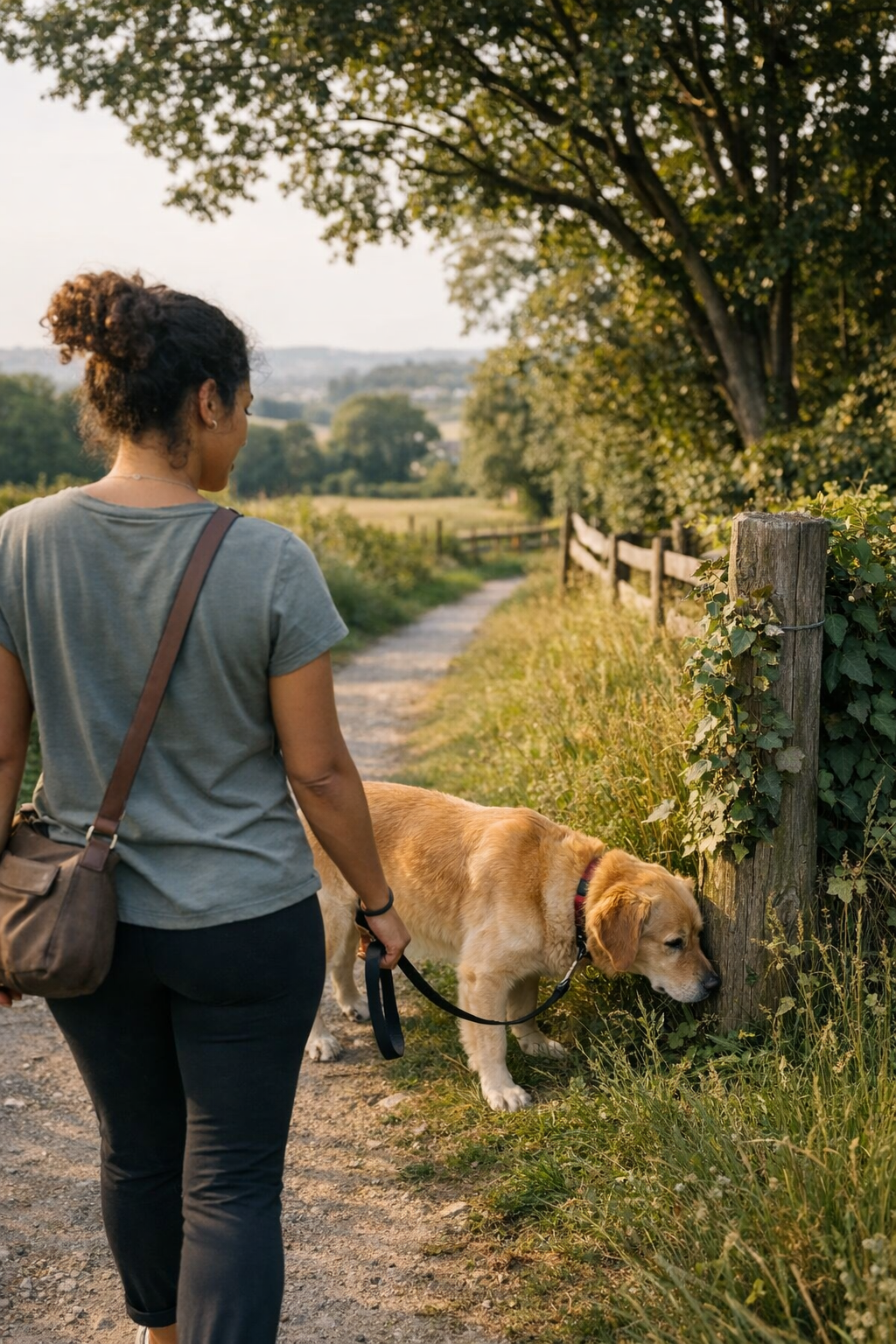
The signs don’t always show up with barking or tangled leashes. Sometimes, it’s reaching for the leash in the same spot every morning—just to find yesterday’s harness looped over cleanup wipes, or the towel for muddy paws still missing from reach. If your daily walk has settled into smooth autopilot while invisible snags pile up—slow starts, less sniffing, longer cleanup, or the same toy blocking your way—you’re in the thick of it. Dog routines have a way of looking efficient on the outside but dragging beneath the surface, and when “order” masks friction, both energy and reset go missing at home. The right setup isn’t about perfection; it’s about recognizing when a walk has stopped working for both of you long before anything looks truly wrong.
When Familiar Paths Become Numbers, Not Adventures
Some dogs set out eager, noses low, zig-zagging along every bit of scent. But after a few days on the same loop, it’s all straight lines and half-hearted pit stops. Leash out, door open, same old path. It looks easy, but the signals add up: dogs pull less, pause less, and start moving on cue rather than from curiosity. The routine turns into checkmarks—walk done, box ticked—while the real walk, the one that resets a restless dog, quietly disappears. What feels efficient for us starts to undercut the edge that made those early walks worthwhile.
You’ll probably notice it creeping in: a familiar leash snap sparks excitement, but a block out, your dog lingers by the same lamppost, waiting for a nudge, then defaults to autopilot. The route hasn’t changed—just the spark. That “smooth” familiarity steals attention away from the small rituals: sniff breaks become rare, two-minute pauses give way to straight passing, and what was exploration is now just transit. The impact lands later, in the home cycle you didn’t think to question.
The Hidden Friction: When Efficiency Hides a Rut
Cutting corners feels smart—skip the extra block, hang the leash closer to the door, stash supplies neatly. But repeated routes and routines that prize tidiness over real flow introduce a different cost. Quickly, you sense it: a dog that once paused everywhere barely notices formerly exciting corners, slows at odd intervals, and finishes the walk with almost no post-return spark. The surface is smooth, yet daily life slows in less visible ways.
The friction is subtle but constant: routines get easier on the clock but heavier to live with. Instead of problem behavior, your dog simply dials back—lingering near the entry, hesitating before drinking, needing longer to settle in the rest corner. The reset—the real one—takes longer every cycle, but the setup “works,” so the slowdown goes unaddressed.
Where It Shows Up After the Walk
The run-down doesn’t stop at the door. After the walk, you see the cost: the towel is again just out of reach, making cleanup awkward. Post-walk wipes get fumbled, and water bowls drift so the after-walk drink becomes a minor hunt. Your dog’s rest isn’t quite rest—there’s more sprawling, less genuine reset. And you find yourself retracing steps for forgotten supplies, or stepping around that one toy that keeps blocking the entryway, even when you thought you had decluttered last night.
Recognizing Signs That the Routine Is Running Dry
You know your walk’s stale if you notice:
- Sniff breaks drop off: The environment seems “done,” so your dog scans without stopping.
- Dragging at predictable spots: Once eager, now it’s a slow ritual. The pause isn’t interest, it’s inertia.
- Frequent glances for cues: Your dog starts borrowing momentum from you, not the environment.
- Slow-downs at the same landmarks: Hesitation isn’t about distractions; it’s about monotony becoming friction.
- Delayed reset indoors: Settling takes longer, with more repositioning and less actual rest.
These blips are rarely dramatic: just enough to stall your own pace, stretch cleanup, and quietly sabotage the sense of moving forward. They signal a routine where “tidy” has started to mean “sluggish.” Without change, the malaise trails into feeding, grooming, and every “reset” routine until the cycle becomes harder, not easier, to break.
Surface Solutions vs. Real Change: Why Repetition Isn’t Always Efficiency
Streamlined walks have their place—quick leash, neat entry, fast out-and-back. But there’s a visible gap between an organized setup and one that really supports your day-to-day. A nicely sorted entryway can still bury recurring snags: finding the bowl moved, wipes hidden behind folded rest pads, toys creeping into walkways. The system “looks” efficient, but the repeated minor interruptions never seem to fade.
Function beats form in reality checks. Dog-life setups that look good but slow you down—awkward leash pulls, misplaced towels, supply bins you have to reach past—invite more friction than clutter ever did. When the walk becomes rote, these hiccups get magnified: you hunt for that missing wipe, double back for a toy, or have to reposition water bowls again when your dog redirects to the kitchen after a lackluster walk. Routine “order” isn’t reducing drag; it’s packaging it in new ways.
Small Setbacks in the Everyday Cycle
Efficiency drops in small ways—never a crisis, but always a drag:
- Leash tangled with harness and wipes, blocking a quick grab at the door.
- Back from a muddy walk, towel nowhere near—cleanup delay, dirt spreading.
- Toys scattered right at reentry, forcing navigation around last night’s overflow.
- Water bowls nudged out of place, so a thirsty dog turns refilling into a detour.
- Rest corners or crates you set up tidily lose their pull, and your dog still sprawls where foot traffic resumes first.
Each repeat slip compounds the friction. You feel it: annoyance at a misplaced towel, extra seconds spent fishing wipes from under a leash, routines that never reset as quickly as they look in a tidy photo—and a dog that settles slower by degrees.
Breaking the Rut: Why Even a Minor Change Matters
Total overhaul isn’t required. Sometimes, a new turn—literally a single right instead of left—reboots curiosity. Dogs signal the difference within minutes: a longer pause at a “new” shrub, faster tail wag, a return home with more energy. That’s not sentimental—it’s an observable change, and it resets the tone for cleanup, water, and post-walk rest without extra effort on your part.
Small disruptions wake up the routine. Adding even two unpredictable minutes—a pause at a different spot, letting your dog set the route for a block—gets things moving again. The benefit is visible: less foot-dragging, more focused sniffing, and, after, a dog that is actually ready to settle. Not every change solves everything, but shifts like these dial down the slowdowns you’d normally blame on clutter or habit.
Reset Your Routine Without Breaking It
If repeated slowdowns keep returning, try this:
- Alternate routes and directions: Even flipping the loop adds enough novelty to sharpen attention—yours and your dog’s.
- Let your dog lead at intervals: Short, safe stretches where you follow their nose often bring out a forgotten bounce.
- Move your setup—temporarily: Treats, leash, wipes or towels in a new spot shake up your own patterns and reveal what’s gotten automatic.
- Rotate toys and rest spots by the entry: New items or placements keep that transition zone from feeling stale, reducing both paw-dragging and spatial conflicts.
Each tweak makes routines less likely to settle into silent drag. The best setups aren’t static; they flex with you. The point isn’t about chasing novelty, but about keeping reset within reach—so you can interrupt slowdowns before they quietly set into the rest of your day.
Spotting Value in the Ordinary Moments
Real shifts don’t shout. Most show up after the door closes: smoother towel grabs, less fumbled wipe-downs, or your dog shaking off and sprawling content—not restless—after the walk. The win isn’t about a perfect-looking setup; it’s about a routine that survives repeat friction and actually helps you move on. What works in photos is never the full picture; what shows up in the countless micro-moments—routine after ordinary routine—is what signals you’ve got a DogPile setup that fits real daily life.
Sometimes all it takes is seeing the familiar routine through a slightly sharper lens: more than how things look, but how they actually function, repeated use after repeated use.