
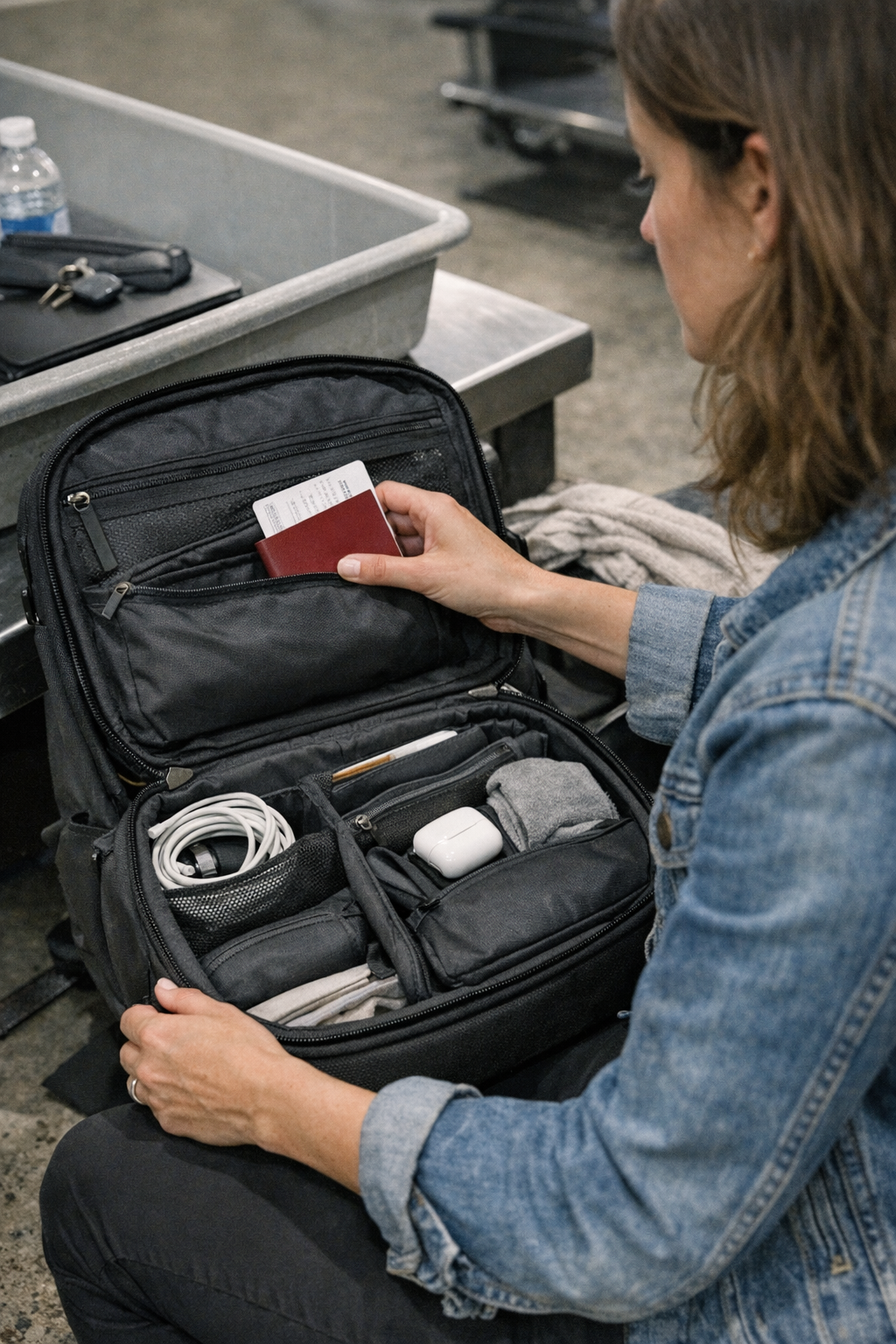
Most travelers realize too late that an organized-looking carry-on can still drag you down once you hit real airport movement. That tidy setup—pouches lined up, color-matched pockets, every charger wound and zipped—holds just long enough for one round of security or boarding. As soon as you’re juggling trays at TSA, digging for a passport while someone breathes down your neck, or trying to find a card at the gate, the initial order starts to break. A pocket that seemed “perfect” at home turns into a two-handed puzzle. Instead of quick retrieval, you get tangled charger cables hiding your boarding pass, critical documents stuck below snack bags, or a comfort item blocked by low-priority gear you thought you packed smart. You don’t just lose time—you lose momentum right when airport movement pushes for speed and access.
A Bag That Looks Ready, But Moves Slowly
Neat packing tricks rarely survive repeat-use pressure. At home, your layout looks under control; in motion—checkpoint panic, boarding squeeze, tray transfer—it exposes friction. Grab for your passport and a stray cable blocks the way. Your receipts, tickets, and boarding document share a slim pocket, but now they tangle every time you reach for one. The pain isn’t just a few seconds lost—it’s hesitation, blocked flow, and the slow realization that “visual order” isn’t cutting it.
Recognizing the Early Warning Signs
The first trip through security rarely shows the problem. But by the next gate, you’re still fumbling for ID while your section boards. Each access becomes messier: zippered pockets pulling double-duty, overlapping pouches forcing awkward two-hand digs, smooth routines derailed by the pocket you now avoid opening. Movement uncovers what home-packing hides—order that resists, rather than supports, real airport flow.
The Hidden Cost of “Order”
Order works until you actually need quick access. Bags that look versatile demand a full reshuffle for one document. Travel passes slip under mesh meant for tech, headphones migrate beneath snacks, and dividers intended to “help” create more layers to clear. With every extra compartment, structured neatness becomes physical friction—especially in the rush or when space closes in. It’s not chaos; it’s the wrong kind of control working against you at every movement checkpoint.
Common Patterns That Disrupt Real Travel Flow
- Re-grabbing the same passport multiple times—always shuffling past cords and bottles to reach it
- Returning from security only to find your phone charger now blocks wallet access in the same pocket
- Boarding hold-ups: awkward one-handed searches for a ticket now trapped under snacks and tissues
- Fatigue that stacks—not just from carrying weight, but from the drain of repeating the same avoidable friction every time you need something fast
When Repeated Use Highlights Real Weak Points
Flaws rarely appear with a first packed bag—they build over three, four, five moments of gate movement. “Packed well” and “moves smoothly” become two different problems. That bedroom-perfect pouch configuration clears floor space, but can’t handle the rhythm of ongoing checks, tray dumps, and seat-side pivots. Every transfer magnifies the same design blind spot: digging for a document under slower-use items, or repacking half the bag to reach the one thing you need twice an hour.
Real Moments That Expose Carry-On Weakness
Imagine: At security, you go to pull your laptop but find it anchored by your liquid pouch. On boarding, your tech organizer traps the pass you need “right now” because it shares space with rarely used adapters. It’s not dramatic—it’s repeated micro-failure, where the cost isn’t a lost item but a lost beat, again and again. By hotel check-in, you realize every interruption today came from layout, not lack of preparation.
Practical Fixes That Change the Experience (But Not Perfectly)
Solutions don’t mean perfection—they mean fewer slowdowns and less rework, in the right places. The simplest fix: dedicate a single top-access pouch for high-frequency items—passport, cards, boarding pass—with no overlap. Cables and small gear live somewhere else. Leave deliberate “lanes” unfilled so nothing blocks the fast path. It’s counterintuitive, but empty space beats over-organized pockets when you’re moving between checkpoints back to back.
Example: The Power of a Dedicated Access Lane
Sail through security when key items sit alone at the top, not mixed with infrequent-use cords or toiletries. Instead of double-zipping around shifting pouches, you open one section, grab, and go. This small design pivot is only obvious after you run out of patience mid-transit and realize one friction-free grab is worth more than an alphabetized packing grid. Mid-journey, a quick-access lane feels like breathing room—less refolding, fewer retrieval errors, and noticeably less mental drag when every second counts between trays, gates, or narrow aisles.
What Really Makes a Carry-On Setup Work
The best layouts aren’t the ones that impress at the check-in counter—they’re the ones that rebuild themselves in seconds after the fifth interruption. Real structure minimizes friction, keeps you reset-ready, and quiets the urge to reorganize after every minor delay. Fast access turns delays into manageable blips instead of recurring headaches, so you spend less time recovering from your own system and more time moving forward through gates, connections, and hotel arrivals.
Structured access always beats just looking tidy: fewer blocked grabs, less confusion about where things went, smoother resets from tray to seat, and a quieter, more controlled motion through unavoidable airport obstacles. The test isn’t what the bag looks like on the bed—it’s how little drag it creates in the middle of real travel.
For more practical travel structure and easier carry-on access, visit: http://www.carryonsupply.myshopify.com