
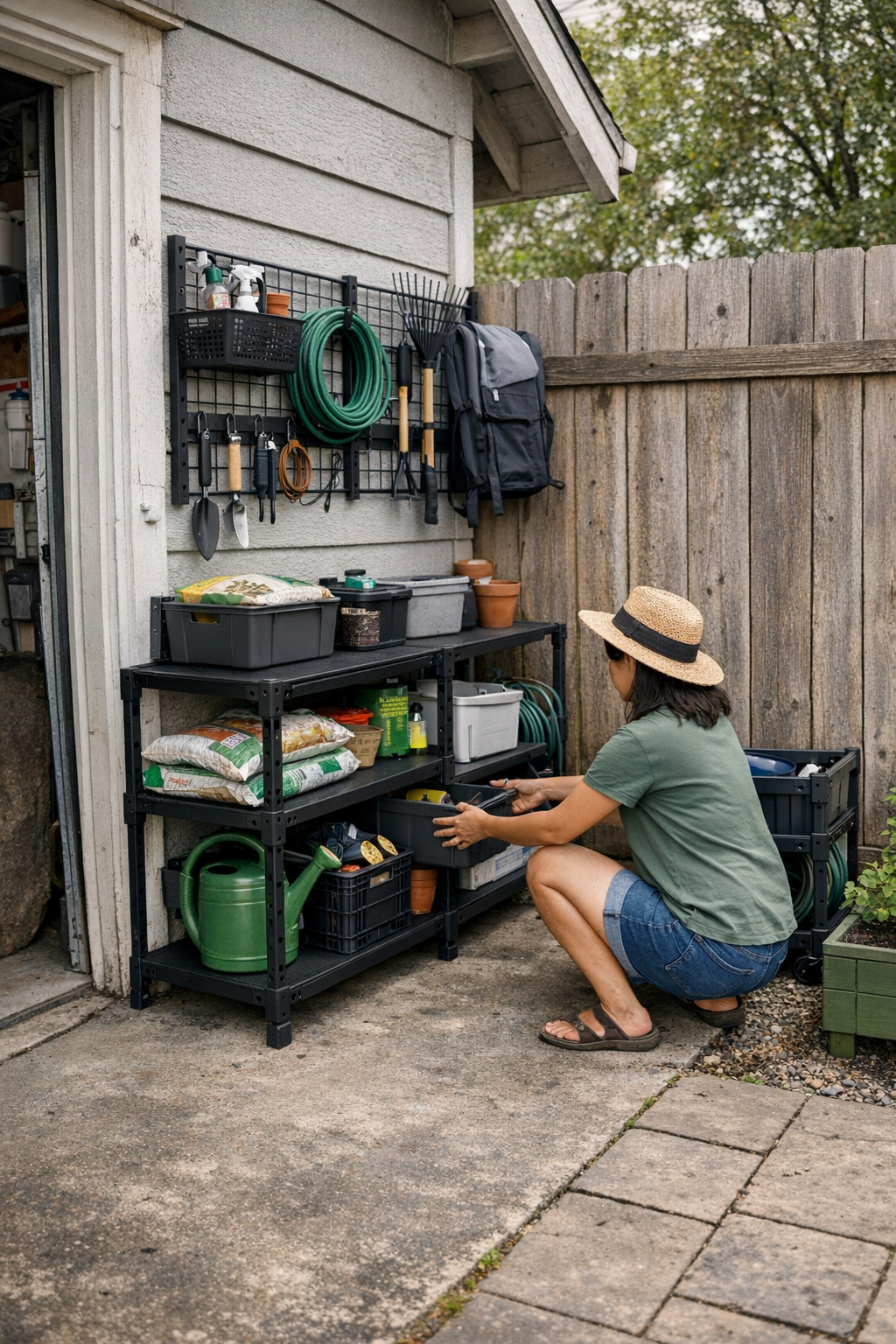
Most outdoor utility zones look organized—for about five days. By week two, patterns settle in: a rake left somewhere between garage and gate, soccer balls forming a minefield along the walkway, hoses and buckets choking the fence line. Each reset feels temporary because it usually is—the problem isn’t you, it’s how the area handles real, repeated use.
How Floor Storage Collapses Under Routine
Picture your side yard after a normal week. Tools start out lined up, bins tucked in the corner. But by Sunday, the ground tells another story: a shovel upends the path, a pile of shoes spreads near the door, and a bag of soil creeps from the wall almost to the patio table. Even spilling sweat on a Saturday reset doesn’t change the rhythm—overflow returns to the same dead spots within days.
This isn’t just an untidy look—it’s floor pressure that keeps stacking up. Every time you squeeze past a muddy boot or nudge a bag aside to open the gate, your setup is actively blocking you. The more the space is used—gardening days, ball games, kid traffic—the narrower the walkways, the heavier the friction. Resets turn into reruns: handling the same handful of stuff, over and over, each week.
The Hidden Stall in Standalone Boxes and Sheds
The appeal is obvious: stash all the loose gear in one big weatherproof lift-top or mini shed. And for the first week or two, it might feel like the problem’s solved. But next, reality creeps in—a buffer zone develops right in front of the chest. You find yourself stepping over a lean-to stack of chairs, dodging hoses, or moving a pile of “for now” shoes and gloves just to return a single shovel.
A heavy lid turns a 10-second tidy into a chore nobody wants. If the latch is sticky or the box is blocked by a wheelbarrow, items hang around the threshold. What looked like maximum capacity quietly loses ground to impromptu piles and awkward workarounds. The box itself becomes ringed by gear that never goes back in, simply because access doesn’t match your real routine.
Blocked Paths, Delayed Returns
If putting something away takes two hands, a heavy lid, or moving another object, it lingers outside. Lawn chairs begin roosting beside the shed. Toys drift down the walkway. In any squeezed zone—a patio edge, garage strip, or skinny fence line—friction multiplies fast. Suddenly, the main path becomes a slalom course, slowed by stalled returns and “just until tomorrow” piles.
What Actually Changes With Modular Wall Systems
Now, picture the same area after a swap: along the fence or garage wall, a few sturdy panels, some adjustable racks, well-placed hooks. Garden tools hang clean and visible. Balls and cones perch above the ground. Folding chairs hang high enough to clear the gate. Each pass-through, you see what belongs—and nothing begs to pile up.
The battle moves off the floor. Movement is clearer. The reset, lighter. Items don’t hide behind lids or get jammed behind bins. Drop-off points stay visible and easy to reach, even when routines shift from weekdays to weekends. The difference is obvious: a walkway that stays usable, even after a week of hard use, versus the quiet creep of clutter that closes the path within days.
The Trap of Wall Space Used Wrong
Not every wall fix works. Slap up too many hooks behind a bin, and you get a dead zone. Put shelves beyond normal reach, and tools start piling up below instead. The smart setups map to how hands actually move: hose reels at hip height, not above the mower; kids’ toy bins at the natural end of play, not at the farthest fence post; flower-pot shelves just inside the gate, visible every time you walk out.
- Hang that hose reel where it sees daily use, even if it breaks symmetry.
- Let kids’ bins meet them at the natural finish line, not tucked out of view.
- Keep active-use shelves within one step of the entry, not lost behind lesser-used items.
Modularity isn’t a buzzword—it’s what pulls the system back into sync as seasons shift and uses multiply. Swapping a hook or folding out a shelf means the system stays relevant, not another fixed annoyance.
Overflow Zones and ‘For Now’ Creep
Watch for the “just for now” pile: a drenched garden cushion on the box lid, folded chairs leaning “temporarily” by the threshold, a tangle of gloves sagging on the closest surface. These clusters aren’t laziness; they’re feedback. If stuff stays outside the unit for days, the flow of putting it back is broken. Each new drop-off makes the next reset slower and the next block larger.
Does one section always collect the backup gear before every party, yardwork day, or rainstorm? If so, your setup is losing the battle against live use. Maybe the gate needs to swing wider for spring planting or the basketball hoop gets moved for a summer dinner—modularity lets you reclaim or reroute those storage clusters fast, adapting to how your yard actually lives, not just to how it looked on move-in day.
Why Flexibility Stops the Reset Spiral
Outdoor spaces never freeze. Shade shifts hour by hour. Tables migrate for a barbecue. Suddenly a corner is needed for a wading pool or a load of firewood. The heavy, anchored box or rigid shed doesn’t move; soon it traps itself in awkwardness, becoming a new obstacle instead of a solution—especially where every foot of breathing room matters.
Wall-based panels and modular frames work because you can shift, trial, and re-stack layouts. Renters aren’t shackled by anchors in the siding, and homeowners aren’t stuck with yesterday’s guess. Utility zones remain flexible, the friction drops, and the setup keeps pace with the way you actually move through the space.
Is Your Setup Holding Back Your Routine?
You’ll see the signs long before the setup “fails”:
- Do you zigzag more than walk on your own path after a regular weekend?
- Do “for now” piles quietly take over the edge of the main storage unit?
- Are you shuffling something every single time you open the gate or reach for a tool?
- Does the memory of a sticky lid or blocked bin make you skip returning gear?
If any of these feel familiar, your friction isn’t about trying harder. It’s that your setup isn’t tuned to your real patterns. Moving to a visible wall system or modular setup isn’t about making the space pretty—it’s about clearing repeat bottlenecks, keeping resets quick, and giving every square foot back its actual use.
Outdoor Setup Practices That Actually Hold Up
Protect the ground. Movement is gold. Treat floor space as non-negotiable. Each tool, ball, or basket lifted onto the wall is one less thing tripped over. The less gear you shuffle just to reach the gate, the faster you reset—minutes, not hours.
Build for sight lines—skip the memory games. If it’s in plain sight and an easy stretch away, you’ll use the return spot. Hide it behind a lid or above your head, and the “for now” pile wins again. Let the structure do the reminding for you.
Stay ready to shift, not just once but every time the routine does. Modularity keeps your sanity. Whether it’s a moved potting bench in May or an extra rack for holiday decor, adapting the storage to match actual changes removes the creeping irritation of spaces “almost” working.
And when you need a shelter for muddy soccer cleats or rain-soaked gloves, a tough box still works—but keep the flow gear high and wide, and away from every natural choke point.
If your weekly resets feel like reruns, it might be time to see how real-world setups can make your routine lighter. See TidyYard’s current wall systems, modular structures, and storage units here.