
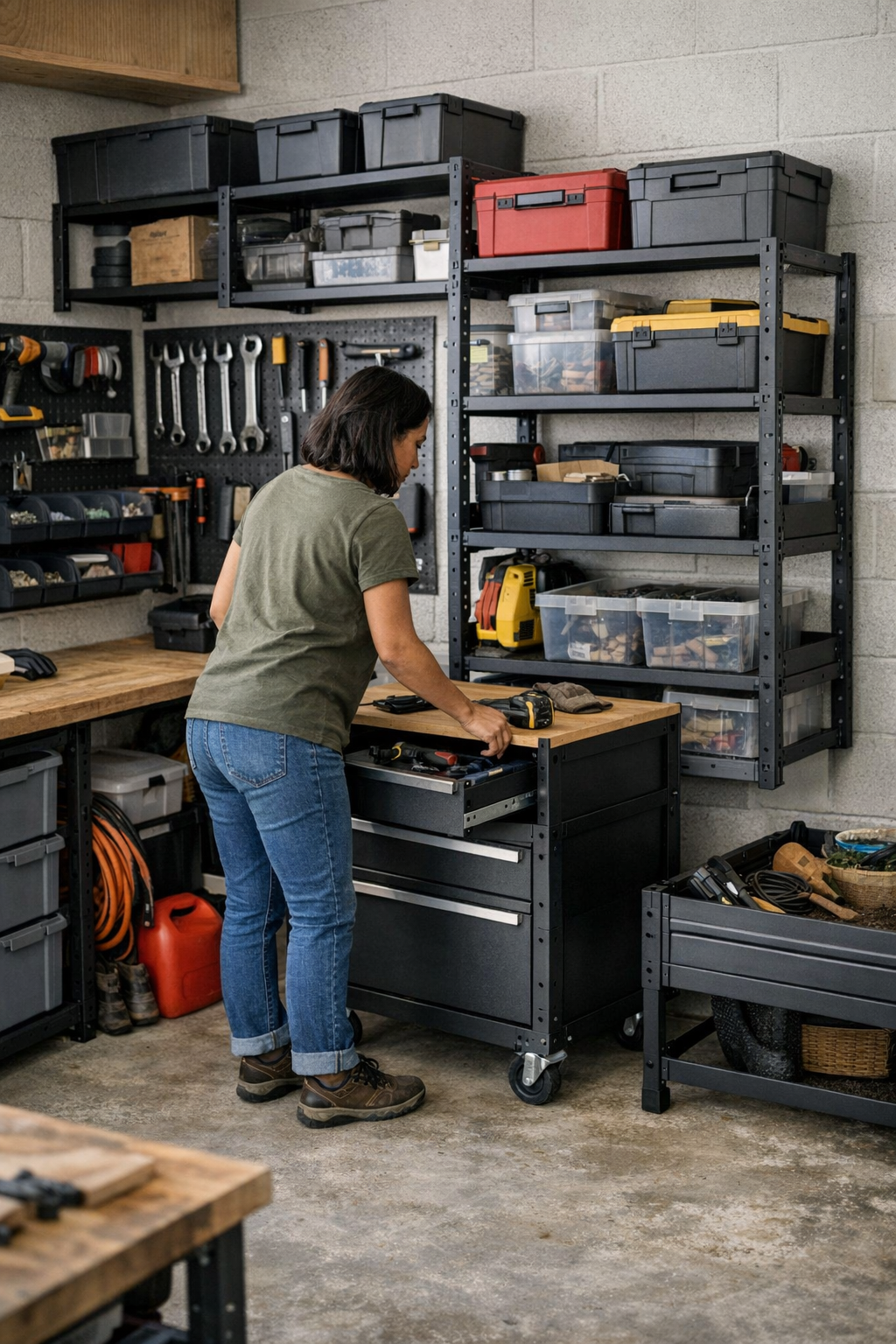
There’s a reason “organized” doesn’t always feel organized—especially after a week in the workshop or garage. The setup is crisp on day one: wall racks lined up, bins labeled, the new rolling cabinet snapped into the perfect showcase spot. It’s the moment everything looks under control. Fast forward a few days, and the illusion starts to crack. That cabinet’s now wedged in, narrowing your path every time you squeeze by. The rolling cart gets nudged around to clear space—then sits awkwardly, half in the walkway, until your next project. Bins fill unevenly: “Sockets” spills over, while Phillips screwdrivers end up loose somewhere closer, because you just need them more. The gap between “looks organized” and “actually works, every day” becomes impossible to ignore.
When Storage Structure Steals Your Flow
It’s easy to blame clutter on a lack of bins or fancy cabinets, but most of the real friction comes from the bones of your layout. Maybe your wall panel sits six inches too high—the top hooks go unused, or worse, demand a stepstool for anything you put there. A floor cabinet might keep gear hidden, but suddenly its open drawer blocks your route whenever you need the drill. The visible order fades as new habits take hold. Instead, what remains is a network of small, consistent annoyances: the aisle that could be clear if only that rolling cart had somewhere better to live; the back corner that gets used as a dumping ground for awkward-size clamps because nothing else fits; the regular trek back and forth after realizing your most-used tool never made it home last time.
The ‘Wall or Floor?’ Trap (and Why Both Can Fail)
Wall-mounted systems sell the dream: gear off the floor, everything one glance away. But three projects later, you’re reaching over a tangle of hooks for that hex key, sliding aside a ladder to grab the garden shears shoved behind. It’s “sorted,” but not seamless. Meanwhile, floor storage promises flexibility—until your rolling cabinet lands right in the lane where you actually walk, and starts catching overflow: half-used glue bottles, random hardware, the one tool you couldn’t quite find a spot for. What’s supposed to flex ends up blocking you in, movement-by-movement.
If your setup collects friction faster than it collects tools, it’s not working. Each awkward shuffle—dragging a mobile cart, digging through a low, shadowed shelf, stretching for a tool because the hooks are just out of reach—chips away at the promise of an effortlessly ordered space. The friction isn’t dramatic, but it builds up daily until your own routine is shaped around all these little workarounds.
Why ‘Everything in Its Place’ Isn’t Enough
The surface-level fix is tempting: bins labeled, shelving dialed in, pegboard hooks filled to capacity. For a moment, it really does look sharp. But then, a rolling cart meant for one task slips into dead space and becomes a catch-all. Wall storage jams up when retrieving a tape measure means shifting two drill bits and a flashlight first. Soon, one shelf or bench attracts everything that doesn’t really “belong.” Corners don’t become open—they become permanent limbo for bulky saws or that garden rake with nowhere else to go.
Visual tidiness collapses under routine use if the system ignores real movement. If returning a tool means awkwardly working around a bottleneck—or if project overflow piles up on whatever’s closest—system breakdown is only a matter of time. As routines settle in, resets get slower, and the neat look you started with becomes harder and harder to reclaim.
Micro-Frustrations Signal Larger Problems
- Shuffling a rolling cart out of the way—every time you need to move long lumber or an armful of supplies.
- Edging around a cabinet corner, because it’s always half-blocking your path to the power tools.
- Wall space technically used, but the top hooks stretch the limits of what’s practical—so they stay empty, or gather only items you rarely need.
- The same shelf perpetually collects overflow: half the gear lands there, the rest scattered wherever there’s open surface.
- Dead zones where odd-shaped gear gathers dust, undisturbed, because reaching there means moving three other things first.
Fixing Flow: Why Smarter Beats Bigger
Real organization isn’t about adding more places to stash tools—it’s about fitting storage to your movement, not the other way around. Swapping a chunky deep cabinet for a narrow wall-mounted rail (even if it “stores less”) can turn a cramped shuffle into an open stroll. Rethinking by task—putting your go-to tools at natural standing height, storing heavy or seasonal stuff just below—means you don’t end up with piles on the floor. The entire reset routine shrinks: less zig-zag, more straight-line return. Suddenly, cleaning up feels almost automatic.
The real test? How simple is it to put things back, every single day.
If it takes even a couple of extra steps, or a detour around an ill-placed cabinet, you’re likely to skip it—resulting in mess that accumulates faster than you realize. Aligning storage with the way you work, not just what you have, shifts the entire feel of the space. Strong systems separate high-frequency from occasional use—not just by type, but by how and where you move. Sometimes, the biggest win is as small as moving a single shelf or cart to free up a pathway that always gets clogged.
Quick Fix: When Overflow Doesn’t Stop
If one zone keeps spilling over, it’s not for lack of containers—it’s a sign your workspace is fighting your routine. Before buying another organizer, ask yourself: is your gardening gear stranded across the garage from the back door? Is that cordless drill forever on the bench because it’s annoying to put away? Relocating storage even just a bit—closer to the real action—can reduce reset friction, more than any new bin or flashy label ever could.
How Real Improvement Shows Itself
An effective setup doesn’t just look tidy—it lets you clear and reset the area with hardly a second thought. The true difference comes after several rounds of heavy use: floors are open, tools find their way back home, and you’re not trapped in a loop of shifting carts or making “temporary” piles. Zones hold firm because they match how you move, not just how you imagined they might be used.
If, after a full week, you’re still reshuffling, detouring around awkward corners, or babysitting tools back to their “homes,” the setup is still fighting you. The right storage makes the entire routine feel lighter, not heavier. Pay attention to how your space holds up after daily use—not just how it shines for a photo.
For storage that makes your workshop or garage actually work—through weeks, not just moments—check out StackNest.