
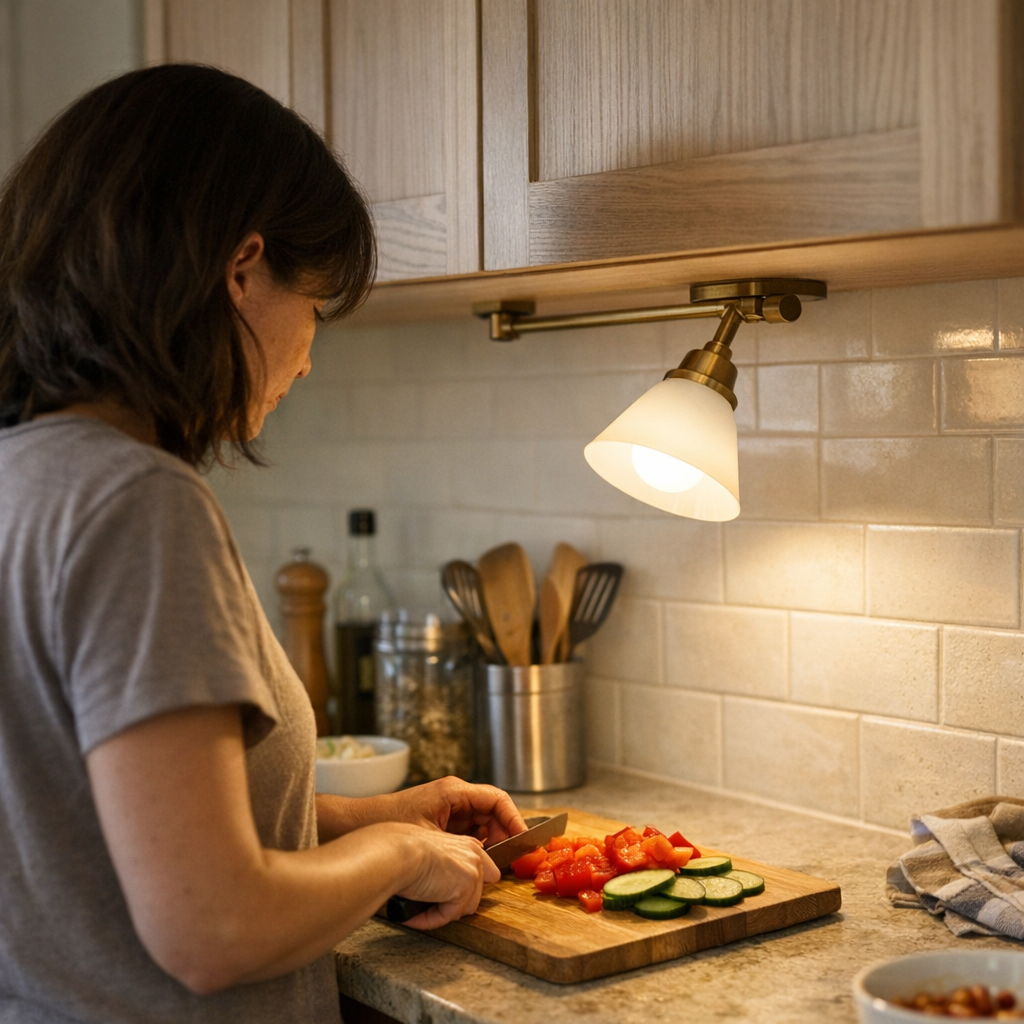
The difference between a kitchen that looks bright and one that actually works becomes obvious as soon as you reach for a knife at the counter. Overhead fixtures might flood the room with light, but the first time you try to slice vegetables after sunset, it’s clear: the countertop itself is still riddled with glare, uneven shadows, and dark corners where you actually need to see. Every meal prep becomes a pattern of leaning closer, shuffling cutting boards into the “least bad” patch of light, second-guessing ingredient colors, and wiping the same area twice because debris hides just out of view. For anyone relying on ceiling lights alone, this isn’t a rare annoyance. It’s a daily design problem that wastes time, strains your eyes, and makes ordinary tasks more awkward than they need to be. The right lighting setup isn’t a style choice—it’s a silent determiner of how smooth, safe, and stress-free your kitchen routine actually feels.
When “Bright Enough” Isn’t: Shadow Problems in Everyday Kitchen Use
A room can seem brightly lit until you actually put it to use at the counter. As soon as you step up to chop, measure, or scrub, overhead-only lighting exposes its weakest point: you’re always working in your own shadow. Cabinets overhang the workspace, your body interrupts the main beam, and even the most powerful flush-mount fixture leaves part of the counter dim. Before you notice it, you’re squinting at labels, dragging utensils to the front edge, or nudging a coffee maker toward any available light spill. This low-key struggle becomes routine, even if you’ve gotten used to the workarounds.
The consequences add up: missed crumbs, knife slips, tomato seeds sticking to unseen patches, or a backsplash that’s never really clean because you just can’t see that last streak. Every subtle frustration stems from the same flaw—surface lighting that only looks good from a distance, but fails right where you need clarity most. The urge to “just get through” the task grows stronger with every evening meal, every hurried morning, every repeated workaround that interrupts real flow in the heart of the house.
Why Shadows Keep Returning: The Limits of Overhead Fixtures
Traditional ceiling fixtures are designed for general brightness—but they almost never solve counter-level visibility. Task surfaces are exactly where ceiling lights perform most poorly. Cabinets and arms cut off the beam, creating uneven patches. You turn on the switch, step forward, and instantly see the lit backsplash fade to gray under the wall cabinets. The edge of the counter vanishes. You find yourself creeping forward, stacking bowls in the only visible zone, or trying to twist a stronger bulb into the socket, only to have glare replace darkness and hotspots pop up beside new shadows.
The scenario repeats every time: you prep dinner with the main light on, but ingredient details are still dull or hidden. Upgrade to a modern ceiling fixture, and the old imbalances still win. No matter how bright the room feels overall, the counter keeps you trapped in a loop of adapting or accepting half-seen tasks—always pushing for a spot where you can “just see enough.”
Under-Cabinet Lighting: The Everyday Improvement That Sticks
Lighting the work surface directly—close to where you actually cut, wash, or organize—breaks the cycle of dimness at the core of your kitchen routine. Under-cabinet lighting isn’t decorative. It’s a physical solution to the specific defects of ceiling-only setups. A well-placed linear strip along the inside cabinet front throws even, focused light across the entire counter. No more shifting side to side to dodge your own shadow. No more missing a rogue peel or oversalting dinner because of muddled contrasts.
- Accurate ingredient colors, visible without adjustment—greens, meats, and spices all read true without guessing.
- Clear work zones—crumbs, smudges, and edge drips stand out instead of fading into murk.
- Consistent comfort—your arm, your knife, your mixing bowl all stay visible, all the way across, every evening.
This isn’t just about convenience; it’s relief from daily micro-frustrations. Every prep or cleanup goes smoother. You don’t need to rearrange your stance or squint. Most importantly, the clarity isn’t just brighter—it’s repeatable, night after night, without effort or correction.
Real Scene: The Shift from Shadow to Clarity
You’re home after work with dinner still to cook. The kitchen looks fully lit, but the instant you stand at the counter, a blunt shadow from your own head and the cabinet lip cuts right across your cutting board. You push vegetables into the open, sigh, and only realize you missed a bit of peel an hour later. With a sharp line of under-cabinet LED—placed close to the cabinet’s front edge—every inch of surface pops into even brightness. Now you slice, sort, and wipe down with everything in plain, shadowless view. The silent drain of arm strain, eye fatigue, and repeated movement simply fades, meal by meal, as the routine finally stops fighting the lighting mistake built into so many kitchens.
Common Missteps: Where Under-Cabinet Setups Go Wrong
Installing under-cabinet lights isn’t a guaranteed fix unless you get their placement right. The most common error is setting fixtures too far back, leaving half your usable space still in shade. Push the light too close to the wall tile and you end up squinting at bounce glare—not the intended result. True usability comes when lights hug the inner cabinet front, flooding the counter (and only secondarily the backsplash) with even, wide coverage. If a shadow lingers, sometimes all it takes is nudging the strip an inch forward.
Quick Tip: Look for Continuous, Even Output
Puck lights or spaced mini-fixtures often cause a polka-dot pattern—bright-hot, then gap, then bright-hot. Continuous LED bars or strips create an uninterrupted band of light: every inch of counter usable, every task zone equally clear, no matter what time you’re working. Small detail, huge difference.
Combining Overhead and Under-Cabinet Lighting: Practical Gains
Ceiling and under-cabinet fixtures aren’t rivals—they’re partners, each fixing what the other leaves out. Overhead ambient light keeps you moving safely through the space, but only real surface-level light kills the fatigue of repeated guessing at details. With both, you move confidently from fridge to sink, prep without interruption, and finish cleaning without chasing invisible streaks. Forgotten messes and slowdowns shrink. You stop treating illumination as something to manage and finally let it serve the routine you wanted in the first place.
Week after week, the small wins add up: less cleanup fatigue, more reliable prep, fewer “missed spots,” and kitchen work that stops feeling like a wrestling match with your own lighting.
Why This Detail Matters—Even in “Well-Lit” Homes
A room that seems bright at a glance can still trip you with surface-level struggle. Task lighting isn’t about visual style or a designer trend—it’s about bridging the gap between general glow and usable, actionable clarity. If you’re still sidestepping for a good view, missing wipedown streaks, or making do with whatever illumination happens to fall on your counter, you’re living with a built-in compromise. The principle is bigger than kitchens: laundry counters, workbenches, even a household command center all suffer from overhead-only washout. The right fixture, targeted to the actual work zone, fixes what vague “brightness” never will. It makes repeated use natural, without ongoing correction.
The question behind every good setup: can you step up and see what you need, every single time, without adjusting or guessing?
For more practical lighting options designed to solve real indoor visibility problems, visit LightHelper.