
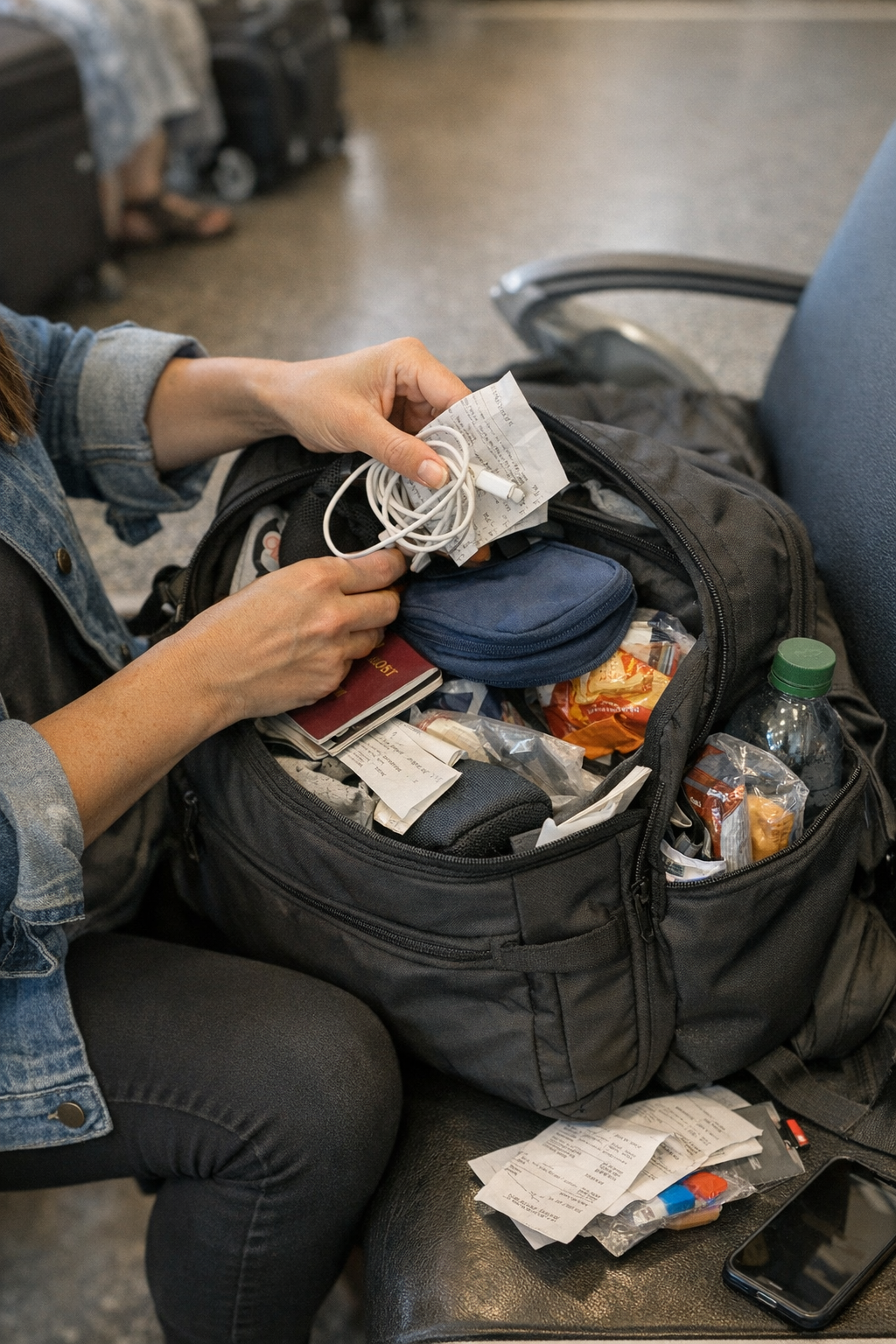
The gap between a tidy carry-on and a usable carry-on is easy to underestimate—right up until travel friction hits. That bag you pre-packed in precise order often collapses fast once you’re in motion: an extra cable here, a last-minute airport purchase there, and suddenly, your boarding pass is buried behind a charger and snack bar you didn’t plan for. Each new addition, however small, breaks the system you trusted to keep you quick through security, smooth in boarding lines, and frictionless at crowded gate zones. It’s not about running out of space—it’s about how easily the logic of your setup starts to block its own promise, turning every everyday retrieval (passport at the counter, phone for a boarding scan, headphones in a seat row) into a small but compounding delay. CarryOnSupply’s world is built around these friction signals: systems that look neat aren’t enough if fast, in-motion access keeps failing you where it matters.
Where Packing Plans Fall Apart in the Real World
The lineup looks flawless at home. Tech cords coiled, documents stacked, toiletries zipped in their cubby—every item has a place. But airport movement isn’t friendly to your plan. The first “just bought” charger or that airport water bottle has nowhere to go except the nearest open slot, shoving your essentials deeper and causing categories to overlap. Main organizers fill, but the real breakdown appears where you touch most: the slim outer pocket meant for your passport, the pouch you thought would stay clear for boarding passes, or the side slot for quick-reach items that’s now absorbing airport overflow.
Where the Friction First Appears
Friction starts where speed should be built in—outer pockets, document sleeves, quick-access pouches. That first purchase or loose snack pushes your ID behind a cable or receipt. Suddenly, retrieving something as basic as your passport feels like starting a scavenger hunt, especially when every line, every checkpoint, adds its own expectation of fast movement. It’s not usually a complete disaster; it’s the cumulative seconds lost with every tray transfer or seat shuffle that signal the system is unclenching. The sense that “everything’s where I need it” gets replaced by minor but repeated hesitation—which, in crowds, is all it takes to sour the sequence.
The Problem with Static Packing Logic
What looked optimal on your bedroom floor doesn’t hold up against mid-trip reality. Picture this: you open your beautifully prepped tech pouch for the third time in one trip. Now there’s a new cable from a duty-free stop, tangled awkwardly with the cords you laid out earlier. Your document sleeve, perfect for tickets and ID, now doubles as a wallet for random receipts. In a security line, one snug pocket is so cramped you hesitate to even try for your ID, elbowing the zipper instead and blocking movement behind you.
These aren’t isolated moments. They’re recurring pain points—frameworks that break whenever anything unscheduled joins the lineup. Each re-packing, whether after a tray at security or a quick dig during seat entry, finds you settling for “close enough.” The friction isn’t always visible (from the outside, everything still looks packed), but every delay compounds as you repeat the same sequence at every stop.
What It Feels Like in Routine Use
It’s only after multiple security passes or boarding changes that you really feel the cost. That dedicated slot for tickets? Cluttered now—paper bent, charger pressing into it, receipts stuck to the side. Want your headphones at row 22C? Now they’re woven between new electronics and a snack. You’re standing in the aisle, clutching a phone and magazine, but the thing you want is always at the bottom or mixed with extras. Meanwhile, other travelers are jostling you or waiting longer as you dig and repack. Every retrieval gets slower, less predictable, and your setup, while still looking orderly, actually makes these moments slower instead of smoother.
How Overlap Compounds Across a Trip
What ruins flow isn’t big new items—it’s the steady drip of little things into the wrong spaces. A bag meant for separation and order turns clumsy when it can’t absorb mid-trip surprises. You hesitate to open the slim pouch in front of TSA, knowing it’s stuffed, or fight a stuck zipper that used to move smoothly before the outer pocket bulged. Each time you reach for what should be at your fingertips, it’s buried under whatever landed there last. By the second or third airport, it’s not just inconvenience—it’s a quiet fight with your bag at every stop. The harder you force the original logic, the more the whole setup resists, making access points obstacles instead of solutions.
This is the moment most travelers recognize something’s off: You’re reopening the same pouch, circling through pockets that once felt intuitive, stepping aside at security to reshuffle. The system you built to help you move now needs constant management—its tidiness becomes the enemy of speed.
The Small Change That Makes Travel Smoother
What actually solves this? One change stands out in repeated use: isolate your overflow from your main zones. Instead of letting on-the-go extras fill every open pocket, designate one less-used compartment as your “change absorber.” Don’t try to permanently fit new finds into core organizers; defend your fastest-access areas (passport pocket, tech section, document holder) by banishing late additions to their own holding space. That way, your main system survives even as travel throws new things at you. The essentials—charging cables, tickets, passports—keep their frictionless lanes, while anything acquired mid-trip is prevented from polluting the logic you rely on for repeated movement.
What This Looks Like in Actual Use
Once you set aside an overflow pocket, there’s a shift. You pull your boarding pass without surprise extras tumbling out; document checks go back to quick flicks instead of frantic sifting; every security repack is familiar because your quickest zippers haven’t become catch-alls. Even as you duck into a tight seat row or reach up to the overhead, the muscle memory returns—what you need is still where you expect. You’re not faster only because the setup “looks” clean, but because every action in the travel chain is back to being predictable and low-interruption.
Why “Looks Organized” Isn’t Enough
A setup that looks ordered on the outside is a half-solution if it doesn’t survive actual travel routines. Travel order that doesn’t protect access under pressure is a false win. Function always outweighs photo-readiness: the key difference is how a bag behaves after its third, fourth, or fifth fast retrieval. By separating overflow, you give your best zones an actual defense against airport randomness, preserving their ritual speed even as surprises hit. In real-world travel, this detail turns a bag from something you fight back into a tool that moves with you—not just for the first checkpoint, but all the way through the last arrival hall.