
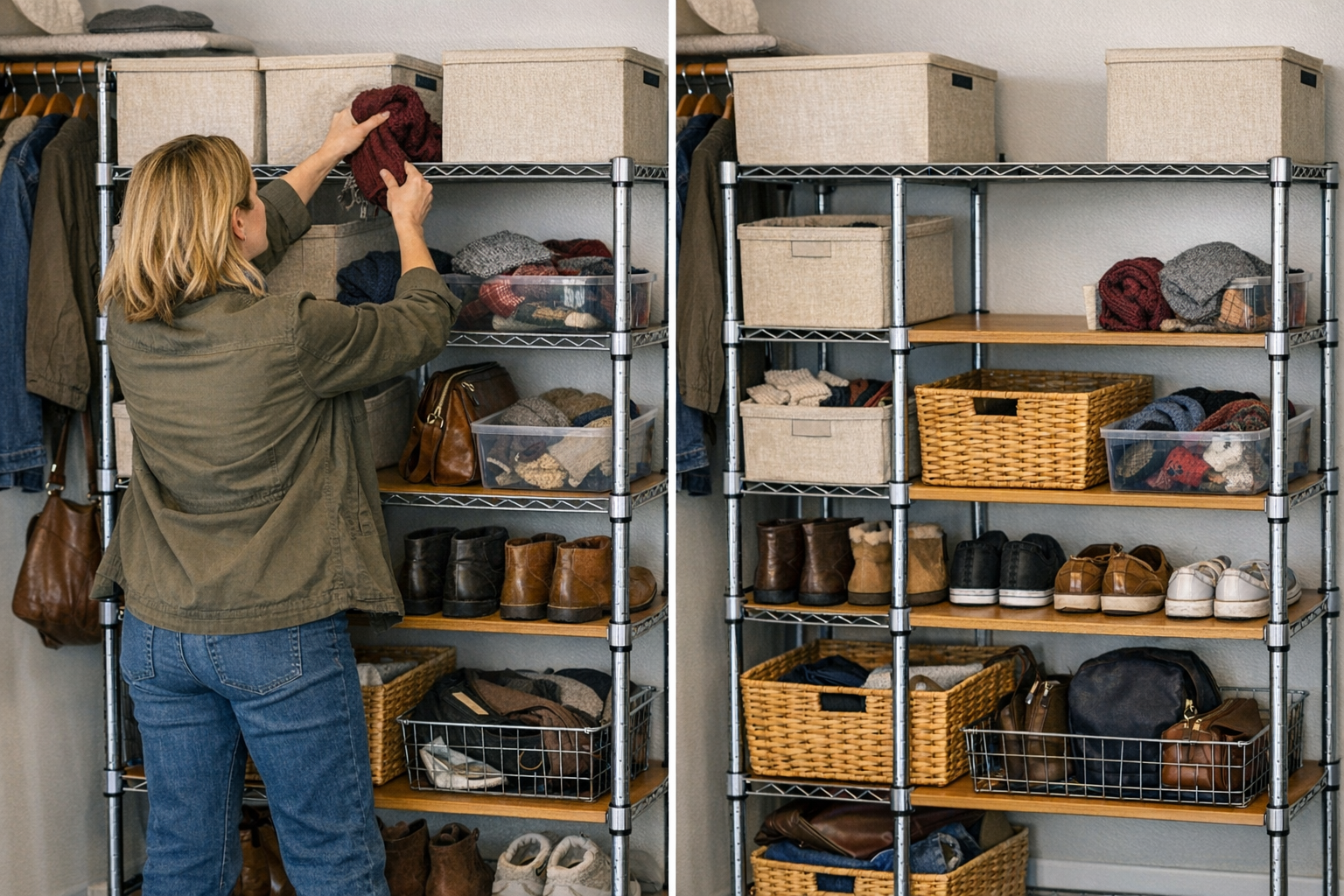
Most closets start out looking under control—and by the end of the week, they betray you. You start with a fresh floor, sorted bins, folded shirts in satisfying rows, and shoes lined up as if everything might finally stay in place. But two or three actual mornings later, boots have crept outside their zone, a hat is missing in action, scarves are tangled, and that crisp order has given way to new clusters of chaos. The truth isn’t that you failed to organize—it’s that your closet was built for how it looks at rest, not for the thousand small moments you actually use it.
The Real-World Storage Challenge
The usual fix? More bins, more dividers, more labels. These work on day one: you pull out a sweater, find your gloves, and everything snaps back into place. But the first day isn’t real life. As soon as you’re running late and need your favorite pair of shoes—now buried behind three others—the cracks in the system show. You stack sweaters but, after a couple grabs, the pile starts to lean. That tight row of baskets? Every time you need the back one, you’re shuffling the whole shelf. Soon, “tidy” turns into a juggling act, and the effort required to keep it up grows with every use.
The main storage struggle isn’t just visibility—it’s friction and access. If putting a pair of boots away means moving three bins or reaching deep into a dark shelf, you start negotiating with yourself: “I’ll put this away later.” That “later” piles up—literally—until the system itself becomes the problem you wanted to solve.
Daily Use Quickly Breaks Good Intentions
Imagine your entry closet at 8:15 AM. The bus is coming, someone’s digging for their backpack (shoved awkwardly on top of a basket), shoes have multiplied by the door, a coat sleeve blocks access to gloves, and you grab whatever you can before heading out. Even if you set up clear categories—hats in one bin, extra shoes in another, scarves neatly rolled—by Tuesday, those boundaries have blurred. A rogue pair of sneakers is blocking the boots, a baseball cap has migrated, and bags now lean against everything.
This isn’t laziness. It’s inevitable when a system only looks organized standing still. The storage that “fits” the most often requires the most reshuffling—and after just a few normal days, categories dissolve and resets get slower. That row of identical baskets? Practical in theory, but if you have to pull out the front two for every reach, the rest of the shelf becomes staging for stuff you don’t have time to sort.
Small Frictions Compound
You barely notice the extra steps at first—the quick bin move to get a hat, the nudge of a shirt stack so the right one slips free. But multiply those little annoyances all week long. Now, two bins are out of place and it’s easier to start a pile on the floor than restore the order. What started as good intentions quickly slides into a cycle of workaround and delay.
Does Your System Survive a Normal Week?
The best way to stress-test your shelves: ignore resets for three days and see what happens. Open the closet, grab what you need, put things back as you’re able—but don’t stop to re-stack, re-fold, or re-categorize every time. Where does the order break down?
- Do you need to remove two bins just to get to socks at the back?
- Are folded shirts losing their shape by midweek?
- Are shoes and boots spreading sideways or blocking the way?
- Do bins end up mixed within a few normal uses?
When those patterns show up, your system’s friction is too high. The neat surface fails the daily test: quick access, clear categories, and a reset that actually feels doable in real time.
Why Adding More Storage Makes Clutter Worse
It’s tempting to solve overflow by stacking in one more bin or squeezing in another shelf divider. But jamming in more storage often increases friction: blocked access, tighter shelves, and nowhere to stage items in transition. When every inch is filled, you lose the flexibility to simply set something down in its right place. Instead, gloves get tossed in the nearest gap, shoes are wedged between bins, and loose items stack up within days.
The real improvement isn’t about hitting “maximum capacity.” It’s about keeping the system functional in the middle of a busy week—doors flung open, hands full, and zero desire to reshuffle three rows just to put away a scarf.
A Daily-Life Fix: Make Room for Movement
Consider the hallway closet that used to implode by Wednesday. Every item had a labeled bin—yet order still collapsed by the end of the week. The actual solution was to remove a single, barely-used bin. That freed up just enough open space—a slim gap, a landing spot—to act as a buffer for influx and quick returns. Suddenly, items stopped piling on the floor. Bins stayed sorted. Gloves were easily tossed back into place without knocking down another category. Everything flowed, not because there were more tools, but because there was finally margin to move.
Let Shelves “Breathe”: The Pressure Valve Principle
A purposeful gap—five inches, one missing basket, a clear end of shelf—serves as your closet’s relief valve. It breaks up crowding and gives you a spot to park in-transit items. That shelf may look a little less packed in the Sunday “after” photo, but by Friday, it’s the difference between a quick toss-back and a total reorganization.
Apply this logic anywhere: bedroom closets where t-shirts tumble off the stack, entryways where shoes overload the mat, laundry areas where the overflow never quite fits. The best indicator you need space isn’t what you see at rest—it’s how fast you can restore order on a Wednesday night, and how distinct your categories remain after just a few family uses.
Recognize Storage Bottlenecks Before They Cause Trouble
Watch for these recurring pain points:
- You avoid putting away shoes because you have to move three pairs first.
- You hesitate to reach for a shirt at the bottom of a stack, so clothes pile on top instead.
- Baskets that started sorted end up mixed or overflowing before the weekend hits.
- Vertical space goes unused because everything’s jammed at shelf-level.
If you repeatedly work around your systems—hesitating, stacking “for now,” avoiding certain shelves—it’s a sign your storage needs breathing room, not another organizing bin.
Long-Term Function Beats Quick “Before and After”
An organized closet only succeeds if you can use it easily three days, three weeks, and three months after you set it up. When “put away” comes with too many steps, or categories are constantly overlapping, the storage becomes one more obstacle. Real function means margins. It means clear zones that survive daily life, and open space so resets don’t require a whole afternoon.
Try This: Build In an Open Section
Instead of crowding every inch, reset your closet by deliberately leaving one shelf or basket empty. Notice what happens by the end of the week. Does that gap keep clutter from spreading? Do items find their way back without a shuffling cascade? If the space fills instantly, treat it as a signal: what’s actually used, and what could be let go so the rest can finally function? The right margin makes every remaining section easier to reach, reset, and keep sorted—for real life, not just photos.
Storage That Moves With You
If your system needs constant workarounds, the answer probably isn’t another product—it’s recognizing where daily use breaks the “just organized” surface. Look for storage solutions that stand up to repeated grabs and quick returns, not just a neat snapshot. Whether you’re overhauling a closet, taming an entryway, or rescuing a laundry shelf, check how much reshuffling you’re doing, how categories hold up by midweek, and how fast you can restore order without starting from scratch. Something as simple as removing a bin or reserving open shelf space can turn a closet from a frustration zone into a functional tool.
If you want more ways to design spaces that actually work—day after day, through real family use—explore shelving, bins, and storage systems built for living at ClosetWorks.