
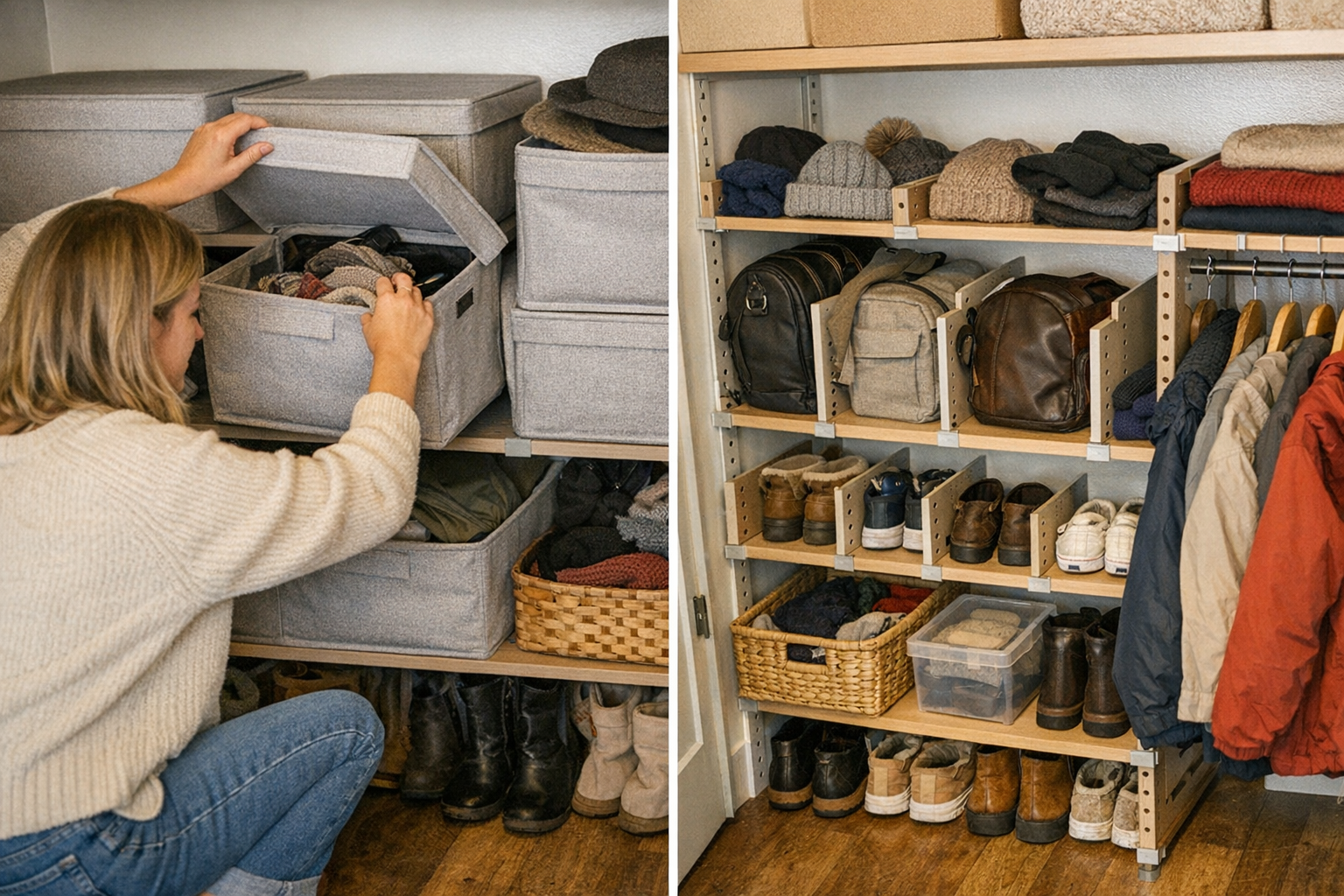
The real test of any closet or shelf isn’t how good it looks after you’ve cleaned it—it’s how it holds up the next time your morning is running late and you need to grab the right pair of shoes in the dark. That’s where most storage “solutions” get exposed. What starts as a picture-perfect setup quickly runs into the mess of daily life: clothes tumbling from stacks, baskets collecting everything but what they’re supposed to, every search for a missing hat turning into a small avalanche.
If your storage only works when you have time and motivation, it’s not really working. The difference between a tidy shelf and a functional one becomes obvious in those repeat moments—when you’re moving piles just to get a shirt, or shoving shoes aside because the bin’s already full. Organization should survive real life, not just the Sunday evening reset.
When “Organized” Shelves Start Slowing You Down
The appeal of neat rows, matching bins, and folded piles is undeniable. At first, there’s a sense of calm—everything in its place, labels facing forward. But that order rarely survives the week. On a busy Thursday, you’re reaching over two storage boxes just to hunt down a kid’s soccer cleats, sending a pile of sweaters sliding in the process, or tossing shoes back in a rush and ruining the line.
“Project organizing” feels productive—stacking, sorting, labeling, and admiring the result. But what happens when you’re trying to put away groceries with one hand and keep a child from tripping over a pile of boots with the other? The system falls apart not all at once, but in small, daily breakdowns.
How Categories Disappear—One Reach at a Time
Uniform bins promise clarity but, by Friday, most become grab-bags. The container that started with just hats picks up loose gloves, stray receipts, and someone’s headphones. Each hurried morning or tired evening erodes the original order. That means more searching, more reshuffling, more time spent rooting through shelves just to find the right scarf—or the second glove buried at the bottom.
The problem isn’t laziness; it’s the friction in the setup. You shouldn’t have to take out an entire basket just to retrieve a pair of socks, or re-stack a pile of shirts so they don’t topple while you dig for one at the bottom. What you gain in visual neatness, you lose in speed and clarity.
The Everyday Clues Your Storage Isn’t Keeping Up
There are patterns you’ll start to notice—subtle ways your “organizing” system is resisting you instead of helping:
- Stacks of folded shirts collapsing halfway through the week, because real use is never top-down
- Shoes creeping out of bins and spreading across the floor as pairs get separated and space dwindles
- Baskets turning into dumping grounds for anything homeless—yesterday’s mail with backpacks and mittens
- Shelves loaded from front to back, so every retrieval means shifting the whole row forward
- The creeping realization that, even after a weekend of cleaning, you’re just days away from clutter taking over again
Entryways: Mess Finds You Fast
Shared spaces expose storage flaws quickest. If grabbing a school bag means moving three pairs of boots, or if hats, scarves, and water bottles merge into an indistinguishable pile by Wednesday, your system isn’t keeping up. Maybe everything looks calm after Sunday’s reset, but by midweek routines, order dissolves. Shelves become landing zones, bins overflow, and the “categories” you set slip away with every rushed exit or muddy shoe drop.
Why Motivation Can’t Beat Everyday Wear and Tear
The problem with project-style organizing is that it depends on big bursts of energy—and those never arrive when the house is chaotic. True storage solutions don’t count on your motivation; they make staying organized the path of least resistance. A system that works means you can put things away quickly and grab what you need without setting off a chain reaction of clutter.
Shelves with built-in dividers or tiered sections make every category obvious and accessible—a pair of shoes has a true “spot,” bags don’t pile up on boots, and gloves aren’t lost among scarves. Low-profile separators keep items from migrating; using sections prevents stacks from merging into one indistinct heap. You shouldn’t need a two-handed effort to extract a sweatshirt or dig for keys. Well-defined storage turns retrieval and resets into one-move actions, not clumsy reshuffles.
What does this feel like in practice? There’s no hunt, no restacking, no mini clean-out every time you need something. Everything returns to its space quickly, whether you’re resetting for the next day’s commute or just clearing the bench in five minutes before guests arrive.
Real Improvement: Stays Useful, Not Just Tidy
You’ll know your storage is working when you aren’t dreading the reset. Instead of stuffing baskets until they’re overflowing or stacking shoes wherever there’s space, you guide them back to a defined section—one that actually fits, holds shape, and keeps categories from blending. The shelf still looks organized—more importantly, it acts organized—after repeated use and three rounds of laundry.
As a quick, daily check: notice where you still find yourself shifting one group of items just to access another. That’s usually the spot that needs a divider, an extra tier, or a clearer boundary—not more effort from you, but smarter design for repeat situations.
“Stored” vs. “Usable”: The Real Difference
The long-term payoff isn’t in magazine-perfect photos. It’s in how often you find yourself not fighting with the setup. Spaces built for easy, repeatable grabs and easy returns stay sane, even when family routines are unpredictable and messy. Organizing projects run out of steam the moment daily life starts erasing their lines; system-based storage stays grounded because it’s made for how things are actually used.
If you’re constantly rearranging a shelf, or if grabbing one thing scatters three others, it’s time to switch focus from surface “order” to real, daily function. Your closet or shelf doesn’t have to be perfect—it just has to work, reliably, when routine life is at its most chaotic.
See smarter closet and shelving systems designed for life in motion at ClosetWorks.