
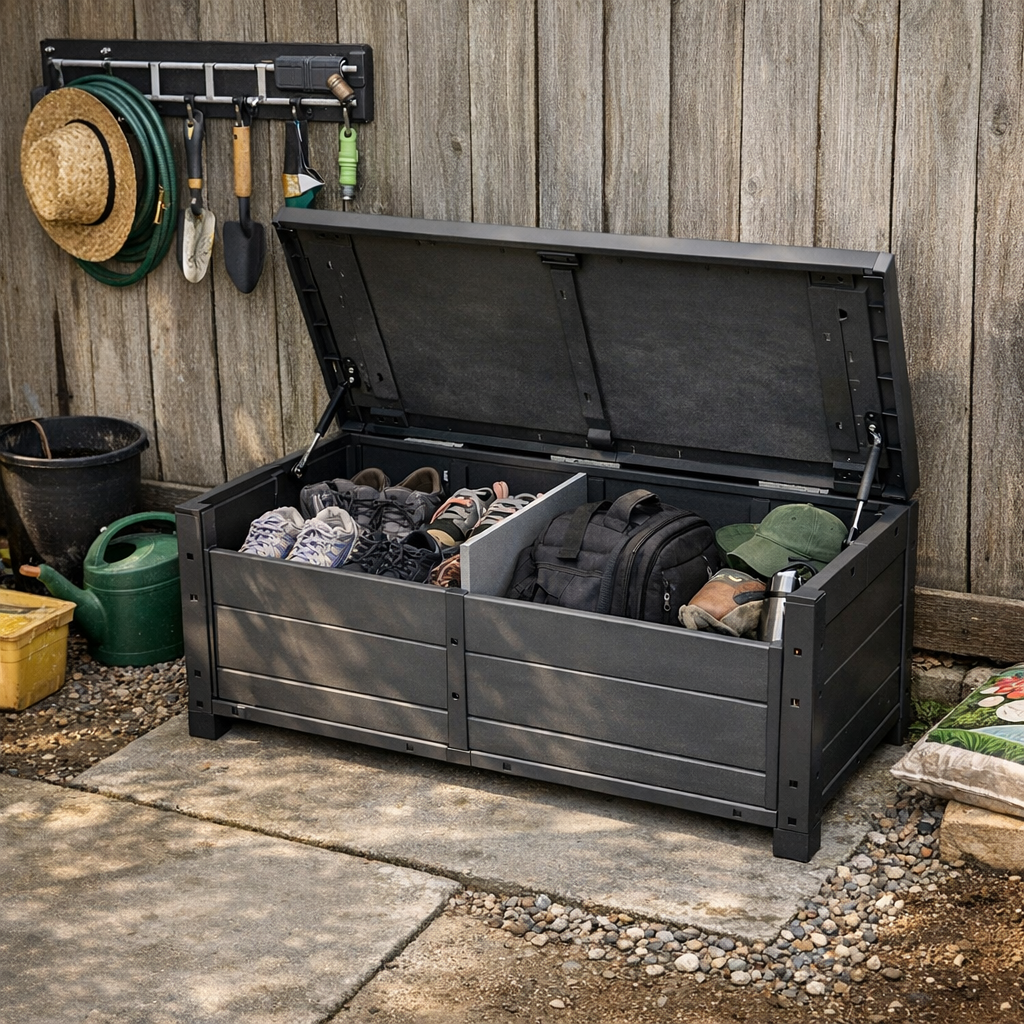
No one expects the storage bench by the door to become a source of delay—but within days, it often does. What began as a shortcut to a cleaner entryway becomes an obstacle: shoes jammed together, bags swallowed into the pile, and the lid hiding an ever-growing tangle. The promise of “grab and go” vanishes the first time you’re pawing through a box of everything, blocking the walkway you meant to clear in the first place. This is the shortfall of a storage bench: not in the basic idea, but in what fails once repeated routines, multiple users, and real-life limits hit at the same time.
When the Storage Bench Becomes a Stumbling Block
Most storage benches are designed to look like tidy solutions—a place to sit, a spot for bags, and a lid that hides scattered mess. But the truth is, a bench with a single open compartment becomes a friction point as soon as it absorbs more than one category of need. Without internal dividers or clear boundaries, shoes end up wedged under coats; stray headphones drift into the murk with yesterday’s beanie; school books and shopping totes press against each other until finding anything requires a rescue operation. Once the lid is down, everything drifts.
Try opening a crowded bench after two weeks of real use: instead of “grab-and-go,” it’s “dig and scatter.” You reach for a glove, end up sifting through sneakers, and finally give up with contents spread across the hallway. What was meant to streamline your exit now blocks your way, and the simplest retrieval winds up as a five-minute sidetrack that leaves the area messier than before. Resetting the bench—putting everything away again—feels like starting from scratch each time, which usually means it doesn’t happen at all. The bench keeps absorbing overflow until it quietly becomes the new clutter zone, hidden behind its own lid.
Shared Use Exposes Weaknesses Fast
Put a single bench in the path of everyone who lives with you—and any invisible flaw shows up fast. In shared apartments, family homes, or companion-heavy hallways, the bench becomes a battle zone. During the weekday rush, you watch as three pairs of shoes tumble on top of someone’s lunch sack, last night’s umbrella tangles with headphones and a missing set of keys, and the rebuilding starts before anyone even gets out the door. Access slows for everyone: one missing item triggers a mass excavation, and whatever doesn’t fit in the scramble just gets dropped by the entryway. The flow stalls, and mess leaks onto the floor around the bench, closing off the shortcut and making movement through the space a chore.
This isn’t just a matter of too little square footage—it’s a design disconnect. With every retrieval demanding a re-stack (or a full reset), forced workarounds like leaving shoes on the mat or bags along the wall become permanent. You start to notice: a storage zone only “works” if it moves at the speed of your actual routine, not just stays hidden for a photo. If it looks sorted but breaks down when touched, you’re just trading out one kind of clutter for another.
The Hidden Cost of Visual Calm
At first glance, closed benches give the illusion of calm—no loose bags, no shoes in sight. But underneath, chaos can churn unchecked. With no partitions or internal structure, the bench becomes a dumping ground where boundaries blur after one busy day. That flawless, closed-lid look is often a surface fix: what’s tidy for the eyes is a trap for your time. It isn’t until you need something in a hurry—a missing glove, gym shoes for pickup—that you realize the “organized” look has bought you extra minutes of digging instead of less stress.
If you’ve found yourself in this spot, you know how a neat entryway flips instantly to frustration the moment you start emptying the bench, hoping this time the item you need hasn’t dropped behind or under something heavier. The cost is hidden until your routine speeds up and the inside can’t keep up—forcing you to choose between a room that looks still and time lost every hectic morning.
Practical Scene: The Morning Rush Meets a Flimsy Setup
Rushed weekday: two people, both hitting the entry bench at once. Person one lifts the lid for gym shoes and gets a scatter-shot of outerwear and a stray lunch bag. Person two needs gloves; both start to unpack the cavity in parallel. Shoes spill out, hats roll underfoot, headphones slide toward the back. The floor clogs, movement halts, and the whole promise of quick storage vanishes. Even the intention of putting things away turns into delay—resetting the bench costs precious time neither person budgeted for, and by noon the entry zone has become just as unpredictable as an open pile on the floor.
Dividers: A Small Addition with a Big Impact
The real shift comes from inside, not outside. Adding even a simple divider—one board, a couple of bins, a snapped-in partition—changes everything. Shoes stay left, hats right, small grab-and-go bits in a narrow bin: suddenly, each item has an expected path. Instead of blending into a single, shifting pile, categories hold their ground. Grab a pair of shoes and your keys without collapsing a pile of scarves; return them later, and the zone stays sorted until the next use. You stop excavating, start repeating a simple pattern: open, spot, grab, return. Each person adapts faster, and resets edge toward zero effort.
This interior structure means the bench supports your routine, not just hides your stuff. Even one clear divider prevents category drift—and brings muscle memory into play. It’s not about chasing perfect neatness, but removing the everyday friction that leaves things dumped outside the bench after one too many failed retrievals.
Assigning Roles and Building Reset Habits
Once zones exist inside, it becomes natural to assign each its own job: one for shoes, one for bags, another for those elusive small items. With shared use, labeling or color-coding sections (or just using separate bins) gives each person a familiar territory to return to. Shoes don’t wander under coats, headphones don’t vanish under heels, and bags aren’t trapped by stray winter accessories. Resetting happens on the fly—often as a side effect of use—because the boundaries reinforce themselves.
For persistent small-item drift, a dedicated basket for keys, earbuds, or gloves inside the bench breaks the cycle. Instead of hunting for loose objects or watching them slip behind the main piles, you contain retrieval and return flow to a reachable spot each time. The result: a bench that doesn’t need major overhauls by Sunday—and a routine that doesn’t fold at the first sign of real use.
Open Versus Closed: What Suits Your Routine?
Open benches work for quick-drop, high-frequency items—athletic shoes, boots that need drying, items everyone needs to see. But that speed comes at a cost: without containment, every item adds to a visible sprawl, and neatness only lasts until the second user passes through. Closed benches cut down visual clutter—but this only holds if the internal setup tracks with your real pace. Shut lids over undefined piles deliver instant calm and instant chaos, depending on what you need and how fast you move. The difference is simple: structure inside, not just coverage outside.
If several people share your entry zone, or return flow is quick and repetitive, the need for separated interiors grows. For solo users or rare-access areas, uniform bins might be enough. But for the majority—families, roommates, shared mudrooms—a divided interior isn’t just a nice touch, it keeps the zone functional and the passage clear. If you skip this step, weeks of use slowly lock you into full resets and repeated workarounds, and movement through the space slows until the bench itself becomes just another hurdle.
Why Setup Details Matter After the First Week
The difference between a bench that only looks organized and one that stays easy to use turns up fast, but isn’t always obvious until routines settle in. Most breakdowns stem from small—often invisible—setup flaws: a missing divider, a skipped basket, a rushed initial setup that never matched real demand. Benches, bins, floor systems, or modular sections: the best-performing setups aren’t just “bigger” or “cleaner,” but better aligned to the repeated cycle of retrieve, return, re-use—regardless of how many hands reach in each morning. The right internal tweak keeps friction low and order visible long after the newness fades.
If you keep reaching for the same missing item at the door or notice new piles forming at the bench edge, the fix is rarely adding space, but sharpening structure. The setups that last are those that adjust for your routine instead of fighting it. A bench, a divider, even a zone-rethinking swap—sometimes a small inside change is all it takes to keep an entry moving, not blocking.
For practical storage systems, components, and benches designed to make real spaces work better—not just look better—visit Gridry.