
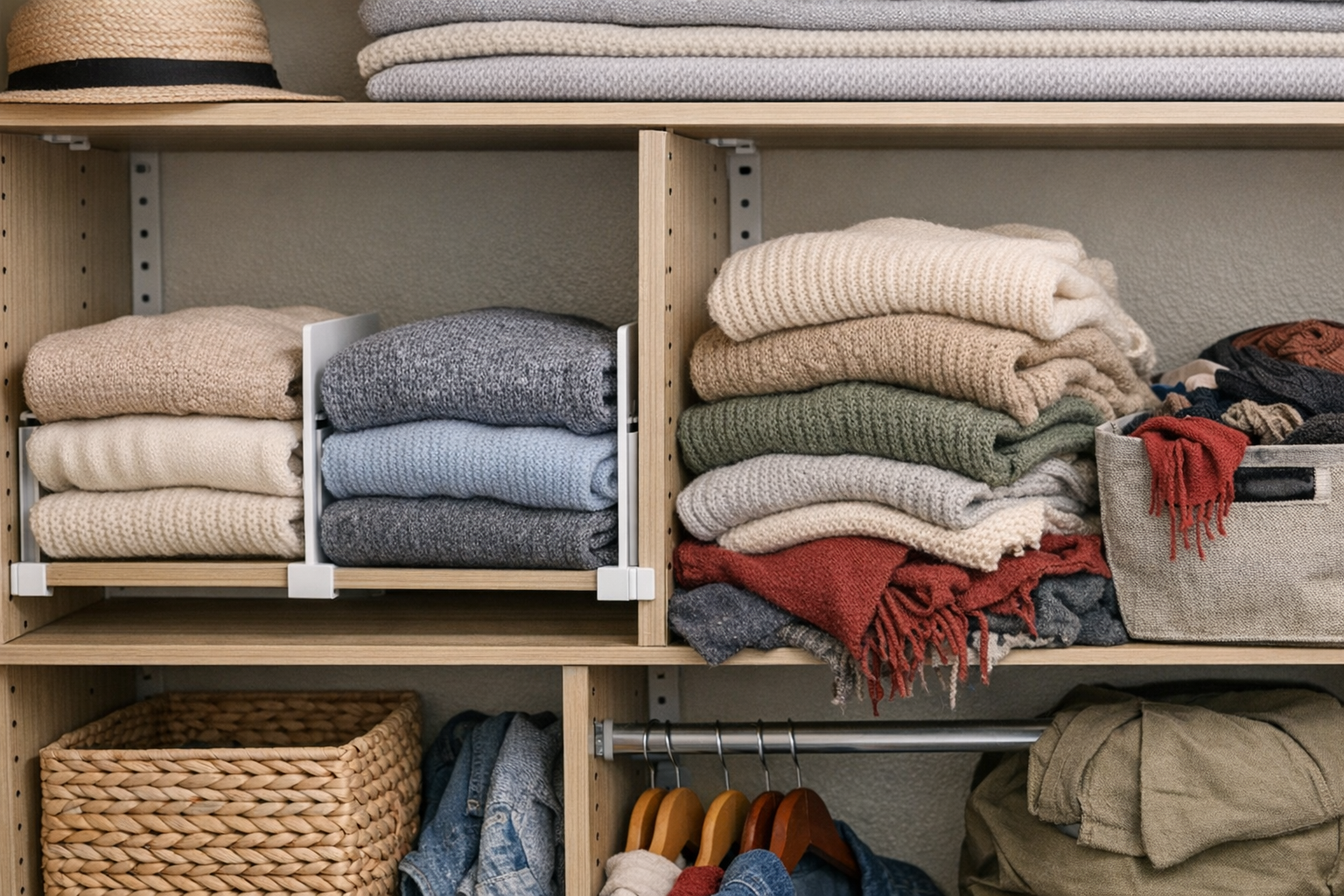
The illusion of a tamed closet shelf rarely survives the first few busy days. Stacks of folded shirts line up neatly and bins squeeze edge-to-edge, promising order. But fast-forward to Wednesday morning: you’re digging through piles, steadying a collapsing stack with your elbow, bracing a bin that’s wandered halfway across the shelf. The surface still looks “organized,” but the friction is building—and not just because you have too many clothes.
Why “Stacked and Sorted” Fails by Midweek
The first setup always feels promising: folded items arranged like a display, containers right to the border, everything giving off that ‘after’ photo energy. Reality arrives the moment you need your favorite sweater from three layers down—or when you try to return a t-shirt to a category that’s already started to blur. Each attempt to grab, return, or reshuffle sends corners drooping and stacks slumping. What started as order quickly dissolves into a juggling act: pull one thing, hold up another, watch the overflow spill into whatever space is open. Categories you swore you’d keep separate slide together, and a shelf intended for “sweaters” becomes part accessory graveyard.
How Boundaries Break Down (and Clutter Creeps In)
Deep shelves almost invite trouble. The more surface area you have, the more likely stacks and bins are to lose form after a few real-life uses. By day three, those once-crisp edges get fuzzy. A hurried morning leaves shirts nudged into the scarf zone. By the second laundry cycle, you’re barely able to tell where one type of clothing ends and the next begins. Maybe you wedge a basket between half-crushed piles just to keep things from sliding completely out of place.
None of it feels catastrophic in the moment. Instead, it drags at you—a slow, steady loss of clarity, until grabbing a single item means rearranging everything around it. The problem isn’t just “stuff overflow.” It’s the absence of a real stopping point—something that holds the line when you’re not looking.
Boundaries: The Real Secret to Closet Calm
What keeps a closet feeling orderly isn’t perfection—it’s the presence of a real, unmoving limit. Shelf dividers, solid-sided bins, or even strict rules about stack size act as brakes against the natural spread of clutter. Their effect is easiest to see after you’ve gone without them. With a clear boundary, your “shirts” section stops at the divider—every time. Reach, retrieve, replace: the rest of the closet holds its form.
In contrast, a bare shelf without boundaries mutates over days. The first shift is barely noticeable, but soon you’re double-handedly controlling piles, or re-folding shirts just to make space for one more. The shelf’s edge ceases to mean anything—the drift wins, and every section bleeds into the next until only the top layer looks intentional.
One Closet, Two Outcomes
Picture this: a closet with two shelves. Both start organized, but only one has fixed dividers every foot. By the end of a week, the divided shelf still lets you grab a hoodie or return a scarf without pushing two stacks together or holding up a toppling pile. The undivided shelf? Categories blur, and you catch yourself propping up one side just to slide something back—from visible order to visible frustration, in less than a workweek.
Boundaries That Actually Hold Up
So what works? Rigid boundaries—physical ones you can’t ignore or accidentally shift. Install vertical shelf dividers every 10–12 inches, or use bins with upright, sturdy sides. Even a tough shoebox can stand in as a makeshift border until a better solution comes along.
The reliability comes down to this: when a stack has a set limit, every grab, return, or hurried reach is absorbed by the boundary, not by your hand or hope. You get one-handed access without needing to restack leftovers or worry about the pile slowly slithering sideways. After laundry day, items return right where they belong, instead of starting the next slow slide toward chaos. Resets are short; lines hold.
Self-Check: Signs You’ve Outgrown Open Stacks
If these feel familiar, your closet needs real boundaries:
- You support one pile just to access another
- You spend more time restacking than actually using the items
- Sections that used to make sense (“shirts here, scarves there”) are now hopelessly blended
Smarter Stacking for Everyday Closets
Keep go-to items in a single-height stack wherever possible. Doubling up works for out-of-season or less-used things, but daily essentials topple plenty fast. Jeans and chunky sweaters can withstand taller piles; t-shirts and delicate linens cannot.
Choose dividers that are firm but flexible. Clip-in shelf dividers or slotted organizers stay put through daily use, so your closet doesn’t drift out of order at the first grab. Temporary solutions are better than none—shoeboxes, shallow totes, even repurposed bookends—all create edges that buy you time and clarity.
The True Difference: One Clear Edge
A closet isn’t “good” because the shelves are deep or the containers pretty. The turning point is always a real physical edge— one that absorbs daily motion so you don’t. That edge means every shirt returns to its spot, resets don’t drag out, and you know at a glance what category belongs where, even at the end of a hectic week. Without boundaries, even the most beautiful setup backslides into hassle. With the right edge, the chaos is contained—and your morning routine (and mood) improves by more than a little.
If your closet feels crowded, slow, or in need of constant policing, stop stacking for height and start creating boundaries that last. Order isn’t about how much you can fit—it’s about how easily everything finds (and keeps) its place.