
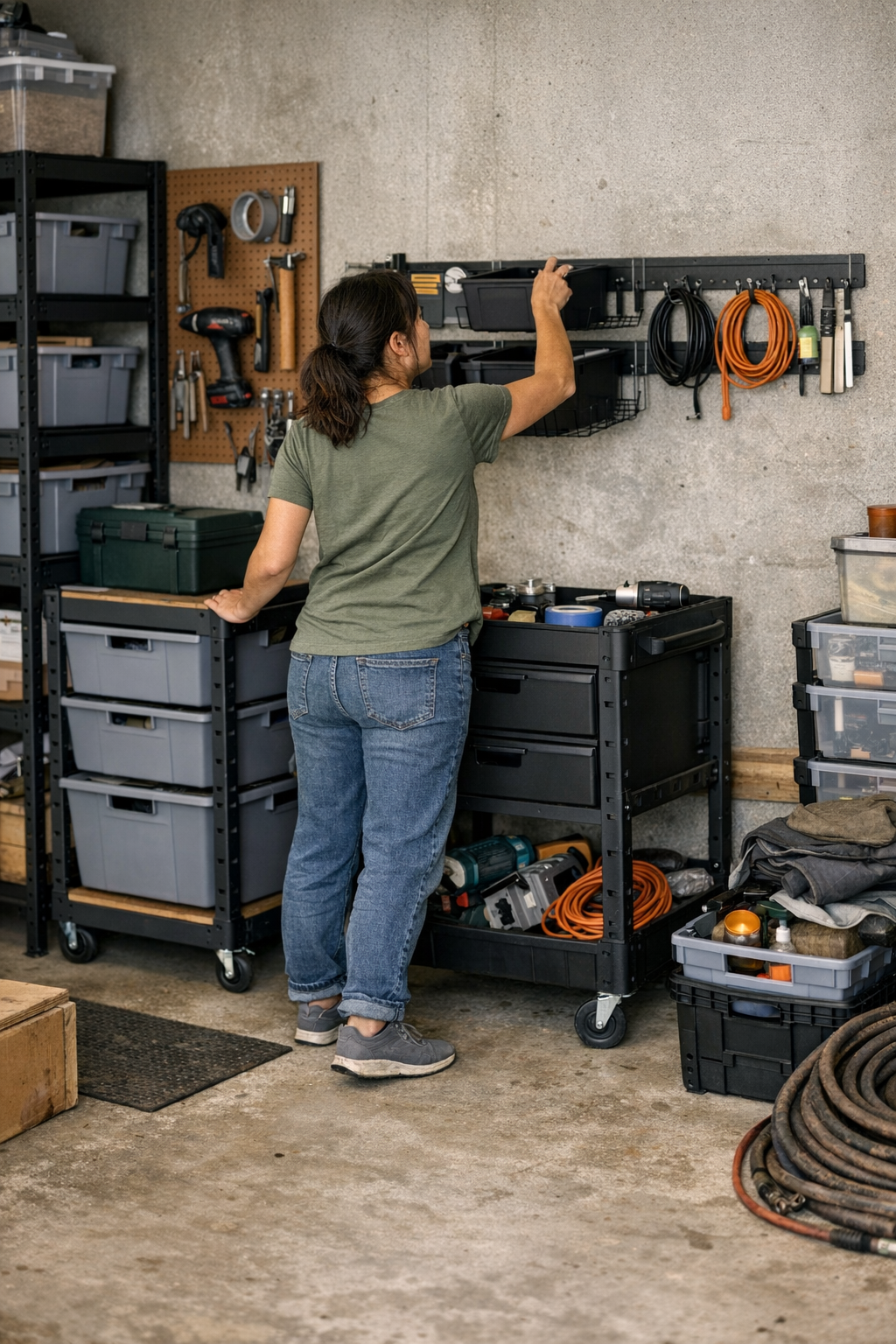
Every reset looks perfect for a day. Bins labeled, carts lined up, floor swept, shelves squared—your garage or workbench corner finally feels under control. But a true setup isn’t proven by the calm after cleaning. It’s tested by real weeks: constant fetch-and-return, a crowded path, corners you sidestep, and old habits sneaking back in.
Surface Order vs. Underlying Friction
That initial sense of victory—everything in its place—fades fast once routine hits. You grab a tool and clip the edge of a cart. Bins begin clustering in the only open spot, which quickly becomes crowded. A cart, flawless in photos, now blocks just enough space that you find yourself shuffling it left, right, back, over and over as projects come and go. Resets, meant to be quick, turn into long sessions of putting away “what doesn’t fit” again.
The illusion of neatness is easy; actual usability is harder. Fresh labels and crisp stacks might impress your camera, but they rarely hold up under the pressure of daily motion. The layouts that last are not the ones that look tightest—they’re the ones that stop fighting your routine and start flowing with it, even when the space looks half-empty.
The Real Test: Day-After-Day Use
Every time you work in the space, the system reveals its blind spots. Maybe you have to swerve around a cart—one hand balancing a bin, the other opening a drawer that barely clears the shelf behind it. Suddenly, “flexibility” means zigzagging to get a screwdriver. The return path for tools gets clogged because one area always absorbs overflow. You’re not reorganizing; you’re repeatedly compensating for small mistakes in the layout.
Adding another rolling chest or sticking up extra hooks feels like progress, but it often multiplies these micro-frictions unless they genuinely fit the way you move. Suddenly, you’re dodging blocked walkways and team-lift zones that never see use—or reshuffling items that should have a simple route back after every project.
Scene: The Perpetually Misplaced Cart
Visualize the wall: storage bins stacked, two carts tucked underneath. That’s the ideal. By midweek, though, one cart has crept forward, then sideways—now it blocks the cabinet door you reach for three times a day. Any quick reset means nudging the cart out, sneaking around one corner, then struggling with the odd gap behind where lost bits and random tools collect out of sight. The fix isn’t another round of tidying; it’s noticing that the “perfect” lineup breaks down when actually used.
Scene: A Wall Rail That Sucks in the Extras
Wall rails promise easy grab-and-go, but routine exposes the truth. What started as your solution for daily tools quietly turns one stretch into a magnet for overflow: shears, odd pliers, a pack of zip ties you grabbed once and never moved. You plan to clear it later, but each week, it grows—blocking straightforward access right when you’re mid-project. The surface stays “organized” yet resists clean workflow when you most need it.
How to Spot a Broken Routine, Not Just a Mess
If putting things away gets slower and sloppier, the setup is telling you something. Concrete warning signs include:
- The same corner or shelf collects random gear, turning into a reset job each time
- Returning tools or bins means moving something else first—never a direct return
- Main walkways get squeezed by carts or racks, breaking up your movement
- One storage zone gets overloaded, while an entire wall sits mostly unused
The “organized” look does not mean the system works; the real test is how little reshuffling or retidying your routine requires to bring things back to order.
What Actually Fixes the Flow
The classic trap is maximizing every inch: carts side by side, shelves butting up, rails loaded ceiling-high. But in use, that wall-to-wall arrangement means jammed walk paths and awkward returns. The fastest fix is often the hardest to accept: leave more gap than you think you need.
Small Gaps, Big Difference
Try parking your rolling cart six inches off from the rack instead of flush. Suddenly, you can return a bin or reach behind without a three-step shuffle. The extra stretch of open floor feels “wasted” until it earns you fifteen faster returns that week—and those missing scuffs on the paint where carts used to bump and drag. Practical breathing room beats a flawless grid every time, especially along main reset routes and wall edges.
Trust real ease, not flawless looks. Strategic emptiness—open zones at corners, between carts, or in front of cabinets—shrinks reset time and makes the space less overwhelming to use, even after months of clutter creep.
Solving Overflow and Breaking Up Dead Space
Overflow is more than clutter. It marks the spot where your setup fails to match your real path. Maybe your “overflow” bin is too far from where you always drop tools. Maybe a blocked shelf collects castoffs behind a stuck cart. Every unsorted pile signals a place where your system put appearances over convenience—and each pile always seems to return unless you rethink the zone.
A Simple Test: Rotate the Trouble Spots
Pick a trouble spot—a cart, an overloaded wall section, an awkward corner. Switch its location or empty it for a week. Watch what happens. Do dropped tools naturally find a new home, or does the gap fill right back up? Is access easier, or are you just shifting the friction? This small experiment exposes whether the friction is built into the layout, not just the stuff. Real fixes come from seeing where the system blocks you again and again, then opening that space up for what you actually do—not what you wish the setup would achieve.
Lasting Setups Make Life Easier, Not Just Neater
Setups that feel “done” usually aren’t. The real winners never draw attention: resets are quick, movement is automatic, and things land in place without you squeezing past, backtracking, or moving a cart for the third time in an hour. It’s not about perfection; it’s about a space that finally stops fighting your routine.
You can browse practical modular storage, rolling carts, and real-use workshop systems at StackNest.