
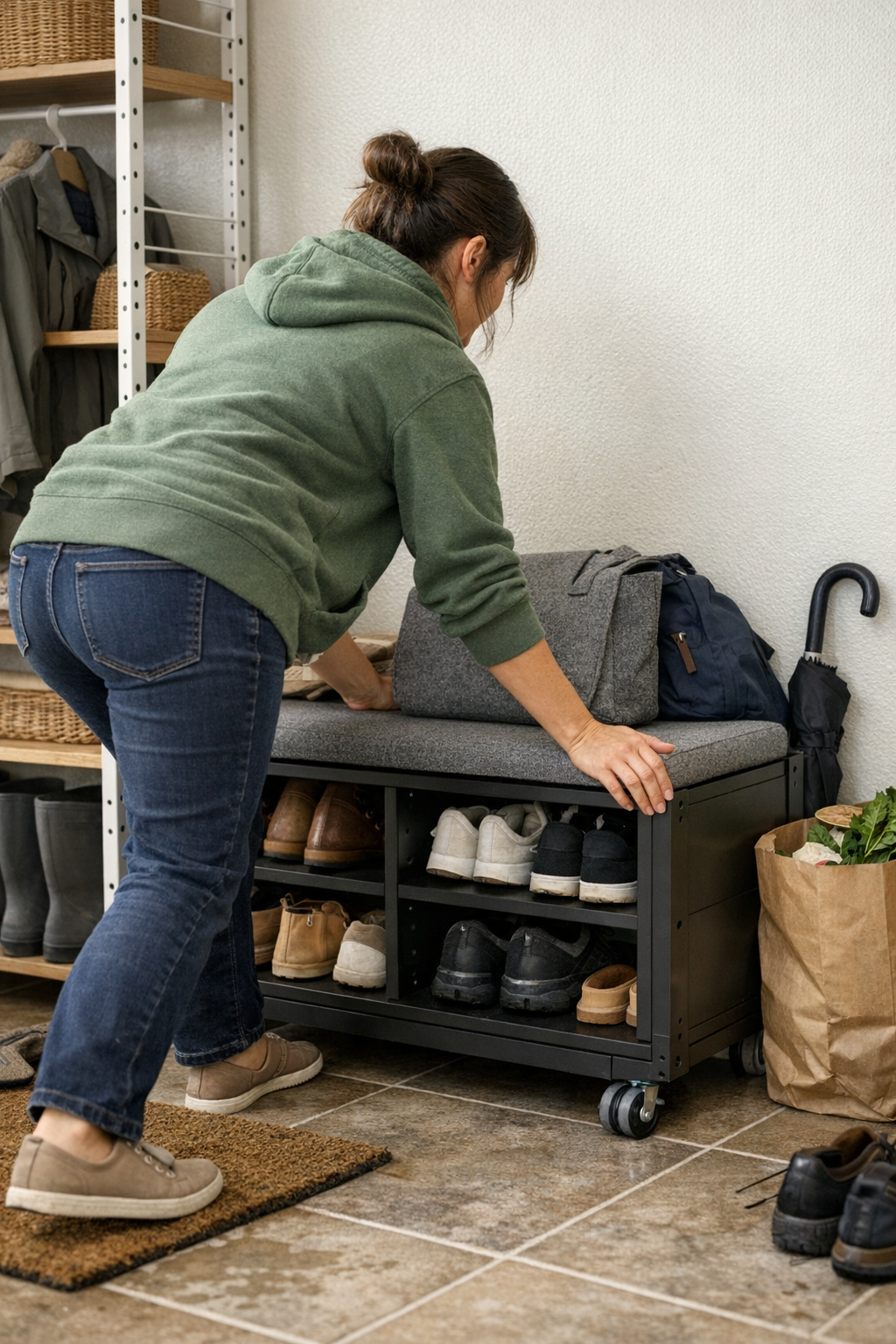
An entryway that looks organized rarely stays that way once real use begins. All it takes is a week of daily rush—bags dropped just inside the door, shoes swapped out mid-step, groceries set down fast—for the weakness in a mobile storage setup to show through. The first signal? Wheels that stall, rattle, or twist out of line, turning what should be smooth resets into noisy, awkward routines, and leaving carts or benches angled out into your path or drifting toward permanent clutter.
Where Looks and Use Start to Diverge
Mobile storage in the entry sounds flexible: benches and rolling carts can shift for cleaning, move aside for deliveries, or come forward for a quick grab. That flexibility only lasts as long as the hardware holds up. Basic wheels might be quiet on day one—but after a few real cycles, the difference starts appearing in your daily walk. A once-straight bench slides off its anchor and blocks the path. Carts develop a clatter or stiff resistance, nudging sideways with each nudge or shove. Suddenly, what was an open zone for movement becomes a series of minor dodges, step-arounds, or corner squeezes just to get through the door with your things.
The telltale rattle of cheap rollers becomes background noise, but the real trouble is how every move throws storage off-line. Each time the unit is adjusted—usually on autopilot or in a hurry—it no longer returns flush to the wall. Bags begin landing on any nearby surface. Shoes don’t stay queued at the bench but spread along the edge where there’s room. Overflow edges appear, and your drop zone is no longer contained—it stretches, blocks, and shrinks the available path with each hurried exit or entry.
The Small Misalignments Add Up Fast
Imperfect mobility feels minor at first: a crooked cart, a bench set at an angle, an extra shuffle required mid-step. But as usage repeats, the reset burden builds. Moving the storage makes noise or drags grit; resetting means wrestling something back to place instead of nudging it automatically. What started as organized quickly morphs into an area crowded by semi-permanent drop piles, bins nudged further out, and inconvenient piles that spread as soon as someone takes a shortcut instead of putting things away.
Day-to-day, the difference is visible: passing through means shifting sideways or stepping over shoe lines that no longer fit. A quick stash of groceries means leaving one bag outside the intended bin to avoid the hassle of moving a cart. The reset that should take seconds now becomes a minor lift or push, always with the question: will this get back into place, or just add to the drift? Over time, the “flexible” setup becomes rigid in all the wrong ways—anchored by friction, not by design.
Real Use: When Entry Routines Collide
Hardware failures don’t announce themselves; they reveal themselves at the worst times. When the weather turns and wet shoes multiply, or when every member of the household comes in at once, the difference between reliable and stubborn storage is immediate. One person pushes the bench to make space, only to have it catch on a door mat or balk at an uneven seam—freezing in place, half-blocking the threshold. Now, bags are left beside instead of inside. Shoes scatter further, blocking the main path, not brushing up neatly against the storage as planned.
Even solo routines break down. If rolling a small cart always involves a thud or scrape, it becomes easier to skip it—dropping gym gear next to the cart, letting items sprawl along the entry. Bulk accumulates at the fringe. The re-entry routine becomes just that—a struggle between the system and lived use, with friction replacing any sense of order or restoration.
When Setup Details Outweigh Decorative Choices
It’s rarely about appearances. From across the room, two rolling benches or carts might seem equally practical. But up close, after a dozen uses, the gap opens: well-built, sealed wheels glide quietly and let you reset instantly. When the hardware supports quick, aligned movement, “putting things back” happens naturally, whether you’re returning boots or clearing a pile after a rushed morning. The piece returns flush and stays out of the way, no extra energy needed.
Cut corners on hardware, though, and your organization scheme turns passive-aggressive. Castors grind or stall. The storage piece drifts out of square with each move and starts acting like an obstacle. Resetting feels like a chore. Overflows and visual clutter grow—not because items lack a spot, but because moving the container takes just enough effort, noise, and real resistance that people avoid it. Day by day, the entry looks less ordered—even if every bin is, technically, still there.
Tackling the Hidden Friction
The simplest fix—often overlooked—is to upgrade the wheels, not just the look. Swapping stiff, noisy rollers for sealed, soft wheels (or adding felts under corners when appropriate for flooring) changes the feel immediately. Now, storage moves cleanly, resets are one-handed and unobtrusive, and even during rush hour, people can use the zone as intended. The drop zone becomes a true flow point instead of a bottleneck.
That “something will be in my way” expectation disappears. Instead, the area holds its form, and the pressure at the threshold doesn’t break the system. Resetting after a storm or a chaotic day no longer feels like rearranging heavy obstacles; it feels like returning the space to working order in a few steps, not a whole reorganization session. Organization stops being a look and starts being an everyday, durable habit, holding up under household traffic, wet weather, and hurried routines alike.
Small Details, Lasting Difference
The real divide between “looks controlled” and “actually works” runs through movement, not just capacity. Cheap wheels, sticky rolls, or misaligned hardware all foster the same result: friction that invites the drift of clutter, the spread of shoe lines, and delay that encourages every shortcut. In a setup that gets hit by daily routines—families coming and going, guests dropping by, bags cycling in and out—the point of failure is rarely storage space itself. It’s how frustrating, noisy, or resistant a reset becomes in real time.
Judgment check: If you’re evaluating mobile storage for any entry or transition zone, ignore appearances for a moment and watch how the piece returns to its place after ten resets, not just one. If it clangs, skids, or hesitates—and you catch yourself leaving items outside the intended space just to avoid moving it—the design already makes daily clutter more likely. The right wheel, in practice, will keep your setup fluid, not fighting against your routine.
See more transition-space storage that behaves as well as it looks at Betweenry.